| ICHIKAWA DANZÔ III |
|
Stage names:
Other name: Matsutarô Guild: Mikawaya Line number: SANDAIME (III) Poetry name: Shikô Existence: 1719 ~ 24th day of the 6th lunar month of 1772 [1] Connection: Master: Ichikawa Danzô I Adopted sons: Ichikawa Danzô IV, Ichikawa Marukame Disciples: Ichikawa Saizô, Ichikawa Ryûzô, Ichikawa Onoe, Ichikawa Jinnosuke, Ichikawa Shôzô, Ichikawa Shunzô, Ichikawa Otokichi, Ichikawa Monzô Career: 1719: born in Edo. His father, Bandô Matabê, was an employee of the Moritaza. 1730~1739: he became disciple of the playwright Bandô Tasuke, who gave him the name of Bandô Jirosaburô. Later on, he joined Bandô Matakurô II and left the Bandô clan afterwhile to become a disciple of the actor Ichikawa Danzô I, who gave him the name of Ichikawa Jirôza. 11th lunar month of 1739: Ichikawa Jirôza was adopted by Ichikawa Danzô I and took the name of Ichikawa Danzaburô II. 5th day of the 4th lunar month of 1740 [2]: his adoptive father Ichikawa Danzô I died. 20th of the 10th lunar month of 1740 [3]: his adoptive father's son Ichikawa Danzô II died. 11th lunar month of 1740: Ichikawa Danzaburô II took the name of Ichikawa Danzô III at the Nakamuraza, playing the role of Murayama Hikoshirô in the drama "Miya Bashira Taiheiki". 11th lunar month of 1741: Danzô played at the Nakamuraza the role of Nabari no Hachirô in the kaomise program "En'ya Hangan Kokyô no Nishiki", which welcomed in Edo the actors Sanogawa Mangiku, Nakamura Shingorô I, Nakayama Shinkurô I and Nakamura Tomijûrô I. 1st lunar month of 1742: Danzô played in the same theater the role of Oniô Shinzaemon in the new year drama "Musume Soga Gaijin Yashima". 11th lunar month of 1742: Danzô moved to the Kawarasakiza and performed in the kaomise drama "Gaijin Taiheiki", which celebrated the return and the arrival in Edo of the actors Ichikawa Ebizô II and Onoe Kikugorô I. 11th lunar month of 1743: Danzô moved with Ichikawa Ebizô II to the Nakamuraza and played the role of Murakami Hikoshirô in the kaomise drama "Funayosooi Mitsugi Taiheiki". Fall 1744: Danzô and Tatsuoka Hisagiku went together to Ôsaka. 11th lunar month of 1744: Danzô played the role of Danzaburô in the kaomise drama "Azuma Soga Fujimi no Sato", which was produced by Nakamura Jûzô I at the Ônishi no Shibai. 1st lunar month of 1745: Danzô's rank in the Ôsaka hyôbanki, tachiyaku section, was jô-jô (superior - superior) [visual]. 9th lunar month of 1745: Danzô played the role of Sakon Tarô in the drama "Ashiya Dôman Ôuchi Kagami", which was produced by Nakamura Jûzô I at the Ônishi no Shibai; his stage partners were Bandô Toyosaburô I (Abe no Yasuna), Nakamura Jûzô I (Dôman), Nakayama Shinkurô I (Yokanpei), Arashi Shichigorô I (Yakanpei, Shôgen) and Yoshizawa Ayame II (Kuzu-no-Ha). 11th lunar month of 1745: Danzô played at the Ônishi no Shibai the roles of the yakko Kunisuke and Yojûrô in the kaomise drama "Tônai Tarô Danjiri Roppô", which was produced by Arashi San'emon IV. 11th lunar month of 1746: Danzô moved to the Naka no Shibai and played the role of Musashibô Benkei in the kaomise drama "Genji Musha Hinode Ôgi", which was produced by Danzô's disciple Ichikawa Ryûzô. 11th lunar month of 1747: Danzô played at the Naka no Shibai the role of Nejigane Kinbê in the kaomise drama "Kogane-bana Michinoku Jikki", which was produced by Ichikawa Ryûzô and celebrated the shûmei of Yamatoya Jinbê IV and Shibazaki Tamijûrô. 8th lunar month of 1748: the drama "Yoshitsune Senbon Zakura" was performed for the first time in Ôsaka, at the Naka no Shibai; Danzô played the roles of Tokaiya Ginpei, Taira no Tomomori and Kawatsura Hôgen [casting]. 11th lunar month of 1748: Danzô moved to Kyôto and played the roles of Kuramigawa Mansaku and Murakami Hikoshirô in the kaomise drama "Mitsu Uroko Asahi no Ume", which was produced at the nadai Miyako Handayû's theater by the zamoto Somematsu Shichisaburô I; his stage partners were Fujioka Daikichi, Iwata Somematsu I, Yamanaka Heijûrô I, Mihogi Shichitarô and Ôtani Hirohachi I. 1st lunar month of 1749: Danzô's rank in the Kyôto hyôbanki, tachiyaku section, was jô-jô-(shiro)kichi (superior - superior - (white) excellent) [visual]. 11th lunar month of 1749: Danzô played in the same theater the role of Nanbu Tatewaki in the kaomise drama "Imosegura Kogane no Ishizue". 11th lunar month of 1750: Danzô went back to Ôsaka and plays 3 roles in the kaomise drama "Tachibana Gojûyongun", which was produced at the Kado no Shibai by Iwata Somematsu I; his stage partners were Arashi Shichigorô I, Bandô Toyosaburô I, Yoshizawa Sakinosuke II and Kirishima Gizaemon I. 2nd lunar month of 1751: Danzô played in the same theater the roles of the wicked priest Narukami and Kumedera Danjô in the drama "Narukami Fudô Kitayama Zakura"; the role of Princess Taema was played by Iwata Somematsu I. 11th lunar month of 1751: Danzô moved to Kyôto and played the roles of Hashidate Ikkaku and the kannushi Ukyô in the kaomise drama "Kyôganoko Asahi no Nishiki", which was produced at the Minamigawa no Shibai by the zamoto Sakakiyama Shirotarô II; his stage partners were Sawamura Kunitarô I, Sakakiyama Koshirô II, Sakakiyama Danshirô I, Anegawa Daikichi I, Sasao Otojûrô II, Someyama Sôjûrô, Takenaka Hyôkichi, Yamamoto Koheiji, Hanakawa Ichinojô and Arashi Ugenta. 9th lunar month of 1752: Danzô played in the same theater the role of Issun Tokubê in the drama "Natsu Matsuri Naniwa Kagami"; his stage partners were Yamamoto Koheiji (Danshichi Kurobê), Sakakiyama Koshirô II (Tsuribune Sabu), Sakakiyama Danshirô I I (Mikawaya Giheiji, Sagaemon), Sakakiyama Shirotarô II (Otatsu) and Arashi Ugenta (Okaji). 11th lunar month of 1752: the play "Ichi-no-Tani Futaba Gunki" was staged for the first time in Ôsaka, as a kaomise drama, at the Naka no Shibai; Danzô played the role of Kumagai Jirô Naozane [casting]. 11th lunar month of 1753: Danzô moved to the Kado no Shibai and played the role of Ogata Umanojô in Fujikawa Sakoku's kaomise drama "Kashû Narihira Ishi". 1st lunar month of 1754: Danzô's rank in the Ôsaka hyôbanki, tachiyaku section, was jô-jô-kichi (superior - superior - excellent) [visual]. 11th lunar month of 1754: Danzô moved to the Ônishi no Shibai and played the role of Odagiri Jûnai in the kaomise drama "Uda Genji Asahi no Menbako", which was produced by Wakayama Bunshichi. 12th lunar month of 1754: Danzô played in the same theater the role of Kikuchi Higonosuke in the ni-no-kawari drama "Keisei Imagawajô". 11th lunar month of 1755: Danzô played at the Ônishi no Shibai the role of Kamata Hyôe in the kaomise drama "Genpei Ôgi Awase", which was produced by Anegawa Shinshirô II. 12th lunar month of 1755: Danzô played in the same theater the role of Kusunoki Masatsura in the drama "Kayou Kami Kuruwa Nikki". 8th lunar month of 1756: Danzô played in the same theater the role of the wicked priest Narukami in the drama "Narukami Fudô Kitayama Zakura"; the role of Princess Taema was played by Sanjô Namie I. Fall 1756: Danzô moved to Kyôto. 11th lunar month of 1756: Danzô played at the Kitagawa no Shibai the role of Yamazumi Shinanosuke in the kaomise drama "Ukematsuri Hôrai Yakata", which was produced by Somematsu Matsujirô. 1st lunar month of 1757: Danzô's rank in the Kyôto hyôbanki, tachiyaku section, was jô-jô-kichi (superior - superior - excellent) [visual]. 3rd lunar month of 1757: Danzô played in the same theater the roles of the wicked priest Narukami, the deity Fudô Myôô and Kumedera Danjô in the drama "Narukami Fudô Kitayama Zakura"; his stage partners were Nakamura Kumetarô I (Princess Taema), Yoshizawa Sakinosuke II (Kisakata Gozen), Arashi Sangorô II (the priest Kokuunbô [4], Bun'yanosuke) and Somematsu Shichisaburô I (Minbu). 1st lunar month of 1758: Danzô went back to Ôsaka and played at the Ônishi no Shibai the role of the warrior Taira no Kagekiyo in the new year drama "Genpei Chitose no Matsu", which was produced by Kirinoya Hidematsu. 11th lunar month of 1758: Danzô moved to the Naka no Shibai and played the role of Watanabe no Tsuna in the kaomise drama "Shitennô Chikara Kurabe", which was produced by Arashi Kichisaburô I. 1st lunar month of 1759: Danzô's rank in the Ôsaka hyôbanki, "Kurokichi Shitennô" section ("the big four with the excellent character written in black"), was jô-jô-kichi (superior - superior - excellent) [visual]. The 3 others actors belonging to this "big four" section, were Yamamoto Kyôshirô I, Nakayama Shinkurô I and Yamashita Matatarô I. 7th lunar month of 1759: Danzô played in the same theater the role of the yakko Ranpei in the drama "Yamatogana Ariwara Keizu". 12th lunar month of 1759: Danzô moved to Kyôto and played at the Kitagawa no Shibai the role of the yakko Goippei in the drama "Bandai Fueki Hôrai Yakata", which was produced by Arashi Hinasuke I. 2nd lunar month of 1760: Danzô played in the same theater the roles of Kikuchi Samanosuke, the boatman Ginpei, Yoshimi Hikojiro and the deity Fudô Myôô in the drama "Keisei Sajiki-ga-Dake". 11th lunar month of 1760: Danzô performed in Kyôto in the kaomise drama "Kiku Nagashi Kokka Taiheiki", which was produced by Nakamura Senzô and celebrated the shûmei of Nakamura Manbê and Tamazawa Saijirô II. Fall 1761: Danzô went back to Edo after 17 seasons spent in Kamigata. He travelled with the actors Ôtani Hiroemon I and Nakamura Matsue I. 11th lunar month of 1761: Danzô achieved a great success at the Moritaza by playing the role of Aoto Saemon Fujitsuna, the superhero of the "Shibaraku" scene, in the kaomise drama "Misonô Banzei no Hachinoki"; his stage partners were Tomizawa Tatsujûrô, Sanogawa Ichimatsu I, Sawamura Otoemon II, Sawamura Kijûrô I, Anegawa Daikichi I, Ôtani Hirohachi I and Morita Kan'ya VI. 1st lunar month of 1762: Danzô's rank in the Edo hyôbanki, tachiyaku section, was jô-jô-kichi (superior - superior - excellent) [visual]. Danzô played in the same theater the roles of Kudô Saemon Suketsune (in reality Kagekiyo) and Oniô Shinzaemon in the new year sogamono drama "Koi Zakura Umewaka Soga". 4th lunar month of 1762: Danzô played in the same theater the roles of Ôboshi Yuranosuke and Amakawaya Gihei in the drama "Kanadehon Chûshingura". 11th lunar month of 1762: Danzô moved to the Ichimuraza and performed in the kaomise drama "Kisoe Uta Sakae Komachi", which celebrated the shûmei of Ôtani Hiroji III. 11th lunar month of 1763: Danzô played at the Ichimuraza the role of the superhero in the "Shibaraku" scene of the kaomise drama "Shikai Nami Yawaragi Taiheiki". 3rd lunar month of 1764: Danzô suddenly left the Ichimuraza and moved to the Nakamuraza. He was welcomed by Ichikawa Danjûrô IV. Both actors performed together for the first time, Danjûrô in the role of Kagekiyo and Danzô in the role of Kumagai Tarô. The performance was a big success. 5th lunar month of 1764: Danzô played in the same theater the role of Takebe Genzô in the drama "Sugawara Denju Tenarai Kagami". The production was a big success and was extended up to the middle of the 6th lunar month. 6th lunar month of 1764: Danzô played in the same theater the role of Nagai Uma-no-Kami Nobuaki in the drama "Ôtô-no-Miya Asahi no Yoroi". 8th lunar month of 1764: Danzô played in the same theater the role of Ohara no Manbê in the "Kenuki" scene, which was included in the "Heike Nyogo no Shima" drama, staged to commemorate the 6th anniversary (7th memorial service) of the passing away of Ichikawa Ebizô II. He also played the role of Shunkan in the drama "Heike Nyogo no Shima". 11th lunar month of 1764: Danzô played at the Nakamuraza the roles of Watanabe no Tsuna and Sakata Kintoki in the kaomise drama "Azuma no Hana Sôma no Dairi". 5th lunar month of 1765: Danzô played in the same theater the roles of Ôboshi Yuranosuke and Amakawaya Gihei in the drama "Kanadehon Chûshingura". Fall 1765: Danzô went to Kyôto. 11th lunar month of 1765: Danzô performed at the Minamigawa no Shibai in the kaomise drama "Kachidoki Asahi no Ôgi", which was produced by Ichiyama Sukegorô II and Yamashita Kyônosuke. 1st lunar month of 1766: Danzô performed in the same theater in the new year drama "Keisei Shinonome Zakura". 7th lunar month of 1766: Danzô played in the same theater the roles of Katagiri Tatewaki and Sarushima Sôta in the drama "Keisei Sumidagawa". Fall 1766: Danzô went back to Edo, travelling with the actors Kirishima Gizaemon I, Bandô Sanpachi I and Takeda Minosuke. 11th lunar month of 1766: Danzô played at the Ichimuraza the roles of Arajishi Iwaonosuke and Fuwa Banzaemon in the kaomise drama "Higashiyama Dono Kabuki no Tsuitachi"; the roles of Nagoya Sanza (Banzaemon's rival in love) and the courtesan Katsuragi were played by Ichimura Uzaemon IX and Segawa Kikunojô II. 1st lunar month of 1767: Danzô played in the same theater the roles of Oniô Shinzaemon, Satô Shirô Tadanobu and the deity Fudô Myôô in the new year drama "Soga Yawaragi Soga". 2nd lunar month of 1767: first Kabuki adaptation, at the Ichimuraza, of Chikamatsu Hanji's puppet theater drama "Taiheiki Chûshin Kôshaku"; Danzô played the role of Ôboshi Yuranosuke [casting]. 7th lunar month of 1767: Danzô played in the same theater the roles of Tokaiya Ginpei, Taira no Tomomori and Yokawa no Zenji Kakuhan in the drama "Yoshitsune Senbon Zakura". He also played the role of Kumedera Danjô in the bombastic drama "Kenuki". 11th lunar month of 1767: Danzô moved to the Moritaza and played the roles of Sanada Yoichi and Sanada Bunzô in the kaomise drama "Sanada no Yoichi Banjaku no Iezuto", which celebrated the shûmei of Sanogawa Ichimatsu II and welcomed in Edo the Kamigata actor Yamashita Kyônosuke. 4th lunar month of 1768: Danzô played in the same theater the roles of Harunaga and Hisayoshi in the drama "Shusse Taiheiki". 11th lunar month of 1768: Danzô, following the advices of the playwright Sakurada Jisuke I, moved to the Ichimuraza and played the roles of Kamakura Gongorô Kagemasa (the superhero of the "Shibaraku" scene), Miura Heitayû and Chôryô in the kaomise "Otokoyama Yunzei Kurabe". 1st lunar month of 1769: Danzô's rank in the Edo hyôbanki, tachiyaku section, was ô-jô-jô-kichi (grand - superior - superior - excellent) [Visual]. He was the kanjiku of the tachiyaku actors. 5th lunar month of 1769: Danzô played in the same theater the role of Kakogawa Honzô in the drama "Kanadehon Chûshingura". 7th lunar month of 1769: Danzô played in the same theater the roles of Watanabe no Tsuna and Urashima Rokurô in the drama "Ichi-no-Tomi Seiwa Nendaiki". Fall 1769 ~ Fall 1770: Danzô's name did not appear on the Edo theaters banzuke. Was he sick or on tour? 11th lunar month of 1770: Danzô played at the Nakamuraza the roles of Hayata and Taira no Munekiyo in the kaomise drama "Nue no Mori Ichiyô no Mato", which celebrated the shûmei of Matsumoto Kôshirô II, Ichikawa Danjûrô V, Nakamura Shôchô, Ichikawa Monnosuke II, Nakamura Shichisaburô III and Bandô Sanpachi II. 1st lunar month of 1771: Danzô played in the same theater the role of Oniô Shinzaemon in the new year drama "Sakaichô Soga no Nendaiki". 4th lunar month of 1771: Danzô played in the same theater the role of Teraoka Heiemon in the drama "Kanadehon Chûshingura". 7th lunar month of 1771: Danzô played in the same theater the role of Yoemon in the drama "Tamura Maro Nanae Gasane". 11th lunar month of 1771: Danzô played at the Nakamuraza the roles of Han'ya Gorô, a thief and Iwato Saemon in the kaomise drama "Kuni no Hana Ono no Itsumoji". 1st lunar month of 1772: Danzô appeared on stage for the last time, in Edo at the Nakamuraza, where he played the role of Monban Shigoemon, in reality Yamada no Saburô, in Nakamura Jûsuke II's new year drama "Haru ha Soga Akebono Zôshi". 24th day of the 6th lunar month of 1772 [1]: Danzô died in Edo. Comments: Ichikawa Danzô III was an outstanding tachiyaku, who won fame for himself in both Edo and Kamigata, excelling in budôgoto, aragotoshi or jitsugotoshi roles. He was also able to occasionally play katakiyaku roles and was equally at home in jidaimono or sewamono dramas. It was said that his acting skills and favourite roles (for example Narukami) were similar to the ones of late Ichikawa Ebizô II. [1] The 24th day of the 6th lunar month of the 9th year of the Meiwa era was the 24th of July 1772 in the western calendar. [2] The 5th day of the 4th lunar month of the 5th year of the Genbun era was the 30th of April 1740 in the western calendar. [3] The 20th of the 10th lunar month of the 5th year of the Genbun era was the 8th of December 1740 in the western calendar. |

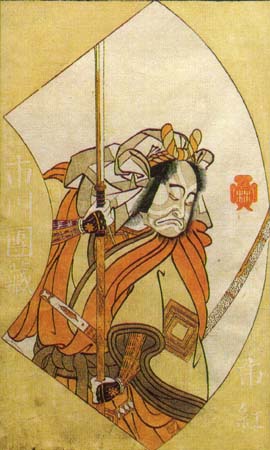 |
|
Ichikawa Danzô III in a print made by Katsukawa Shunshô Print made by Katsukawa Shunshô in 1769 The Ichikawa Danzaburô line of actors The Ichikawa Danzô line of actors |
|
|
| Contact | Main | Top | Updates | Actors | Plays | Playwrights | Programs | Links | FAQ | Glossary | Chronology | Illustrations | Prints | Characters | Derivatives | Theaters | Coming soon | News |