| NAKAYAMA SHINKURÔ I |
|
Stage names:
Other name:
Guild: Izumiya Line number: SHODAI (I) Poetry name: Icchô (1) Existence: 1702 ~ 3rd day of the 4th lunar month of 1775 [1] Connections: Brother: Anegawa Shinshirô I Father-in-law: Izumikawa Sennosuke Adopted son: Nakayama Bunshichi I Disciples: Nakayama Shinkurô II, Nakayama Banzô, Nakayama Monjûrô, Nakayama Tatsunosuke, Nakayama Hyakujirô, Nakayama Ikumatsu, Nakayama Kamematsu, Matsuya Shinjûrô, Hyakumura Tomokurô I Career: 1702 ~ 1716: born in Kamigata. He started his career at an early age, playing under the name of Matsumoto Kaheiji in children-actors troupes (kodomo shibai). He took the name of Anegawa Shinkurô at an unknown date. 2nd lunar month of 1716: he took the name of Nakayama Shinjûrô, performing in the kaomise drama "Chôja Mannengura" which was produced in Ôsaka by Sugiyama Heihachi and Nakamura Gentarô. 11th lunar month of 1723: he took the name of Nakayama Shinkurô I in Ôsaka at the Naka no Shibai, playing the role of Watanabe Kingo Katsuharu in the kaomise drama "Chûshin Futaba no Matsu" which was produced by Matsushima Hyôtarô. 1st lunar month of 1724: Shinkurô achieved a great success in the same theater by playing the role of Akamatsu Sokuyû in the drama "Ôtô-no-Miya Asahi no Yoroi". 11th lunar month of 1724: Shinkurô played at the Ônishi no Shibai the role of Ikoma Jôsuke in the kaomise drama "Senbon Matsu Hi-no-De no Maizuru", which was produced by Sakakiyama Shirotarô I and Sawamura Kiyojûrô. 11th lunar month of 1725: Shinkurô played at the Naka no Shibai the roles of Uda Magosaburô and the rônin Jûheiji from Iga) in the kaomise drama "Hôraisan Imose no Matsu", which was produced by Yamamoto Kyôshirô I and celebrated the shûmei of Nakamura Shirogorô II and Yamashita Kamenojô II. 12th lunar month of 1725: Shinkurô also played in the same theater the role of Zenbê in the kiri kyôgen "Kôri no Haraobi Inochi no Kaname". 11th lunar month of 1728: Shinkurô achieved a great success at the Kado no Shibai by playing the role of Hideyama Sanzaemon in the kaomise drama "Aioi Chôja Sangai-gura", which was produced by Arashi Sanjûrô II. 1st lunar month of 1731: Shinkurô played the role of Yamamoto Kansuke in the drama "Takechi Jûbê Miyako Nishiki", which was produced in Ôsaka at the Naka no Shibai by Iwai Hanshirô III. 11th lunar month of 1734: Shinkurô became zamoto at the Kado no Shibai, working for the nadai Shioya Kuroemon; he produced the kaomise drama "Shin Yakata In'yô no Ishizue" with the following line-up: Sawamura Otoemon I, Izumikawa Sennosuke, Tamiya Shirogorô, Yamashita Matatarô I, Kamakura Heikurô I, Asao Motogorô I, Kirinami Takie and Matsushima Moheiji. 11th lunar month of 1736: Shinkurô became zamoto at the Naka no Shibai, working for the same nadai; he wrote and produced the kaomise drama "Furômon Kon no Shikigawara" with the following line-up: Arashi San'emon III, Arashi Sanjûrô II, Sanogawa Hanazuma I, Yamashita Matatarô I, Nakamura Jûzô I and Fujikawa Heikurô. 11th lunar month of 1737: Shinkurô produced at the Naka no Shibai the kaomise drama "Fukakusa-no-In Sannô no Maki". 8th lunar month of 1738: Shinkurô produced in the same theater the drama "Shinoda-zuma"; the roles of Ashiya Dôman, Abe no Yasuna and Kuzu-no-Ha were played by Fujikawa Hanzaburô II, Arashi San'emon III and Matsushima Hyôtarô. 11th lunar month of 1738: Shinkurô played the role of Ono Tanzaemon in the kaomise drama "Fuji Daiko Wagô no Shirabe", which was produced by Arashi Sangorô I at the Naka no Shibai. Fall 1739: Shinkurô settled in Kyôto. 11th lunar month of 1739: he took back the name of Nakayama Shinjûrô, playing the role of Tamura Gennojô in the kaomise drama "Oiwai Nô Nishiki no Manmaku" which was produced in Kyôto by Nakamura Kumetarô I; this kaomise program included the shosagoto "Dôjôji", in which Shinjûrô achieved a great success by performing the leading role. 11th lunar month of 1740: he went back to Ôsaka, took back the name of Nakayama Shinkurô I and achieved a great success at the Kado no Shibai by performing in the kaomise drama "Hanaikusa Nishiki no Manmaku" and the dance "Dôjôji", which were produced by Nakamura Jûzô I. 11th lunar month of 1741: Shinkurô went to Edo and performed at the Nakamuraza in Hayakawa Denshirô's kaomise drama "En'ya Hangan Kokyô no Nishiki"; his stage partners were Matsumoto Kôshirô II, Nakamura Tomijûrô I, Sanogawa Mangiku, Tomizawa Tatsujûrô and Sawamura Sôjûrô I. Shinkurô also performed the leading role of the shosagoto "Dôjôji". 1st lunar month of 1742: Shinkurô's rank in the Edo hyôbanki, tachiyaku section, was jô-jô-kichi (superior - superior - excellent) [visual]. Fall 1742: Shinkurô went back to Ôsaka. 11th lunar month of 1742: Shinkurô played the role of Todoroki Kôsuke in the kaomise drama "Kudô Suketsune Ôiso Gayoi", which was produced by Nakamura Jûzô I at the Ônishi no Shibai. 7th lunar month of 1744: Shinkurô played the role of the sumô wrestler Nuregami Chôgorô in Matsuya Raisuke I's drama "Otokodate Gojitsu Kagami", which was produced at the Naka no Shibai by his brother Anegawa Shinshirô I. Shinkurô wears on stage the anegawa geta ('Anegawa wooden clogs') and the anegawa zukin ('Anegawa hood'), which started a new fashion in Ôsaka when Shinshirô used them in the 1st lunar month of 1743 in the drama "Kurofune Isse Ichidai Otoko". 1st lunar month of 1745: Shinkurô's rank in the Ôsaka hyôbanki, tachiyaku section, was jô-jô-kichi (superior - superior - excellent) [visual]. 9th lunar month of 1745: Shinkurô played the role of Yokanpei in the drama "Ashiya Dôman Ôuchi Kagami", which was produced by Nakamura Jûzô I at the Ônishi no Shibai; his stage partners were Bandô Toyosaburô I (Abe no Yasuna), Nakamura Jûzô I (Ashiya Dôman), Ichikawa Danzô III (Sakon Tarô), Arashi Shichigorô I (Yakanpei, Shôgen) and Yoshizawa Ayame II (Kuzu-no-Ha). 12th lunar month of 1745: the drama "Natsu Matsuri Naniwa Kagami" was performed for the first time in Ôsaka, simultaneously in the three major theaters of the city, which started a competition for the best performance and line-up; Shinkurô played the role of Danshichi Kurobê at the Ônishi no Shibai [casting]. 11th lunar month of 1747: he went to Kyôto, took back the name of Nakayama Shinjûrô and performed in the kaomise drama "Meiken Kogane Zukuri", which was produced by Nakamura Kumetarô I. 25th day of the 11th lunar month of 1749 [2]: his brother Anegawa Shinshirô I died. 1750: tour in Ise. 11th lunar month of 1750: Shinjûrô performed in Matsuya Raisuke I's kaomise drama "Kaikei Wagô Hanayakata", which was produced in Kyôto by Miyako Handayû. 1st lunar month of 1751: first Kabuki adaptation of the puppet theater drama "Tamamo-no-Mae Asahi no Tamoto", which was produced in Kyôto by Miyako Handayû at his theater; Shinjûrô played the roles of Kazusanosuke Tsunehiro and the farmer Jûsaku [casting]. 11th lunar month of 1751: Shinjûrô joined his adopted son Nakayama Bunshichi I, the zamoto working with the nadai Hayagumo Chôdayû in another theater in Kyôto; the two actors performed together in the kaomise drama "En no Gyôja Ômine Zakura". Fall 1752: Shinkurô and Nakayama Bunshichi I went together to Ôsaka. 11th lunar month of 1752: Nakayama Shinjûrô and Nakayama Bunshichi I respectively took the names of Wakayama Shinkurô and Wakayama Bunshichi at the Ônishi no Shibai, performing in the kaomise drama "Kyô Miyage Matsuri Zoroe" which was produced by Sanjô Sadasuke; their stage partners were Yamamoto Kyôshirô I, Ôtani Hirohachi I, Iwata Somematsu I, Matsushima Kiyosaki, Ichimura Sanohachi, Kirishima Gizaemon I, Kiriyama Monji I, Matsushima Moheiji, Takenaka Heikichi, Murayama Heijûrô IV and Nakamura Shirogorô III. Fall 1755: he took back the name of Nakayama Shinkurô I. 11th lunar month of 1756: Shinkurô played at the Ônishi no Shibai the role of Takamura Gôsuke in Namiki Shôzô I's kaomise drama "Daimatsu Kyokusuke Tanzen Roppô", which was produced by Daimatsu Kyokusuke. 1st lunar month of 1757: premiere at the Ônishi no Shibai of Namiki Shôzô I's drama "Tenjiku Tokubê Kikigaki Ôrai"; Shinkurô played the role of Tenjiku Tokubê, in reality Shôrinkei from Kôrai [casting]. 1st lunar month of 1758: first Kabuki adaptation of the 5-act maruhonmono drama "Hime Komatsu Ne-no-Hi no Asobi" in Ôsaka at the Naka no Shibai; Shinkurô played the roles of Shunkan and Gankutsu no Raigen [casting]. 11th lunar month of 1758: Shinkurô played the role of Tankai Sôshin in the kaomise drama "Arigatashi Fujiwara Keizu", which was produced by his adopted son Nakayama Bunshichi I at the Kado no Shibai. 12th lunar month of 1758: premiere at the Kado no Shibai of Namiki Shôzô I's ni-no-kawari drama "Sanjikkoku Yofune no Hajimari"; for the very first time in Kabuki history, a mawari-butai, invented by Namiki Shôzô I, was built and used on the stage of a theater [more details]; Shinkurô played the roles of Hanamitsu Kenpô and the watashimori Mojibê. 1st lunar month of 1761: premiere at the Kado no Shibai of Namiki Shôzô I's ni-no-kawari drama "Kiritarô Tengu no Sakamori"; Shinkurô played the role of Kiritarô Tengu [more details]. 5th lunar month of 1762: premiere in Ôsaka at the Kado no Shibai of Namiki Shôzô I's drama "Koi Hakke Hashira Goyomi", which was a revision of Chikamatsu Monzaemon's drama "Daikyôji Mukashi Goyomi"; Shinkurô played the role of Gonbê [more details]. 7th lunar month of 1763: Shinkurô played the roles of Kakuju and Fujiwara no Shihei in the drama "Sugawara Denju Tenarai Kagami", which was produced by his adopted son Nakayama Bunshichi I at the Kado no Shibai; his stage partners were Nakayama Bunshichi I (Matsuômaru, Terukuni), Arashi Hinasuke I (Haru), Anegawa Daikichi I (Tonami, Yae), Asao Tamejûrô I (Hyôe, Shundô Genba), Nakayama Raisuke I (Umeômaru), Bandô Toyosaburô I (Shiratayû), Fujikawa Hachizô I (Genzô, Sukune Tarô), Ichinokawa Hikoshirô II (Sakuramaru), Yoshizawa Sakinosuke II (Chiyo, Tatsuta) and Nakamura Kichiemon I (Kan Shôjô). 9th lunar month of 1764: première in Ôsaka at the Kado no Shibai of "Oriawase Tsuzure no Nishiki", based on the puppet drama "Katakiuchi Tsuzure no Nishiki", which was produced by Nakayama Bunshichi I and celebrated the 16th anniversary (17th memorial service) of the passing away of Shinkurô's elder brother Anegawa Shinshirô I. A similar play was staged one day later under a different title, "Hare Kosode Tsuzure no Nishiki", at the Naka no Shibai [casting]. The competition for the best performance and the best line-up was open between the 2 theaters. The performance at the Kado no Shibai was more successful than the one at the Naka no Shibai; Shinkurô played at the Kado no Shibai the role of Shundô Sukedayû [casting]. 2nd lunar month of 1765: Shinkurô played the role of Takemura no Sadashin at the Kado no Shibai in the drama "Koi Nyobo Somewake Tazuna". 11th lunar month of 1765: Shinkurô played the role of Wada Shinpochi in the drama "Hanayagura Kikigaki Taiheiki", which was produced in Ôsaka by Anegawa Kikuhachi. 12th lunar month of 1766: Shinkurô played the role of Gonshirô in the drama "Hirakana Seisuiki", which was produced by Arashi Hinasuke I at the Kado no Shibai; his stage partners were Fujikawa Hachizô I (Matsuemon, Higuchi no Jirô Kanemitsu), Arashi Hinasuke I (Umegae), Ichinokawa Hikoshirô II (Kajiwara Genta Kagesue), Nakayama Raisuke I (Shigetada), Arashi Koroku I (Enju), Yoshizawa Ayame III (Oyoshi, Tomoe Gozen) and Arashi Shichigorô II (Kajiwara Heiji Kagetaka). Fall 1767: Shinkurô went to Kyôto. 11th lunar month of 1767: Shinkurô played in Kyôto at Hayagumo Chôdayû's theater the role of Asai Kenmotsu [illustration] in the kaomise drama "Shinchoku Fukki no Kanatoko", which was produced by Ichiyama Sukegorô III and celebrated the shûmei of Sakakiyama Koshirô IV and Sakakiyama Shirotarô IV. 11th lunar month of 1768: Shinkurô and Nakayama Bunshichi I went together to Ôsaka and performed in the kaomise drama "Kômei Daifukuchô", which was produced by the zamoto Mimasu Tanin I at the Naka no Shibai; Shinkurô played the role of the deity Fukurokuju. Spring 1771: tour in Ise with Bunshichi, Yamamura Kôzô and Fujikawa Hachizô I; Shinkurô played the roles of Yazaemon ("Sushiya") and Yokawa no Zenji Kakuhan in the drama "Yoshitsune Senbon Zakura". 9th lunar month of 1772: Shinkurô appeared on stage for the last time (isse ichidai performance); he played the role of Hanzaemon in the drama "Monogusa Tarô", which was produced by Ogawa Kichitarô I at the Kado no Shibai. 3rd day of the 4th lunar month of 1775 [1]: Shinkurô died. Comments: Nakayama Shinkurô I was one of the best tachiyaku of the eighteenth century. He was renowned for his great voice and the perfection of his lines delivery. Jitsugotoshi roles were his forte and he was also an outstanding jitsuaku. [1] The 3rd day of the 4th lunar month of the4th year of the An'ei era was the 2nd of May 1775 in the western calendar. [2] The 25th day of the 11th lunar month of the 2nd year of the Kan'en era was the 3rd of January 1750 in the western calendar. |

 |
|
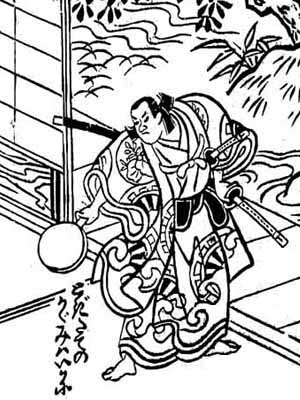
Nakayama Shinkurô I in an illustration from the book "Sanga no Tsu Yakusha Meijin Furue" (1750~1752) The Nakayama Icchô line of actors The Nakayama Shinkurô line of actors |
|
|
| Contact | Main | Top | Updates | Actors | Plays | Playwrights | Programs | Links | FAQ | Glossary | Chronology | Illustrations | Prints | Characters | Derivatives | Theaters | Coming soon | News |