| ARASHI SHICHIGORÔ I |
|
Stage name:
Other name:
Guild: Kyôya Line number: SHODAI (I) Poetry names: Shagan, Hoppi (?) Existence: ??? ~ ??? Connection: Master: Arashi Sangorô I Brother: Arashi Hidegorô Son: Arashi Shichigorô II Career: Before 1728: most likely born in Kamigata. He started his career with his brother in countryside theaters, as disciples of Arashi Sangorô I. His stage name was Arashi Shichigorô I. 11th lunar month of 1728: Shichigorô played at the Ônishi no Shibai; this was most likely his first stage appearance in ôshibai. 11th lunar month of 1730: Shichigorô plays as a wakashugata in Ôsaka in the kaomise drama "Kunkoku Ôe no Kôbai", which was produced by Asao Motogorô I. 11th lunar month of 1733: Shichigorô became katakiyaku and performed in Kyôto in the kaomise drama "Meotogura Kogane no Masugata". 1st lunar month of 1734: Shichigorô's rank in the Kyôto hyôbanki, katakiyaku section, was jô-jô-(shiro)hankichi (superior - superior - (white) half excellent) [visual]. 11th lunar month of 1734: Shichigorô became jitsuaku and played at Miyako Mandayû's theater the role of Sekiguchi Manzô in the kaomise drama "Tomi Yakata Kogane no Yaguruma". 1st lunar month of 1735: Shichigorô's rank in the Kyôto hyôbanki, jitsuaku section, was jô-jô-hankichi (superior - superior - half excellent) [visual]. 11th lunar month of 1736: Shichigorô performed in Kyôto in the kaomise drama "Tomi no Ichi Kogane no Aratama", which was produced by Nakamura Tomijûrô I; his stage partners were Ichiyama Sukegorô I, Nakamura Shingorô I, Sakurayama Shirosaburô II, Yamanaka Heijûrô I, Sanogawa Mangiku, Yamashita Kinsaku I, Tatsuoka Hisagiku and Tatsuoka Someemon. 1st lunar month of 1737: Shichigorô's rank in the Kyôto hyôbanki, jitsuaku section, was jô-jô-kichi (superior - superior - excellent) [visual] 1st lunar month of 1739: Shichigorô played in Kyôto at Kameya Kumenojô's theater the role of Kantetsu and Ishidô Hyôbu in the drama "Keisei Arashiyama", which was produced by Nakamura Tomijûrô I. 12th day of the 7th lunar month of 1739 [2]: his master Arashi Sangorô I died. Fall 1739: Shichigorô went to Ôsaka. 12th lunar month of 1739: Shichigorô played at the Ônishi no Shibai the role of Fuwa Banzaemon in the drama "Kewai Musha Ômi Genji", which was produced by Yoshizawa Ayame II; his stage partners were Yoshizawa Ayame II (Okichi), Nakamura Sôjûrô (Shôgen), Sakakiyama Shirotarô I (Nagoya Sanza), Anegawa Shinshirô I (Matahei) and Segawa Kikunojô I (the courtesan Tôyama). 11th lunar month of 1740: Shichigorô performed at the Ônishi no Shibai in the kaomise drama "Yaguruma Yakata no Fuji", which was produced by Nakamura Tomijûrô I; his stage partners were Yamamoto Kyôshirô I, Nakamura Shingorô I, Nakayama Shinkurô I, Sanogawa Mangiku, Segawa Kikunojô I, Onoe Kikugorô I and Nakamura Sôjûrô. 11th lunar month of 1741: Shichigorô performed at the Ônishi no Shibai in the kaomise drama "Bankoku Taiheiki", which included the "Uirô Uri" scene and stars Ichikawa Ebizô II, Ichikawa Danjûrô III, Yamamoto Kyôshirô I, Sadoshima Chôgorô I, Onoe Kikugorô I, Yamashita Kinsaku I, Nakamura Jirôsa I, Bandô Toyosaburô I, Shibazaki Taminosuke, Yamanaka Heijûrô I and Yamatogawa Akashi. 1st lunar month of 1742: premiere at the Ônishi no Shibai of the play "Narukami Fudô Kitayama Zakura"; Shichigorô played the role of Yatsurugi Genba [casting]. 11th lunar month of 1743: Shichigorô played at the Ônishi no Shibai in Namiki Sôsuke's kaomise drama "Futatsu Biki Nishiki no Manmaku", which was produced by the zamoto Nakamura Jûzô I; his stage partners were Sawamura Sôjûrô I, Nakamura Tomijûrô I, Sanogawa Mangiku, Sakurayama Shirosaburô II, Nakamura Shingorô I and Iwai Hanshirô III. 9th lunar month of 1745: Shichigorô played the roles of Yakanpei and Shôgen in the drama "Ashiya Dôman Ôuchi Kagami" , which was produced by Nakamura Jûzô I at the Ônishi no Shibai; his stage partners were Bandô Toyosaburô I (Abe no Yasuna), Nakamura Jûzô I (Dôman), Nakayama Shinkurô I (Yokanpei), Ichikawa Danzô III (Sakon Tarô) and Yoshizawa Ayame II (Kuzu-no-Ha). 12th lunar month of 1745: the drama "Natsu Matsuri Naniwa Kagami" was performed for the first time in Ôsaka, simultaneously in the three major theaters of the city, which started a competition for the best performance; Shichigorô played the role of Danshichi Kurobê at the Naka no Shibai [casting].
11th lunar month of 1750: Shichigorô performed at the Kado no Shibai in the kaomise drama "Tachibana Gojûyongun", which was produced by Iwata Somematsu I; his stage partners were Ichikawa Danzô III, Bandô Toyosaburô I, Yoshizawa Sakinosuke II and Kirishima Gizaemon I. Fall 1751: Shichigorô went to Edo. 11th lunar month of 1751: Shichigorô played at the Ichimuraza the role of the painter Matahei, in reality Ômi no Kotôta, in the kaomise drama "Kamimukae Nigiwai Genji", which celebrated the shûmei of Bandô Hikosaburô II. 1st lunar month of 1752: Shichigorô's rank in the Edo hyôbanki, jitsuaku section, was jô-jô-kichi (superior - superior - excellent) [visual]. 11th lunar month of 1752: Shichigorô played at the Ichimuraza the role of Adachi Hachirô in Tsuuchi Jihê II's kaomise drama "Ume Sakura Ninin Semimaru". 1st lunar month of 1753: Shichigorô's rank in the Edo hyôbanki, jitsuaku section, was ô-jô-jô-kichi (grand - superior - superior - excellent). He played in the same theater the role of Kajiwara Heizô Kagetoki in the new year drama "Haru Fukami Iroha Soga". This was his last-recorded performance. No record afterwards. Comments: Arashi Shichigorô I was a talented actor, who achieved fame for himself during the first half of the 18th century as a jitsuaku actor. He made most of his career in Kamigata but ended it with a short and successful stay in Edo. He was said to be better in jidaimono rather than in sewamono. [1] Not reported in Nojima Jusaburô's book "Kabuki Jinmei Jiten" or the Ritsumeikan University Actors Database. As Arashi Shichigorô I was the first actor to use the haimyô Shagan, we assume he was de facto Arashi Shagan I. [2] The 12th day of the 7th lunar month of the 4th year of the Genbun era was the 16th of August 1739 in the western calendar. |

 |
|
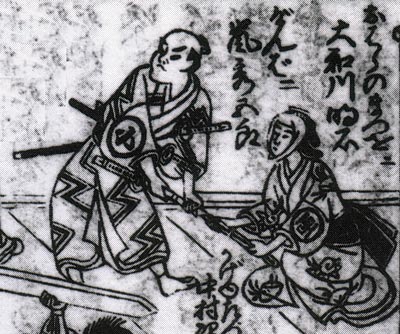
Arashi Shichigorô I and Yamatogawa Akashi playing the roles of Moronô and Ôhara no Matsuo in the drama "Bankoku Taiheiki", which was staged in the 11th lunar month of 1741 at the Ônishi no Shibai The Arashi Shagan line of actors The Arashi Shichigorô line of actors |
|
|
| Contact | Main | Top | Updates | Actors | Plays | Playwrights | Programs | Links | FAQ | Glossary | Chronology | Illustrations | Prints | Characters | Derivatives | Theaters | Coming soon | News |