| BANDÔ MITSUGORÔ I |
|
Stage names:
Guild: Yamatoya Line number: SHODAI (I) Poetry name: Zegyô Existence: 1745 ~ 10th day of the 4th lunar month of 1782 [1] Connection: Adoptive father: Bandô Sanpachi I Father-in-law: Morita Kan'ya VI Sons: Bandô Mitsugorô III, Bandô Mitahachi Disciples: Ogino Izaburô II (Bandô Mitsugorô II), Bandô Kijûrô Career: 1745 ~ 1766: born in Ôsaka. He started his career at the Takeda no Shibai, a hama shibai theater, performing under the name of Takeda Minosuke. Bandô Sanpachi I decided to adopt and to train him in 1766. Fall 1766: Bandô Sanpachi I and Minosuke went together to Edo. 11th lunar month of 1766: he took the name of Bandô Mitsugorô I at the Moritaza, playing 2 roles in the kaomise drama "Tsuno Moji Izu no Irifune". Fall 1767: Mitsugorô achieved a great success at the Moritaza by playing the role of the yakko Yokanbê in the drama "Ashiya Dôman Ôuchi Kagami". 11th lunar month of 1767: Mitsugorô moved to the Ichimuraza and played in the kaomise drama "Nue Shigedô Sakiwake Yûsha". 8th lunar month of 1768: Mitsugorô achieved a great success by playing at the Ichimuraza the role of Takebe Genzô in the drama "Sugawara Denju Tenarai Kagami"; the roles of Kan Shôjô, Matsuômaru and Genzô's wife Tonami were played by Ichimura Uzaemon IX, Sawamura Sôjûrô II and Sanogawa Ichimatsu II. 11th lunar month of 1768: Mitsugorô moved to the Moritaza and played the role of Minamoto no Yoshiie in the kaomise drama "Mutsuchidori Meika no Yumitori". 2nd lunar month of 1769: the play "Sekitori Senryô Nobori", which was originally written for the puppet theater and staged for the first time in the 8th lunar month of 1767 in Ôsaka at the Takemotoza, was adapted for Kabuki for the first time, in Edo at the Moritaza; Mitsugorô played the roles of the sumôtori Iwagawa and Tsuda Ryôsuke [casting]. 4th ~ 6th lunar months of 1769: Mitsugorô played at the Moritaza the role of Teraoka Heiemon in the drama "Kanadehon Chûshingura"; the roles of Okaru and Yuranosuke were played by Iwai Hanshirô IV and Sakata Hangorô II. 11th lunar month of 1769: Mitsugorô played at the Moritaza 2 roles in the kaomise drama "Na ni Takashi Kumoi no Yumihari". 11th day of the 1st lunar month of 1770 [2]: his adoptive father Bandô Sanpachi I died. 1st lunar month of 1770: Mitsugorô played in the same theater the role of Kobayashi no Asahina in the new year sogamono drama "Kurikaesu Soga no Odamaki". He also played the role of Hanbê in a shinjûmono, which was staged as the second part (nibanme) of this program; the role of Hanbê's lover Ochiyo was played by Yamashita Kinsaku II. 6th lunar month of 1770: Mitsugorô played in the same theater the role of Issun Tokubê in the drama "Natsu Matsuri Naniwa Kagami"; the roles of Danshichi Kurobê, Tsuribune Sabu and Otatsu were played by Kasaya Matakurô II, Sawamura Kijûrô I and Yamashita Kinsaku II. 9th lunar month of 1770: Chikamatsu Hanji's 1759 puppet theater drama "Hidakagawa Iriai Zakura" was staged for the first time in Edo, at the Moritaza; Mitsugorô played the role of a bonze [casting]. He also played the role of Shôji's wife in the drama "Ashiya Dôman Ôuchi Kagami". 11th lunar month of 1770: Mitsugorô played at the Moritaza the role of Osada no Tarô in the kaomise drama "Miyako Zome Giô Katsugi", which celebrated the arrival in Edo of the actor Nakamura Tomijûrô I. 1st lunar month of 1771: Mitsugorô played in the same theater the role of Kudô Suketsune in the drama "Ehô Soga Nennen Goyomi". 5th lunar month of 1771: Mitsugorô played in the same theater the roles of Kokingo and Yasuke in the drama "Yoshitsune Senbon Zakura". 11th lunar month of 1771: Mitsugorô played at the Moritaza the role of Kashiwagi Emonnosuke in the kaomise drama "Fukikaete Tsuki no Yoshiwara"; his stage partners were Matsumoto Kôshirô II, Ichikawa Danjûrô V, Nakamura Tomijûrô I, Yamashita Kinsaku II, Nakamura Sukegorô II, Ôtani Hiroemon III and Nakamura Jûzô II (who came from Kamigata). 8th lunar month of 1772: Mitsugorô played in the same theater the role of Lord Ashikaga Yorikane in the Tokiwazu dance-drama "Sono Utsushie Matsu ni Kaide"; his stage partners in the roles of the courtesan Takao (and the ghost of Takao) and the ghost of Seigen were Nakamura Noshio I and Ichikawa Danjûrô V. 11th lunar month of 1772: Mitsugorô performed at the Moritaza in the kaomise drama "Izu Goyomi Shibai no Ganjitsu", which celebrated the shûmei of Sawamura Chôjûrô IV. 1st lunar month of 1773: Mitsugorô played in the same theater the role of Soga Jûrô Sukenari in the new year sogamono drama "Iro Makie Soga no Sakazuki"; the roles of Soga Gorô Tokimune and Kudô Saemon Suketsune were played by Nakamura Noshio I and Ichikawa Danjûrô V. 11th lunar month of 1773: Mitsugorô performed [illustration] at the Moritaza in the kaomise drama "Onna Aruji Hatsuyuki no Sekai". 1st lunar month of 1774: Mitsugorô played in the same theater the role of Soga Jûrô Sukenari in Horikoshi Saiyô's new year sogamono drama "Kite Hajime Hatsugai Soga"; the roles of Kudô Saemon Suketsune and Soga Gorô Tokimune were played by Nakamura Jûzô II and Ichikawa Yaozô II. 4th lunar month of 1774: Mitsugorô played in the same theater the role of En'ya Hangan in the drama "Kanadehon Chûshingura". 11th lunar month of 1774: Mitsugorô performed at the Moritaza in the kaomise drama "Ichi no Tomi Tsuki no Kaomise", which welcomed in Edo the Kamigata actor Nakamura Shingorô II. 1st lunar month of 1775: Mitsugorô played in the same theater the roles of Soga Jûrô Sukenari, Umezawa Yoshibei and Mionoya Shirô in the new year sogamono drama "Shida Yuzuriha Hôrai Soga"; the roles of Soga Gorô Tokimune and Kudô Saemon Suketsune were played by Bandô Matatarô IV and Ichikawa Danjûrô V. 5th lunar month of 1775: Mitsugorô in the same theater the roles of Umeômaru and Takebe Genzô in the drama "Sugawara Denju Tenarai Kagami"; his stage partners were Ichikawa Danjûrô V (Kan Shôjô), Matsumoto Kôshirô IV (Matsuômaru, Kakuju), Iwai Hanshirô IV (Sakuramaru, Genzô's wife Tonami, Umeômaru's wife Haru). 11th lunar month of 1775: Mitsugorô performed at the Moritaza in the kaomise drama "Kikujidô Shuen no Iwaya". 3rd lunar month of 1776: Mitsugorô played in the same theater the role of Kajiwara Genta Kagesue Kagetaka in the drama "Hirakana Seisuiki"; the roles of Kajiwara Heiji Kagetaka, Chidori and Enju were played by Ichikawa Danjûrô V, Yoshizawa Iroha I and Sawamura Chôjûrô IV. 6th lunar month of 1776: tour in Kôfu; Mitsugorô played in the precinct of the Kyôanji Temple the role of Issun Tokubê in the drama "Natsu Matsuri Naniwa Kagami"; the roles of Danshichi Kurobê, Tsuribune Sabu and Otatsu were played by Yamashina Shirojûrô, Arashi Otohachi II and Yamashita Kinsaku II. 11th lunar month of 1776: Mitsugorô performed at the Nakamuraza in the kaomise drama "Sakuya Kono Hana no Kaomise". Summer 1777: the book "Yakusha Sensakuron" ('About actors prying') was published in Edo. It gives some private information on actors. Edo readers could read that Mitsugorô lived with his spouse and his young son in the district of Kobiki-chô and his annual salary was 650 ryô. 11th lunar month of 1777: Mitsugorô performed at the Nakamuraza in the kaomise drama "Masakado Kanmuri no Hatsuyuki"; his stage partners were Ichikawa Danjûrô V, Matsumoto Kôshirô IV, Iwai Hanshirô IV, Ichikawa Monnosuke II and Yoshizawa Sakinosuke III. 2nd lunar month of 1778: Mitsugorô played in the same theater the roles of Soga Jûrô Sukenari and Kyô no Jirô in the new year sogamono drama "Kaidô Iro Yawaragi Soga"; his stage partners in the roles of Soga Gorô Tokimune and Kudô Saemon Suketsune were Ichikawa Monnosuke II and Ichikawa Danjûrô V. 7th lunar month of 1778: premiere at the Nakamuraza of the drama "Date Kurabe Okuni Kabuki"; Mitsugorô played the roles of Ashikaga Sakingo Yorikane, the Nanzenji tôfu maker Saburobê, Imagawa Tarô, Akaneya Hanshichi, Dote no Dôtetsu and Tosa no Matahei Mitsuoki [casting]. 11th lunar month of 1778: Mitsugorô played at the Nakamuraza 2 roles in the kaomise drama "Motomishi Yuki Sakae Hachinoki", which celebrated the shûmei of Yoshizawa Ayame IV and the first stage appearance of Mitsugorô's son Bandô Mitahachi I. 1st lunar month of 1779: Mitsugorô played in the same theater the roles of Soga Jûrô Sukenari and Kobayashi no Asahina in the new year sogamono drama "Gohiiki Nennen Soga"; his stage partners in the roles of Jûrô's lover Ôiso no Tora and Kudô Saemon Suketsune were Nakamura Rikô I and Matsumoto Kôshirô IV. 5th lunar month of 1779: Mitsugorô played in the same theater the roles of Takebe Genzô and Umeômaru in the drama "Sugawara Denju Tenarai Kagami"; the roles of Matsuômaru and Sakuramaru were played by Matsumoto Kôshirô IV and Ichikawa Monnosuke II. 11th lunar month of 1779: Mitsugorô played at Nakamuraza the roles of Nitta Yoshisada and Oyamada Tarô in the kaomise drama "Kaeribana Eiyû Taiheiki", which celebrated the shûmei of Yamashita Mangiku I and Sengoku Hikosuke II. The performance was a tremendous success. 1st lunar month of 1780: Mitsugorô played in the same theater the roles of Soga Jûrô Sukenari and Fuji Mibu in the new year sogamono drama "Hatsumonbi Kuruwa Soga"; his stage partners in the roles of Soga Gorô Tokimune and Kudô Saemon Suketsune were Ichikawa Monnosuke II and Ichikawa Danjûrô V. 5th lunar month of 1780: tour in Sendai. 11th lunar month of 1780: Mitsugorô played at the Ichimuraza 2 roles in the kaomise drama "Mure Takamatsu Yuki no Shirahata". 1st lunar month of 1781: Mitsugorô's rank in the Edo hyôbanki, tachiyaku section, was just one rank below jô-jô-kichi (superior - superior - excellent) [visual]. 9th lunar month of 1781: Mitsugorô played in the same theater the role of Kameya Chûbê in the shinjûmono "Keisei Koi Bikyaku"; the role of Chûbê's lover Umegawa was played by Segawa Kikunojô III. 11th lunar month of 1781: Mitsugorô performed [illustration] at the Moritaza in the kaomise drama "Sakikaese Yuki no Miyoshino", which welcomed in Edo the Kamigata minor actors Arashi Konomatsu, Onoe Kokichi and Onoe Kosaburô. Spring 1782: Mitsugorô appeared on stage for the last time, at the Moritaza, playing the role of Soga Jûrô in the new year sogamono drama "Haru no Kotobuki Tokiwa Soga". 10th day of the 4th lunar month of 1782 [1]: Mitsugorô suddenly collapsed and died in the backstage of the Moritaza. Comments: Bandô Mitsugorô I was a talented tachiyaku and dancer, who won fame for himself during
the Meiwa and An'ei eras.
[1] The 10th day of the 4th lunar month of the 2nd year of the Tenmei era was the 21st of May 1782 in the western calendar. [2] The 11th day of the 1st lunar month of the 7th year of the Meiwa era was the 6th of February 1770 in the western calendar. |

 |
|
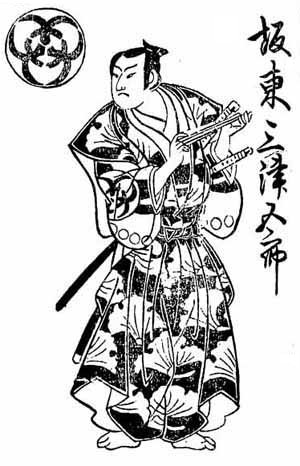
Bandô Mitsugorô I as depicted in an illustration from the book "Santo Yakusha Omokage Zukushi" (1784) The Bandô Mitsugorô line of actors |
|
|
| Contact | Main | Top | Updates | Actors | Plays | Playwrights | Programs | Links | FAQ | Glossary | Chronology | Illustrations | Prints | Characters | Derivatives | Theaters | Coming soon | News |