| NAKAMURA KICHIEMON I |
|
Stage names:
Guild: Hiranoya Line number: SHODAI (I) Existence: 1694 ~ 17th day of the 6th lunar month of 1770 [1] Connections: Brother/master: Sanogawa Mangiku Adopted son: Nakamura Jûzô II Disciples: Edosaka Kyôemon, Nakamura Danzô, Nakamura Matsusuke, Nakamura Jûbê, Nakamura Bunzô, Nakamura Kichiji, Nakamura Ushiemon, Nakamura Yaehachi, Nakamura Taizô Career: 1694: born in the province of Banshû. His father was a rônin named Sudô. He started his career when he was over 20 and became a disciple of his brother Sanogawa Mangiku, who gave him the name of Sanogawa Jûzô. Fall 1723: Jûzô went to Edo after a tour in Ise. 11th lunar month of 1723: Jûzô became tachiyaku and played at the Moritaza the role of Ôe no Hachirô in the kaomise drama "Yorimasa Kaikeizan". Fall 1724: Jûzô went to Kyôto. 11th lunar month of 1724: Sanogawa Jûzô took the name of Nakamura Jûzô I, playing the role of Hanazato Kakubê in the kaomise drama in the kaomise drama "Yomeiri Miyako no Shimadai", which was produced by the zamoto Ogino Umenosuke for the nadai Ebisuya Kichirôbê and also celebrated the shûmei of Murayama Heijûrô III. 11th lunar month of 1725: Jûzô became jitsuaku and played in Kyôto the role of Kanamori Tamiemon in the kaomise drama "Ôkamado Hatsumen Bako", which was produced by his brother Sanogawa Mangiku for the nadai Hayagumo Chôdayû. He also changed the writing of his first name:
Fall 1726: Jûzô went to Ôsaka. 11th lunar month of 1726: Jûzô switched back to tachiyaku roles and played at the Naka no Shibai the role of Kanematsu Miyakonosuke in the kaomise drama "Hakoiri Daikoku Gane", which was produced by Kaneko Kichizaemon. 11th lunar month of 1730: Jûzô played in Ôsaka the role of Sakuragawa Kôsuke in the kaomise drama "Kunkoku Ôe no Kôbai", which was produced by Asao Motogorô I. 1st lunar month of 1731: Jûzô's rank in the Ôsaka hyôbanki, tachiyaku section, was jô-jô-(shiro)kichi (superior - superior - (white) excellent) [visual]. 11th lunar month of 1731: Jûzô played at the Kado no Shibai the role of Takahama Kuranojô in the kaomise drama "Aioi Kikenjô", which was produced by Arashi Kokuseki. 1st lunar month of 1732: Jûzô's rank in the Ôsaka hyôbanki, tachiyaku section, was jô-jô-(hanshiro)kichi (superior - superior - (half-white) excellent) [visual]. 11th lunar month of 1733: Jûzô became zamoto and produced in Ôsaka the kaomise drama "Shigeri Matsu Kogane no Takaragura". 11th lunar month of 1734: Jûzô produced at the Ônishi no Shibai the kaomise drama "Asahi no Matsu Kogane no Shinbashira". 9th lunar month of 1735: Jûzô produced at the Ônishi no Shibai the drama "Ashiya Dôman Ôuchi Kagami", in which he played the role of Dôman. 11th lunar month of 1735: Jûzô produced at the Ônishi no Shibai the kaomise drama "Ôyamato Kane no Kinzan". 11th lunar month of 1736: Jûzô performed at the Naka no Shibai in the kaomise drama "Furômon Kon no Shikigawara"; his stage partners were Arashi San'emon III, Arashi Sanjûrô II, Sanogawa Hanazuma I, Yamashita Matatarô I, Nakayama Shinkurô I and Fujikawa Heikurô. 11th lunar month of 1740: Jûzô produced at the Kado no Shibai the kaomise drama "Hanaikusa Nishiki no Manmaku". 1st lunar month of 1741: Jûzô's rank in the Ôsaka hyôbanki, tachiyaku section, was jô-jô-kichi (superior - superior - excellent) [visual]. 11th lunar month of 1742: Jûzô produced at the Ônishi no Shibai the kaomise drama "Kudô Suketsune Ôiso Gayoi". Summer 1743: tour in Nara. 11th lunar month of 1743: Jûzô produced at the Ônishi no Shibai Namiki Sôsuke's kaomise drama "Futatsu Biki Nishiki no Manmaku", which celebrated the arrival in Ôsaka of the star Sawamura Sôjûrô I. 9th lunar month of 1745: Jûzô produced at the Ônishi no Shibai the drama "Ashiya Dôman Ôuchi Kagami", in which he played the role of Dôman; his stage partners were Yoshizawa Ayame II (Kuzu-no-Ha), Bandô Toyosaburô I (Abe no Yasuna), Nakayama Shinkurô I (Yokanpei), Arashi Shichigorô I (Yakanpei, Shôgen) and Ichikawa Danzô III (Sakon Tarô). Fall 1745: Jûzô went to Kyôto after 19 seasons spent in Ôsaka. 11th lunar month of 1745: Jûzô played the role of Kuroda Honzô in the kaomise drama "Toragoyomi Hoteibukuro", which was produced by Nakamura Kumetarô I. 1st lunar month of 1746: Jûzô's rank in the Kyôto hyôbanki, tachiyaku section, was jô-jô-kichi (superior - superior - excellent) [visual]. 3rd lunar month of 1747: Jûzô played at Miyako Handayû's theater the role of Kanki in Chikamatsu Monaemon's drama "Kokusen'ya Gassen"; the roles of Watônai and Kinshôjo were played by Fujikawa Heikurô and Tatsuoka Hisagiku. 1st lunar month of 1748: Jûzô went to Ôsaka and produced at the Kado no Shibai the new year drama "Keisei Yoshiokazome". 11th lunar month of 1748: Jûzô went back to Kyôto and played the role of Ashikaga Yoshinori in the kaomise drama "Jidai Makie Chûshingura", which was produced by Nakamura Matsubê I. Fall 1749: Jûzô went to Ôsaka. 11th lunar month of 1749: Jûzô produced at the Naka no Shibai the kaomise drama "Fûryû Gosho Zakura". 1st lunar month of 1750: Jûzô's rank in the Ôsaka hyôbanki, tachiyaku section, was kô-jô-jô-kichi (meritorious - superior - superior - excellent) [Visual]. 11th lunar month of 1750: Jûzô produced at the Naka no Shibai the kaomise drama "Yasa Heike Sakiwake Musha". 1st lunar month of 1751: Jûzô was sôkanjiku in the Ôsaka hyôbanki. 11th lunar month of 1752: the play "Ichi-no-Tani Futaba Gunki" was staged for the first time in Ôsaka, as a kaomise drama, at the Naka no Shibai; it was produced by Jûzô, who also played the role of Okabe Rokuyata [casting]. Fall 1755: Jûzô went to Kyôto. 11th lunar month of 1755: Jûzô played at the Kitagawa no Shibai the role of Noto-no-Kami Noritsune in the kaomise drama "Onna Monji Heike Monogatari". 1st lunar month of 1756: Jûzô's rank in the Kyôto hyôbanki, tachiyaku section, was goku-jô-jô-kichi (extreme - superior - superior - excellent). Fall 1756: Jûzô went to Ôsaka. 11th lunar month of 1756: Jûzô played at the Kado no Shibai the role of the togiya Tôsaku, in reality Miura Shirô, in Namiki Eisuke I's kaomise drama "Taihei Yamato Monogatari". 1st lunar month of 1757: Jûzô's rank in the Ôsaka hyôbanki, tachiyaku section, was goku-jô-jô-kichi (extreme - superior - superior - excellent). Fall 1757: Jûzô went to Kyôto. 11th lunar month of 1757: Jûzô played at the Minamigawa no Shibai the role of Okabe Rokuyata in the kaomise drama "Ôyashiro Musubu no Sanban Tsuzuki", which was produced by Sawamura Kunitarô I and Somematsu Matsujirô. He also played the role of Kan Shôjô in the kiri kyôgen drama "Kitano no Goengi Senbon Ume". 1st lunar month of 1758: first Kabuki adaptation of the puppet theater drama "Gion Sairei Shinkôki", which was simultaneously produced at the Minamigawa no Shibai [casting] and the Kitagawa no Shibai [casting]. It used its real title at the former theater but it was entitled "Keisei Niwatoriyama" at the latter theater; Jûzô played in the former theater the role of Konoshita Tôkichi. 11th lunar month of 1758: Jûzô performed at the Minamigawa no Shibai in the kaomise drama "Homare Musha Senri no Kachidoki", which was produced by Sawamura Kunitarô I and Somematsu Matsujirô. 11th lunar month of 1759: Nakamura Jûzô I and his disciple Ogurayama Sentarô respectively took the names of Nakamura Kichiemon I and Nakamura Jûzô II at the Minamigawa no Shibai, performing together in the kaomise drama "Hônen no Miyako Mutsuki no Kotobuki", which was produced by Sawamura Kunitarô I and also celebrated the shûmei of Matsuya Shinjûrô. 2nd lunar month of 1760: Nakamura Kichiemon I took the name of Nakamura Kitsuemon at the Minamigawa no Shibai, playing the role of Watanabe Honzô in the new year drama "Keisei Chikai no Kane". Fall 1761: Kitsuemon went to Ôsaka. 11th lunar month of 1761: Nakamura Kitsuemon took back the name of Nakamura Kichiemon I at the Kado no Shibai, playing in the kaomise drama "Sôtsui Hoshi Kamakura Kagami", which was produced by Nakayama Bunshichi I. 5th lunar month of 1762: premiere in Ôsaka at the Kado no Shibai of Namiki Shôzô I's drama "Koi Hakke Hashira Goyomi", which was a revision of Chikamatsu Monzaemon's drama "Daikyôji Mukashi Goyomi"; Kichiemon played the role of Kishino Yûsuke [more details]. 7th lunar month of 1763: Kichiemon played at the Kado no Shibai the role of Kan Shôjô in the drama "Sugawara Denju Tenarai Kagami"; his stage partners were Nakayama Shinkurô I (Kakuju, Fujiwara no Shihei), Arashi Hinasuke I (Haru), Anegawa Daikichi I (Tonami, Yae), Asao Tamejûrô I (Hyôe, Shundô Genba), Nakayama Raisuke I (Umeômaru), Bandô Toyosaburô I (Shiratayû), Fujikawa Hachizô I (Genzô, Sukune Tarô), Ichinokawa Hikoshirô II (Sakuramaru), Yoshizawa Sakinosuke II (Chiyo, Tatsuta) and Nakayama Bunshichi I (Matsuômaru, Terukuni). 11th lunar month of 1763: the play "Suma no Miyako Genpei Tsutsuji", which was originally written by Hasegawa Senshi and Matsuda Bunkôdô for the puppet theater in 1730, was adapted for Kabuki 33 years later by the playwright Namiki Eisuke I. It was entitled "Sakigake Genpei Tsutsuji" (the second drama of an unusual 3-part kaomise program) and staged at the Naka no Shibai, starring Kichiemon and Arashi Hinasuke I in the roles of Kumagai Jirô Naozane and Taira no Atsumori. 9th lunar month of 1764: première in Ôsaka at the Naka no Shibai of "Hare Kosode Tsuzure no Nishiki", based on the puppet drama "Katakiuchi Tsuzure no Nishiki", which was produced by Mimasu Daigorô I. A similar play was staged one day before under a different title, "Oriawase Tsuzure no Nishiki", at the Kado no Shibai. The competition for the best performance and the best line-up was open between the 2 theaters. The performance at the Kado no Shibai was more successful than the one at the Naka no Shibai; Kichiemon played at the Naka no Shibai the role of Takaichi Buemon [casting]. 11th lunar month of 1767: Kichiemon performed at the Naka no Shibai in the kaomise drama "Shitennô Maizuru Ôgi". Fall 1768: Kichiemon went to Kyôto. 11th lunar month of 1768: Kichiemon performed in Kyôto in the kaomise drama "Enmusubi Asahi no Shimadai", which was produced by Onoe Kumesuke. 1st lunar month of 1769: Kichiemon appeared on stage for the last time, in Kyôto, playing the role of Asai Shûrinosuke in the new year ni-no-kawari drama "Keisei Sato no Kinzan". 17th day of the 6th lunar month of 1770 [1]: Kichiemon died. Comments: "Nakamura Kichiemon began to rise as Anegawa Shinshirô I declined. Kichiemon had the advantage of being ten years younger than Shinshirô, and was well-born, since he was the son of a samurai who had turned rônin. He lived in Ôsaka, and as his younger brother became an onnagata, he was also influenced to enter the profession, performing during his earlier career in provincial theatres, especially in Ise, and later in Edo. His specialty was to represent samurai, and he was excellent as a stage fighter. No doubt his samurai antecedents had given him his taste in this direction. As samurai of noble mien and aristocratic bearing he was at his best." (Zoë Kincaid in "Kabuki, the Popular Stage of Japan") [1] The 17th day of the 6th lunar month of the 7th year of the Meiwa era was the 9th of July 1770 in the western calendar. |

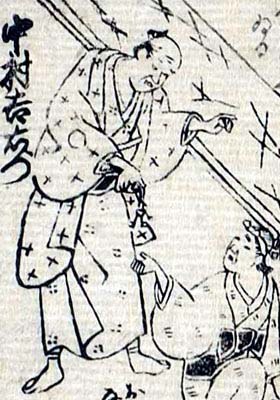 |
|
Nakamura Kichiemon I playing the role of the curio dealer Magoemon in the drama "Natsu Matsuri Naniwa Kagami", which was staged in the 5th lunar month of 1765 at the Naka no Shibai The Nakamura Jûzô line of actors The Nakamura Kichiemon line of actors |
|
|
| Contact | Main | Top | Updates | Actors | Plays | Playwrights | Programs | Links | FAQ | Glossary | Chronology | Illustrations | Prints | Characters | Derivatives | Theaters | Coming soon | News |