| ARASHI RAISHI I |
|
Stage names:
Other name:
Guild: Kyôya Line number: NIDAIME (II) Existence: 1732 ~ 2nd day of the 5th lunar month of 1803 [1] Connection: Father : Arashi Sangorô I Son: Arashi Raishi II (Arashi Sangorô III) Grandsons: Arashi Raishi III, Arashi Sangorô IV Disciples : Arashi Bungorô I, Arashi Fusajirô, Arashi Wakamatsu I, Arashi Yoichi I, Arashi Shigenoi, Arashi Isaburô, Arashi Kashichi, Ikushima Jûjirô, Arashi Bungorô II, Arashi Sennosuke, Arashi Kichizô, Arashi Gohachirô, Arashi Shirogorô, Arashi Sanjirô, Arashi Sodesuke Career: Before 1739: son of Arashi Sangorô I, his first stage name was Arashi Tomisaburô I. 12th day of the 7th lunar month of 1739 [2]: his father Arashi Sangorô I died. 11th lunar month of 1739: Arashi Tomisaburô I took the name of Arashi Sangorô II. 11th lunar month of 1748: Sangorô became zamoto and produced in Ôsaka at the Kado no Shibai the kaomise drama "Toyoashihara Taihei Keizu". 12th lunar month of 1748: the play "Kanadehon Chûshingura" was adapted for Kabuki for the first time, produced by Sangorô in Ôsaka at the Kado no Shibai; Sangorô played the role of Ôboshi Rikiya [casting]. 11th lunar month of 1750: Sangorô performed at the Naka no Shibai in the kaomise drama "Yasa Heike Sakiwake Musha", which was produced by Nakamura Jûzô I. 11th lunar month of 1754: Sangorô played at the Ônishi no Shibai the role of Yamatonosuke in the kaomise drama "Uda Genji Asahi no Menbako", which was produced by Wakayama Bunshichi. Fall 1756: Sangorô went to Kyôto. 11th lunar month of 1756: Sangorô played at the Kitagawa no Shibai the roles of Mikasa Yomosaku and Kamonnosuke in the kaomise drama "Ukematsuri Hôrai Yakata", which was produced by Somematsu Matsujirô for the nadai Hoteiya Umenojô. 3rd lunar month of 1757: Sangorô played in the same theater the roles the monk Kokuunbô [3] and Bun'yanosuke in the drama "Narukami Fudô Kitayama Zakura"; his stage partners were Ichikawa Danzô III (Narukami, Fudô, Kumedera Danjô), Nakamura Kumetarô I (Princess Taema), Yoshizawa Sakinosuke II (Kisakata Gozen) and Somematsu Shichisaburô I (Minbu). 1st lunar month of 1758: first Kabuki adaptation of the puppet theater drama "Gion Sairei Shinkôki", which was simultaneously produced at the Minamigawa no Shibai [casting] and the Kitagawa no Shibai [casting]. It used its real title at the former theater but it was entitled "Keisei Niwatoriyama" at the latter theater; Sangorô played in the former theater the roles of Kanônosuke Naonobu and Shinsaku. 11th lunar month of 1758: Sangorô became zamoto in Kyôto and produced Sakurato Bunsaku's kaomise drama "Inari Yakata Irifune no Arashi". 11th lunar month of 1759: the play "Yoshitsune Senbon Zakura" was staged for the first time in Kyôto, at the Minamigawa no Shibai. The play was produced by Sawamura Kunitarô I and Somematsu Matsujirô and the roles of Yoshitsune and Tadanobu were played by Sangorô. 1st lunar month of 1760: Sangorô plays 2 roles in the drama "Senjin Ukisu no Iwa", which was produced in the same theater by Sawamura Kunitarô I. 5th lunar month of 1760: Sangorô played in the same theater the role of Hiranoya Tokubê in the drama "Sonezaki Shinjû"; the role of the courtesan Ohatsu was played by Nakamura Kiyosaburô I. 9th lunar month of 1761: Sangorô achieved a great success in Kyôto at the Minamigawa no Shibai by playing the role of Sanada Yoichi in the drama "Sugomori Hiru-ga-Kojima", which was produced by Sawamura Kunitarô I. 11th lunar month of 1761: Sangorô went back to Ôsaka and performed at the Naka no Shibai in the kaomise drama "Miyo no Hana Yunzei Kagami", which was produced by Mimasu Daigorô I. 12th lunar month of 1761: premiere at the Naka no Shibai of Takeda Haruzô's ni-no-kawari drama "Akiba Gongen Kaisen Banashi". It was the first drama in Kabuki history using gandô-gaeshi on stage; Sangorô played the role of Tsukimoto Hajimenosuke [casting]. 4th lunar month of 1762: first Kabuki adaptation of the 5-act puppet theater drama "Gosho Zakura Horikawa no Youchi", which was staged at the Naka no Shibai; Sangorô played the roles of Yoshitsune and Ike-no-Hata Hariemon [casting]. 9th lunar month of 1762: Sangorô played in the same theater the roles of Kokingo, Yasuke and Yoshitsune in the drama "Yoshitsune Senbon Zakura". 12th lunar month of 1762: Sangorô achieved a great success in the same theater by playing the role of Ukiyonosuke in the ni-no-kawari drama "Ide no Tamagawa Shôhei Ori". 2nd lunar month of 1763: Sangorô played the role of Shirojirô in the drama "Keisei Hangonkô", which was produced by Mimasu Daigorô I at the Naka no Shibai; his stage partners were Mimasu Daigorô I (Matahei), Nakamura Tomijûrô I (Tôyama) and Iwata Somematsu I (Otoku). 9th lunar month of 1764: première in Ôsaka at the Naka no Shibai of "Hare Kosode Tsuzure no Nishiki", based on the puppet drama "Katakiuchi Tsuzure no Nishiki", which was produced by Mimasu Daigorô I. A similar play was staged one day before under a different title, "Oriawase Tsuzure no Nishiki", at the Kado no Shibai. The competition for the best performance and the best line-up was open between the 2 theaters. The performance at the Kado no Shibai was more successful than the one at the Naka no Shibai; Sangorô played at the Naka no Shibai the roles of the wakatô Ihê and Shundô Jihê [casting]. 5th lunar month of 1766: first Kabuki adaptation of the 5 acts puppet theater drama "Honchô Nijûshikô", which was staged in Ôsaka at the Naka no Shibai; Sangorô played the roles of Takeda Katsuyori and Minosaku [casting]. 11th lunar month of 1766: Sangorô performed at the Naka no Shibai in Namiki Jûsuke's kaomise drama "Yamato Uta Hikime no Yaguruma". Fall 1767: Sangorô went to Kyôto. 11th lunar month of 1767: Sangorô played at the Kitagawa no Shibai the role of Kanô Shirojirô in the kaomise drama "Daikokuten", which was produced by Onoe Montarô and Onoe Kumesuke and celebrated the shûmei of Bandô Yasuke and Bandô Sukesaburô II. 8th lunar month of 1768: Sangorô played at the Kitagawa no Shibai the roles of Kokingo, Yasuke, Tadanobu and the fox Genkurô in the drama "Yoshitsune Senbon Zakura". 3rd lunar month of 1770: Sangorô played the roles of Yogorô and Sukeichi in the drama "Ranjatai Nitta Keizu", which was produced in Kyôto by Onoe Kumesuke. Spring 1770: tour in Miyajima with Arashi Hinasuke I. 9th lunar month of 1770: premiere at the Kitagawa no Shibai of the drama "Keisei Awa no Naruto", a revision of Chikamatsu Hanji's 1768 puppet drama "Keisei Awa no Naruto"; Sangorô played the role of Fujiya Izaemon [more details]. Fall 1770: Sangorô went to Edo. 11th lunar month of 1770: Sangorô played at the Ichimuraza in the kaomise drama "Meoto Giku Izu no Kisewata", which celebrated the shûmei of Bandô Hikosaburô III, Bandô Sanpachi II and Segawa Kichiji III. 5th lunar month of 1774: the drama "Natsu Matsuri Naniwa Kagami" was staged for the first time at the Ichimuraza; Sangorô played the role of Issun Tokubê [casting]. 11th lunar month of 1774: Sangorô performed at the Ichimuraza in Horikoshi Saiyô's kaomise drama "Chigo Sakura Jûsangane", which celebrated the shûmei of Segawa Kikunojô III. 2nd lunar month of 1775: Sangorô played in the same theater the role of Soga Jûrô Sukenari in Horikoshi Saiyô's new year sogamono drama "Sakae Soga Kagura no Taiko"; the role of Soga Gorô Tokimune was played by Ichikawa Yaozô II. 11th lunar month of 1775: premiere at the Nakamuraza of Kanai Sanshô's Tomimoto-based dance-drama "Shijûhatte Koi no Showake", the first version of "Oshidori", which was staged within the kaomise drama "Hana Zumô Genji Biiki"; Sangorô played the roles of Kawazu Saburô Sukeyasu and the spirit of the male mandarin duck [more details]. 3rd lunar month of 1776: Sangorô's rank in the Edo hyôbanki, tachiyaku section, was jô-jô-kichi (superior - superior - excellent) [visual]. 3rd lunar month of 1776: first Kabuki adaptation of Matsu Kanshi's puppet theater drama "Koi Musume Mukashi Hachijô", which was staged at the Nakamuraza; Sangorô played the role of Obana Saizaburô [casting]. 5th lunar month of 1776: the play "Honchô Nijûshikô" was performed for the first time in Edo, at the Nakamuraza; Sangorô played the roles of Katsuyori and Minosaku [casting]. 9th lunar month of 1777: Sangorô celebrated his coming departure from Edo (onagori kyôgen) by playing at the Nakamuraza the role of Shirojirô in the dance "Hangonkô Nagori no Nishikie"; the role of the courtesan Tôyama was played by Nakamura Tomijûrô I. Fall 1777: Sangorô went back to Ôsaka after 3 and 7 seasons spent in Kyôto and Edo. 11th lunar month of 1777: Sangorô played at the Naka no Shibai in the kaomise drama "Daijizai Kaminari no Kodakara", which was produced by the zamoto Ichiyama Tajirô and celebrated the shûmei of Yamashita Kamenojô IV. 12th lunar month of 1777: Sangorô played in the same theater the role of Sue Yadorinosuke in the new year ni-no-kawari drama "Keisei Suô no Dairi". 1st lunar month of 1778: Sangorô's rank in the Ôsaka hyôbanki, tachiyaku section, was jô-jô-kichi (superior - superior - excellent) [visual]. 9th lunar month of 1778: Sangorô played in the same theater the role of Sakuramaru in the drama "Sugawara Denju Tenarai Kagami"; his stage partners were Nakamura Utaemon I (Matsuômaru), Arashi Kichisaburô I (Shiratayû, Genzô, Terukuni), Yamashita Kamenojô IV (Tatsuta, Haru), Sawamura Kunitarô I (Tonami, Kakuju, Yae), Arashi Shichisaburô II (Umeômaru), Bandô Iwagorô (Shihei, Shundô Genba), Mimasu Tokujirô I (Kan Shôjô, Chiyo) and Nakamura Jiroza II (Hyôei, Mareyo). Fall 1778: Sangorô went to Kyôto. 11th lunar month of 1778: Sangorô performed at the Kitagawa no Shibai in the kaomise drama "Ume no Nazorae Azuma Hyakkan", which was produced by Somematsu Shichisaburô II. 1st lunar month of 1778: Sangorô's rank in the Kyôto hyôbanki, tachiyaku section, was jô-jô-kichi (superior - superior - excellent) [visual]. Summer 1780: Sangorô played the role of the blindman Hyôsuke in the drama "Gokusaishiki Musume Ôgi", which was produced by Nakayama Ihachi I in Kyôto. 3rd lunar month of 1781: tour in Ise; Sangorô played the roles of Yasuke and Tadanobu ("Yoshitsune Senbon Zakura"), Tôkichi ("Gion Sairei Shinkôki") and Hyôsuke ("Gokusaishiki Musume Ôgi"). 6th lunar month of 1781: Sangorô went back to Kyôto and played at the Kitagawa no Shibai the roles of Yasuke, Tokaiya Ginpei, Taira no Tomomori and Tadanobu in the drama "Yoshitsune Senbon Zakura", which was produced by Yamashita Yaozô I; the roles of Osato, Shizuka Gozen and Suke-no-Tsubone were played by Sawamura Kunitarô I. 9th lunar month of 1781: Sangorô played in the same theater the role of Kajiwara Genta Kagesue in the drama "Hirakana Seisuiki". His stage partners were Onoe Kikugorô I (Enju, Shigetada), Shibazaki Rinzaemon II (Takatsuna, Gonshirô), Arashi Hinasuke I (Kajiwara Heiji Kagetaka, Matsuemon, Higuchi no Jirô Kanemitsu), Sawamura Kunitarô I (Chidori), Arashi San'emon VI (Ofude) and Anegawa Minato II (Oyoshi). Fall 1782: Sangorô went to Ôsaka. 11th lunar month of 1782: Sangorô played at the Naka no Shibai in the kaomise program. 1st lunar month of 1783: Sangorô's rank in the Ôsaka hyôbanki, tachiyaku section, was ô-jô-jô-kichi (grand - superior - superior - excellent). He played the roles of En'ya Hangan and Okaya in the drama "Kanadehon Chûshingura", which was produced by Arashi Tanin at the Naka no Shibai. 9th lunar month of 1783: the play "Igagoe Dôchû Sugoroku" was adapted for Kabuki for the first time, in Ôsaka at the Naka no Shibai; Sangorô played the roles of Sasaki Tan'emon, Honda Dainaiki and Ikezoe Magohachi [casting]. 12th lunar month of 1783: Sangorô played in the same theater the role of Kajiwara Genta Kagesue in the drama "Hirakana Seisuiki". The sudden death of the star Onoe Kikugorô I casted a pall over the performance. 1st lunar month of 1784: premiere at the Naka no Shibai of Namiki Gohê's drama "Keisei Yamato Zôshi"; Sangorô played the roles of Kitabatake Yukienosuke and Sukekuni [casting]. 4th lunar month of 1784: Sangorô played in the same theater the roles of Gyôji Shôkurô and Okô in the drama "Futatsu Chôchô Kuruwa Nikki". 5th lunar month of 1784: the play "Katsuragawa Renri no Shigarami", which was originally written in the 10th lunar month of 1776 by Suga Sensuke for the puppet theater, was adapted for Kabuki for the first time by Namiki Gohê, and staged in Ôsaka at the Naka no Shibai; Sangorô played the role of Imadegawa Raisaku [casting]. 5th lunar month of 1784: Sangorô and Sawamura Kunitarô I went together to Kyôto. Fall 1784: Sangorô and Sawamura Kunitarô I performed together in Kyôto the dance "Chô no Michiyuki", which was produced by Nakayama Raisuke II. Then, Sangorô went back to Ôsaka. 11th lunar month of 1784: Sangorô played at the Kado no Shibai the roles of Sakuramaru and Kakuju in the drama "Sugawara Denju Tenarai Kagami", which was produced by Onoe Ushinosuke I. 5th lunar month of 1785: the Kado no Shibai was destroyed by a fire the 23rd day of the 4th lunar month of 1785 [4]; Sangorô decided to go to Kyôto. 9th lunar month of 1785: Sangorô played at Hoteiya Umenojô's theater the roles of Hayano Kanpei and En'ya Hangan in the drama "Kanadehon Chûshingura", which commemorated the 2nd anniversary (3rd memorial service) of the passing away of late Onoe Kikugorô I. Summer 1786: tour in Miyajima. 2nd lunar month of 1788: premiere at the Ônishi no Shibai of the drama "Gishinden Yomikiri Kôshaku"; Sangorô played the roles of En'ya Hangan and Koharuya Yashichi (in reality Senzaki Yagorô) [more details]. It was supposed to be staged first in Kyôto at the beginning of the month at the Nishi no Shibai but the theater was destroyed by fire the 29th day of the 1st lunar month. The troupe went to Ôsaka to perform at the Ônishi no Shibai and to celebrate the shûmei of Kataoka Nizaemon VII. 1st lunar month of 1789: Sangorô's rank in the Kyôto hyôbanki, tachiyaku section, was goku-jô-jô-kichi (extreme - superior - superior - excellent). 12th lunar month of 1790: Sangorô played at the Naka no Shibai the role of Mashiba Hisayoshi in the drama "Kinmon Gosan no Kiri"; the role of the king of thieves Ishikawa Goemon was played by Arashi Hinasuke I. 1st lunar month of 1793: premiere at the Naka no Shibai of the ni-no-kawari drama "Keisei Yanagi Zakura", the first yanagisawa-sôdômono in Kabuki history, written by Tatsuoka Mansaku and Chikamatsu Tokusô; Sangorô played the roles of Ashikaga Yoshinori, Yodoya Tatsugorô and a shiokumi dancer looking like Minamoto no Tôru (there was a shiokumi dance at the end of the play) [more details]. 3rd lunar month of 1795: Chikamatsu Monzaemon's drama "Komochi Yamanba", which was originally written for the puppet theater, was adapted for Kabuki for the first time, in Ôsaka at the Kado no Shibai; Sangorô played the roles of Tabakoya Genshichi (in reality Sakata Kurando Tokiyuki) and Kaidômaru [casting]. 11th lunar month of 1796: common kaomise program for the Kitagawa no Shibai (Kyôto) and the Kado no Shibai (Ôsaka); Sangorô played the roles of Chôzaburô (in reality Abe no Yasuna) and the fox Sakon in the drama "Yama Katsura Asahi no Menbako", which was staged in Kyôto from the 5th day and in Ôsaka from the 18th day and celebrated the shûmei of Onoe Koisaburô I. 2nd lunar month of 1797: premiere at the Kado no Shibai of Chikamatsu Tokuzô's drama "Keiseikai Shinanjo" (commonly called "Ninin Yûgiri") [more details]; Sangorô played the role of the Fujiya Izaemon. 11th lunar month of 1797: great shûmei for the Kyôya guild; Arashi Sangorô II and his son Arashi Matsunosuke took the names of Arashi Raishi I (isse ichidai performance in ôshibai) and Arashi Sangorô III in Kyôto at the Minamigawa no Shibai, performing together in the kaomise drama "Nanboku Yuki no Miyako". 3rd lunar month of 1798: Raishi appeared on stage for the last time, in Ôsaka at the Tenma Tenjin Shrine, where he performed in the dramas "Hirakana Seisuiki" [5], "Uekiya" [6], "Yûgiri" [7], "Domo Mata" [8] and "Hanagoromo Iroha Engi" [9]. Spring 1798: Raishi definitively retired from the theater world and called himself Kyôya Shichihê. He shaved his head and became a monk called Mitsugen. He spent his latter years in Kyôto in the district of Okazaki. 2nd day of the 5th lunar month of 1803 [1]: Raishi died in Kyôto. Comments: Arashi Raishi I was an outstanding tachiyaku actor, who won a fame for himself in the three major cities (Kyôto, Ôsaka and Edo) during the second half of the eighteenth century. His fields of excellence were wagoto and budôgoto roles in jidaimono dramas. [1] The 2nd day of the 5th lunar month of the 3rd year of the Kyôwa era was the 20th of June 1803 in the western calendar. [2] The 12th day of the 7th lunar month of the 4th year of the Genbun era was the 16th of August 1739 in the western calendar. [3] Literally dark cloud bonze. [4] The 23rd day of the 4th lunar month of the 5th year of the Tenmei era was the 31st of May 1785 in the western calendar. [5] Raishi played the role of Kajiwara Genta Kagesue. [6] Raishi played the role of Yashichi. [7] Raishi played the role of Fujiya Izaemon; the role of Ôgiya Yûgiri was played by Sawamura Kunitarô I. [8] Raishi played the role of Matahei; the role of Otoku was played by Yamashita Kinsaku II. [9] Raishi played the role of Yamanaka Saemon. |

 |
|
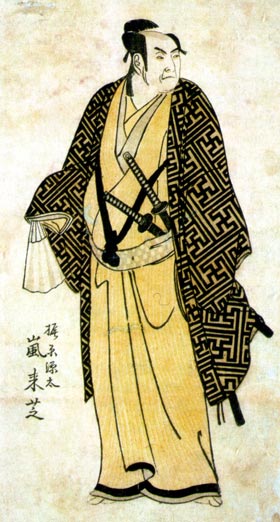
Arashi Raishi I playing the role of Kajiwara Genta Kagesue in the drama "Hirakana Seisuiki", which was staged in the 3rd lunar month of 1798 in Ôsaka at the Tenma Tenjin Shrine (print made by Ryûkôsai Jokei) The Arashi Tomisaburô line of actors The Arashi Sangorô line of actors The Arashi Raishi line of actors |
|
|
| Contact | Main | Top | Updates | Actors | Plays | Playwrights | Programs | Links | FAQ | Glossary | Chronology | Illustrations | Prints | Characters | Derivatives | Theaters | Coming soon | News |