| MATSUMOTO KÔSHIRÔ IV |
|
Stage names:
Guild: Kôraiya Line number: YODAIME (IV) Poetry name: Kinkô Existence: 1737 ~ 27th day of the 6th lunar month of 1802 [1] Connections: Masters: Matsumoto Kôshirô III, Ichikawa Danjûrô IV, Segawa Kikunojô I Son: Matsumoto Kôshirô V Grandsons: Matsumoto Kôshirô VI, Ichikawa Sumizô II Disciples: Ichikawa Ikuzô, Matsumoto Sanjûrô (?), Ichikawa Somegorô II, Ichikawa Somegorô III, Matsumoto Shichizô, Ichikawa Tatsujûrô Career: 1737: born in Kyôto. 1744: he settled with his family in Edo. He became disciple of the star Segawa Kikunojo I, who gave him the name of Segawa Kingo. 1st lunar month of 1745: Kingo made his first appearance on stage, in Edo at the Nakamuraza, where he performed in the new year drama "Hagoromo Kotobuki Soga". 2nd day of the 9th lunar month of 1749 [2]: his first master Segawa Kikunojô I died. 1751: Kingo went back to Kyôto. Fall 1754: Kingo went to Edo. 11th lunar month of 1754: Segawa Kingo took the name of Segawa Kinji at the Ichimuraza, performing in the kaomise drama "Keisei Asakusa no Kane". 1755 ~ 1756: he stopped acting and worked for the tea house Ineya, managed by his elder sister in Takanawa. 1756: he was back in the theater world, becoming a disciple of Ichikawa Danjûrô IV, who gave him the name of Ichikawa Takejûrô. 11th lunar month of 1762: he became disciple of the actor Matsumoto Kôshirô III, who gave him the name of Ichikawa Somegorô I; he performed at the Nakamuraza in the kaomise drama "Nagi no Ha Izu no Sugatami". 2nd lunar month of 1763: Somegorô played in the same theater the roles of Hôjô Gorô, Tamaya Shinbê and Soga Jûrô Sukenari in Kanai Sanshô's new year drama "Momo Chidori Ôiso Gayoi". 11th lunar month of 1763: Ichikawa Somegorô I took the name of Ichikawa Komazô II at the Nakamuraza, playing the role of Izumi no Saburô in the kaomise drama "Daijôbu Takadachi Jikki". 5th lunar month of 1764: Komazô played in the same theater the role of Sakuramaru in the drama "Sugawara Denju Tenarai Kagami"; the roles of Matsuômaru and Umeômaru were played by Ichikawa Danjûrô IV and Ichikawa Raizô I. 1st lunar month of 1766: Komazô played at the Nakamuraza the roles of Ômi no Kotota and Kawazu in the new year drama "Kaidô Ichi Izu no Harugoma". 5th lunar month of 1766: Komazô played in the same theater the role of Danzaburô in the drama "Yaoya Oshichi Koi no Edozome". 8th lunar month of 1766: Komazô played in the same theater the roles of Date no Yosaku and Keimasa in the drama "Koi Nyôbô Somewake Tazuna". 11th lunar month of 1766: Komazô played at the Nakamuraza the role of Utô Bunji, disguised as a tea seller, in the kaomise drama "Kogane no Hana Kaijin Aramusha"; his stage partners in the roles of the two rebels Abe no Sadatô and Abe no Munetô, Bunji's wife and Hachiman Tarô Yoshiie (Abe clan ennemy) were Kirishima Gizaemon I, Matsumoto Kôshirô III, Yoshizawa Sakinosuke III and Bandô Hikosaburô II. 1st lunar month of 1767: Komazô played in the same theater the roles of the tedai Matsuwakaya Shirobê, Mioya, Soga Jûrô and Yodoya Tatsugorô in the new year sogamono drama "Hatsu Akinai Ômise Soga". He also replaced Ichikawa Raizô I, who suddenly fell ill, in the role of Honmachi no Tsunagorô. 7th lunar month of 1767: Komazô played in the same theater the roles of Satô Shirobê Tadanobu and the fox Genkurô in the drama "Yoshitsune Senbon Zakura"; his stage partner in the role of Shizuka Gozen was Nakamura Matsue I. 11th lunar month of 1767: Komazô played at the Nakamuraza the roles of Nitta Yoshisada and Nagahama Shinzaemon in the kaomise drama "Taiheiki Shizu no Furisode". 1st lunar month of 1768: Komazô played in the same theater the roles of Shigetada, Soga Jûrô and Minoya Kichibê in the new year sogamono drama "Fude Hajime Soga no Tamazusa"; his stage partners in the roles of Soga Gorô and Kudô Saemon Suketsune were Ichikawa Yaozô II and Ichikawa Danjûrô IV. 4th lunar month of 1768: Komazô played in the same theater the role of Karigane Bunshichi in the otokodate drama "Otokodate Itsutsu Karigane"; his stage partners were Nakamura Sukegorô II (Kaminari Shôkurô), Matsumoto Kôshirô III (Gokuin Sen'emon), Arashi Otohachi I (Hotei Ichiemon) and Ichikawa Yaozô II (An no Heibê). He also played the roles of Ono no Tôfû, Sakuramaru and Monogusa Tarô in the dramas "Ono no Tôfû Aoyagi Suzuri", "Sugawara Denju Tenarai Kagami" and "Monogusa Tarô". 8th lunar month of 1768: premiere at the Nakamuraza of the drama "Tenjiku Tokubê Kokyô no Torikaji"; Komazô played the role of Hosokawa Katsumoto [more details]. 11th lunar month of 1768: Komazô played at the Nakamuraza the roles of the shamisen player Kichiroku and Suruga Hachirô in the kaomise drama "Ima o Sakari Suehiro Genji", which celebrated the arrival in Edo of the Kamigata star Nakamura Utaemon I and the shûmei of Osagawa Tsuneyo II. 1st lunar month of 1769: Komazô played in the same theater the role of Shigetada in the new year sogamono drama "Soga Moyô Aigo no Wakamatsu". 2nd lunar month of 1769: Komazô played in the same theater the role of Oniô Shinzaemon in the dance drama "Sugatami Asama-ga-Dake". 7th lunar month of 1769: Komazô played in the same theater the roles of Chihara Sakon, Shinoda Saemon and Sasaya Jûbê in the drama "Nenriki Yuzuriha no Kagami". 11th lunar month of 1769: Komazô played at the Nakamuraza the role of Sano Genzaemon Tsuneyo in the kaomise drama "Kawaranu Hana Sakae Hachinoki". 1st lunar month of 1770: Komazô played in the same theater the role of Soga Jûrô Sukenari in the new year sogamono drama "Kagamigaike Omokage Soga"; his stage partners in the roles of Soga Gorô Tokimune, Kudô Saemon Suketsune and the courtesan Ôiso no Tora (Jûrô's lover) were Ichikawa Yaozô II, Nakamura Nakazô I and Nakamura Matsue I. His son made his first appearance on stage, receiving the name of Ichikawa Sumizô I. 11th lunar month of 1770: great shûmei at the Nakamuraza. Ichikawa Danjûrô IV took back the name of Matsumoto Kôshirô II, Matsumoto Kôshirô III became Ichikawa Danjûrô V, Nakamura Shichisaburô II took the name of Nakamura Shôchô and Ichikawa Benzô I received the name of Ichikawa Monnosuke II. Komazô played the roles of Minamoto no Yorimasa [picture] and Hanamori Kisuke in the kaomise drama "Nue no Mori Ichiyô no Mato". 1st lunar month of 1771: Komazô played in the same theater the roles of Soga Jûrô Sukenari, Sukebê and Mionoya in the new year sogamono drama "Sakaichô Soga no Nendaiki"; his stage partners in the roles of Soga Gorô Tokimune, Kudô Saemon Suketsune and the courtesan Ôiso no Tora (Jûrô's lover) were Ichikawa Danjûrô V, Nakamura Nakazô I and Iwai Hanshirô IV. 3rd lunar month of 1771: Komazô played in the same theater the role of Hanbê in the Miyakoji-based dance-drama "Oborozuki Tsui no Someginu", which put in the same michiyuki the couples of lovers Tokubê/Ohatsu ("Sonezaki Shinjû"), Ochiyo/Hanbê ("Shinjû Yoi Gôshin") and Osome/Hisamatsu (osome-hisamatsumono); the role of Hanbê's lover Ochiyo was played by Yamashita Kinsaku II. 4th lunar month of 1771: Komazô played in the same theater the role of Ôboshi Yuranosuke in the drama "Kanadehon Chûshingura"; his stage partners in the role of En'ya Hangan, Kô no Moronô, Kakogawa Honzô and Okaru were Ichikawa Yaozô II, Ichikawa Danjûrô V, Nakamura Nakazô I and Nakamura Matsue I. 7th lunar month of 1771: Komazô played in the same theater the role of Hamanari in the drama "Tamura Maro Nanae Gasane". 11th lunar month of 1771: Komazô played at the Nakamuraza the role of Ariwara no Yukihira [picture] in the kaomise drama "Kuni no Hana Ono no Itsumoji"; his stage partners in the roles of Matsukaze and Murasame, two pearl-diving sisters in love with Yukihira, were Nakamura Nakazô I and Iwai Hanshirô IV. 1st lunar month of 1772: Komazô plays for the first time, in the same theater, the role of Kudô Saemon Suketsune in the new year sogamono drama "Haru Soga Akebono no Zôshi"; his stage partners in the roles of Soga Gorô Tokimune and Soga Jûrô Sukenari were Ichikawa Monnosuke II and Ichikawa Yaozô II. 2nd lunar month of 1772: the Nakamuraza was completely burned in a big fire. There was no performance up to the 8th lunar month. 8th lunar month of 1772: the new Nakamuraza reopened. Komazô played the roles of Nan Yohê (later Nanpô Jûjibê) and the sumô wrestler Hanaregoma Chôkichi in the drama "Futatsu Chôchô Kuruwa Nikki"; his stage partners were Ichikawa Yaozô II (Chôkichi's rival, the sumô wrestler Nuregami Chôgorô), Yoshizawa Ayame III (Chôkichi's sister Oseki) and Iwai Hanshirô IV (Yohei's spouse Ohaya) 11th lunar month of 1772: great shûmei at the Nakamuraza; Matsumoto Kôshirô II, Ichikawa Komazô II and Matsumoto Sumizô I respectively took the names of Ichikawa Ebizô III, Matsumoto Kôshirô IV and Ichikawa Komazô III; Kôshirô played the roles of Yoshigorohachi and Sagami Jirô in the kaomise drama "Ôyoroi Ebidô Shinozuka". 1st lunar month of 1773: Kôshirô played in the same theater the roles of Soga Jûrô Sukenari, the priest Seigen and Kyô no Jirô in the new year sogamono drama "Wada Sakamori Eiga Kagami"; his stage partners in the roles of Soga Gorô Tokimune, Kudô Saemon Suketsune and the courtesan Ôiso no Tora (Jûrô's lover) were Ichikawa Yaozô II, Nakamura Denkurô II and Sanogawa Ichimatsu II. 5th lunar month of 1773: Kôshirô played in the same theater the role of Katsukawa Harumoto in the drama "Dainippon Ise no Kamikaze". 7th lunar month of 1773: Kôshirô played in the same theater the role of Asama Saemon in the drama "Keisei Kataokayama". 9th lunar month of 1773: Kôshirô played in the same theater the role of Matsuômaru in the drama "Sugawara Denju Tenarai Kagami"; his stage partners were Nakamura Shôchô (Kan Shôjô), Ichikawa Monnosuke II (Sakuramaru), Bandô Matatarô IV (Umeômaru), Ôtani Tomoemon I (Matsuômaru's father Shiratayû), Nakajima Mihoemon II (Matsuômaru's master Fujiwara no Shihei) and Yoshizawa Sakinosuke III (Matsuômaru's wife Chiyo). 11th lunar month of 1773: premiere at the Nakamuraza of the play "Gohiiki Kanjinchô", performed as a kaomise drama; Kôshirô played the roles of Minamoto Yoshitsune and Izumi no Saburô [casting]. This 46-days long performance, which also celebrated the shûmei of Nakamura Rikô I, was a tremendous success. 1st lunar month of 1774: Kôshirô played in the same theater the roles of Soga Jûrô Sukenari and Shigetada in the new year sogamono drama "Oatsuraezome Soga Hinagata"; his stage partners in the roles of Soga Gorô Tokimune, Kudô Saemon Suketsune and the courtesan Ôiso no Tora (Jûrô's lover) were Ichikawa Monnosuke II, Ichikawa Danjûrô V and Nakamura Rikô I. A "meeting in the darkness" scene, which was performed by Nakamura Nakazô I, Ôtani Hiroji III, Nakamura Rikô I and Kôshirô, was particularly well received by the audience. 3rd lunar month of 1774: Kôshirô and Iwai Hanshirô IV performed together the roles of Onatsu and Seijûrô in the same theater in the michiyuki "Nushiyatare Koi no Yamabuki". 5th lunar month of 1774: several actors, including Ichikawa Ebizô III, Ichikawa Danjûrô V, Iwai Hanshirô IV and Kôshirô left the Nakamuraza. 11th lunar month of 1774: Kôshirô moved to the Moritaza and played the roles of Matsuura Saemon and Satô Tadanobu in the kaomise drama "Ichi no Tomi Tsuki no Kaomise", which welcomed in Edo the Kamigata actor Nakamura Shingorô II; Kôshirô's stage partners in the roles of Shizuka Gozen and Minamoto Yoshitsune were Iwai Hanshirô IV and Bandô Mitsugorô I. It was reported that Kôshirô, portraying Matsuura Saemon, made his stage appearance from a trapdoor riding a horse. 1st lunar month of 1775: Kôshirô played in the same theater the roles of Chihara Sakon, Kashima Saburô, Umegaya Yoshibê and Kyô no Jirô in the new year sogamono drama "Shida Yuzuriha Hôrai Soga". 5th lunar month of 1775: Kôshirô played in the same theater the roles of Matsuômaru and Kakuju in the drama "Sugawara Denju Tenarai Kagami"; his stage partners were Ichikawa Danjûrô V (Matsuômaru's master Fujiwara no Shihei, Kan Shôjô), Iwai Hanshirô IV (Sakuramaru), Bandô Mitsugorô I (Umeômaru, Genzô), Sawamura Chôjûrô IV (Matsuômaru's father Shiratayû), Azuma Tôzô II (Tatsuta-no-Mae), Nakamura Noshio I (Matsuômaru's wife Chiyo) and Sakata Kônosuke (Princess Kariya). 8th lunar month of 1775: Kôshirô played in the same theater the roles of Yamana Saemon and Nagoya Sanzaburô in the drama "Keisei Tsuki no Miyako". 11th lunar month of 1775: Kôshirô moved to the Ichimuraza and performed in the kaomise drama "Oyafune Taiheiki"; his stage partners were Ichikawa Ebizô III, Iwai Hanshirô IV, Ichikawa Yaozô II and Nakamura Noshio I. This kaomise was a huge success, starting the 1st day of the 11th lunar month and ending the 15th day of the 12th lunar month. 1st lunar month of 1776: Kôshirô's rank in the Edo hyôbanki, tachiyaku section, was jô-jô-kichi (superior - superior - excellent) [visual]. He played in the same theater the roles of Chichibu no Shôji Shigetada and Soga Jûrô Sukenari in the new year sogamono drama "Kamuri Kotoba Soga no Yukari"; the roles of Soga Gorô Tokimune and Kudô Saemon Suketsune were played by Ichikawa Yaozô II and Ichikawa Ebizô III. 3rd lunar month of 1776: Kôshirô's rank in the Edo hyôbanki, tachiyaku section, was jô-jô-kichi (superior - superior - excellent). He played in the same theater the role of the shirozake seller Shinbê in the drama "Sukeroku Yukari no Hatsuzakura"; the roles of Sukeroku, Agemaki and the villain Ikyû were played by Ichikawa Yaozô II, Iwai Hanshirô IV and Sakata Hangorô II. The performance was a huge success and a long run. 11th lunar month of 1776: Kôshirô moved to the Moritaza and played the roles of Hakata Rozaemon, Masashige and Tamaya Shinbê in the kaomise drama "Hikitsurete Yagoe Taiheiki". 1st lunar month of 1777: Kôshirô was in the Edo hyôbanki the kanjiku for tachiyaku actors. Summer 1777: the book "Yakusha Sensakuron" ('About actors prying') was published in Edo. It gave some private information on actors. Edo readers could learn that Kôshirô lived in the district of Sakai-chô and his annual salary was 800 ryô. 11th lunar month of 1777: Kôshirô moved to the Nakamuraza and performed in the kaomise drama "Masakado Kanmuri no Hatsuyuki"; his stage partners were Ichikawa Danjûrô V, Yoshizawa Sakinosuke III and Bandô Mitsugorô I. 2nd lunar month of 1778: Kôshirô played in the same theater the roles of Chichibu no Shôji Shigetada, Takemura Sadanoshin and Oniô Shinzaemon in the new year sogamono drama "Kaidô Iro Yawaragi Soga". 25th day of the 2nd lunar month of 1778 [3]: his second master Ichikawa Ebizô III (Ichikawa Danjûrô IV) died. 7th lunar month of 1778: premiere at the Nakamuraza of the drama "Date Kurabe Okuni Kabuki"; Kôshirô played the roles of Hanyûmura Yoemon, Kizu no Kansuke, Nagoya Sanza, the sumô wrestler Kinugawa Tanizô and Watanabe Minbunosuke [casting]. 8th lunar month of 1778: the 'Kôshirô Impeachment affair' shook the Kabuki world. The growing influence of Ichikawa Danjûrô V in the patrons organizations or the shibai jaya circles created some enmities and a group of people plotted in the shadows to get him accused of misappropriation of funds. Ichikawa Danjûrô V was ordered to leave the stage for a while, give his name to Kôshirô and take the name of Ichikawa Ebizô. The widow of late Ichikawa Yaozô II, who was also the lover of Ichikawa Danjûrô V, led him to think that both Iwai Hanshirô IV and Kôshirô were responsible for this dirty and complicated plot. Ichikawa Danjûrô V let his anger explode twice on stage in front of the audience: the 27th of the 8th lunar month, he accuses Kôshirô and the 28th it was the turn of Iwai Hanshirô IV. As a consequence, Ichikawa Danjûrô V decided to leave the Nakamuraza. 11th lunar month of 1778: Kôshirô became zagashira at the Nakamuraza and played the roles of Sano Genzaemon Tsuneyo and Aoto Magosaburô Fujitsuna in the kaomise drama "Motomishi Yuki Sakae Hachinoki", which celebrated the shûmei of Yoshizawa Ayame IV and the first stage appearance of Bandô Mitahachi I. 1st lunar month of 1779: Kôshirô played in the same theater the roles of Kudô Saemon Suketsune and Gunsuke in the new year sogamono drama "Gohiiki Nennen Soga". 3rd lunar month of 1779: Kôshirô played in the same theater the role of the shirozake seller Shinbê in the drama "Sukeroku Sato no Yozakura"; the roles of Sukeroku, Agemaki and the villain Ikyû were played by Ichikawa Monnosuke II, Iwai Hanshirô IV and Ôtani Hiroemon III. 5th lunar month of 1779: Kôshirô played in the same theater the roles of Kan Shôjô and Matsuômaru in the drama "Sugawara Denju Tenarai Kagami"; the roles of Umeômaru and Sakuramaru were played by Bandô Mitsugorô I and Ichikawa Monnosuke II. 11th lunar month of 1779: as a consequence of his troubles with Ichikawa Danjûrô V, Kôshirô moved to the Ichimuraza and played the role of Kanesuki in the kaomise drama "Azuma no Mori Sakae Kusunoki", which celebrated the shûmei of Azuma Tôzô III and Segawa Otome. 1st lunar month of 1780: Kôshirô played in the same theater the roles of Kyô no Jirô, Yawata no Saburô and Kaminari Tsurunosuke in the new year sogamono drama "Ume Goyomi Akebono Soga". 5th ~ 6th lunar months of 1780: big troubles at the Ichimuraza! Onoe Kikugorô I left the theater after a terrible quarrel with Kôshirô and there were some serious management troubles (the theater could not pay the actors). 11th lunar month of 1780: Kôshirô performed at the Ichimuraza in the kaomise drama "Mure Takamatsu Yuki no Shirahata". 3rd lunar month of 1781: Kôshirô played in the same theater the role of Obiya Chôemon in the Tomimoto-based dance "Michiyuki Segawa no Adanami"; the role of Chôemon's lover Ohan was played by Segawa Kikunojô III. 9th lunar month of 1781: Kôshirô played in the same theater the role of Magoemon in the drama "Keisei Koi Bikyaku". 11th lunar month of 1781: Kôshirô performed at the Ichimuraza in the kaomise drama "Mukashi Otoko Yuki no Hinagata", which celebrated the shûmei of Matsumoto Sanjûrô and Ichiyama Sukejûrô. The management of the theater had to struggle hard to find the money to pay the actors. Kôshirô's stage partners were Iwai Hanshirô IV, Yoshizawa Ayame IV, Nakamura Sukegorô II, Ichimura Uzaemon IX, Nakayama Tomisaburô I, Sakata Hangorô II, Sawamura Chôjûrô IV and Onoe Monzaburô I. 1st lunar month of 1782: Kôshirô played in the same theater the role of Matsuômaru in the drama "Sugawara Denju Tenarai Kagami"; the roles of Umeômaru and Sakuramaru were played by Onoe Monzaburô I and Ichiyama Sukejûrô. 2nd lunar month of 1782: Kôshirô played in the same theater the roles of the sumô wrestler Kinugawa Tanizô and the yakko Gunsuke in the drama "Sumidagawa Yanagi no Dateginu". 5th lunar month of 1782: Kôshirô played in the same theater the role of the shirozake seller Shinbê in the drama "Sukeroku Yukari no Edo Zakura"; his stage partners were Ichimura Uzaemon IX (Sukeroku), Iwai Hanshirô IV (Agemaki) and Sakata Hangorô II (Ikyû). 6th lunar month of 1782: casting change in "Sukeroku Yukari no Edo Zakura"; Kôshirô replaced Ichimura Uzaemon IX in the prestigious role of Sukeroku [illustration] and his son Ichikawa Komazô III played the role of Shinbê. 9th lunar month of 1782: Kôshirô played in the same theater the roles of the tôfu maker Goroemon and the king of thieves Ishikawa Goemon in the drama "Hama no Masago Otogi Zôshi". 11th lunar month of 1782: Kôshirô performed at the Ichimuraza in the kaomise drama "Ise Heiji Eika Goyomi". 6th lunar month of 1783: Kôshirô played in the same theater the roles of Ôboshi Yuranosuke and Hayano Kanpei in the drama "Kanadehon Chûshingura". 11th lunar month of 1783: Kôshirô moved to the Moritaza and performed in the kaomise drama "Ono no Terusaki Yuki no Akebono". 1st lunar month of 1784: Kôshirô played in the same theater the role of Fujiya Izaemon in the drama "Haru no Yo Shôji no Ume"; the role of Izaemon's lover Yûgiri was played by the Kamigata actor Mimasu Tokujirô I. 2nd lunar month of 1784: Kôshirô played in the same theater the roles of Kudô Saemon Suketsune, the warrior Taira no Kagekiyo and Oniô Shinzaemon in the new year sogamono drama "Haru Goyomi Nigiwai Soga". 3rd lunar month of 1784: Kôshirô played in the same theater the role of Kameya Chûbê in the drama "Keisei Koi Bikyaku"; the role of Chûbê's lover Umegawa was played by Mimasu Tokujirô I. He also played the role of Mohei in Chikamatsu Monzaemon's drama "Daikyôji Mukashi Goyomi"; the role of Mohei's lover Osan was played by Mimasu Tokujirô I. 4th lunar month of 1784: Kôshirô played in the same theater the role of the yakko Gunsuke in the drama "Sumidagawa no Meishoki". 7th lunar month of 1784: Kôshirô played in the same theater the roles of Sagisaka Sanai and the yakko Ippei in the drama "Koi Nyôbô Somewake Tazuna". 9th lunar month of 1784: Kôshirô celebrated his coming departure from Edo by playing in the same theater the role of Obiya Chôemon in the drama "Tagasode Futatsu Nishikie"; the role of Chôemon's lover Ohan was played by Mimasu Tokujirô I. Fall 1784: Kôshirô and Iwai Hanshirô IV went together to Ôsaka. 11th lunar month of 1784: Kôshirô performed at the Naka no Shibai in the kaomise drama "Naka ni Môketa Otogo Kaomise", which was produced by Nakamura Kumetarô II. Kôshirô was not very well welcomed by the Ôsaka audience and Onoe Kikugorô I's son Onoe Ushinosuke I, who worked at the Kado no Shibai as a zamoto, made a scornful speech on stage against Kôshirô, the 'frightening uncle from Edo in the little hut next door'. 1st lunar month of 1785: Kôshirô's rank in the Ôsaka hyôbanki, tachiyaku section, was jô-jô-kichi (superior - superior - excellent) [visual]. 4th lunar month of 1785: Kôshirô played in the same theater the roles of Sasaki Rokkaku, Ukiyo Watahei and Watari Kanpei in the drama "Zen'aku Onna no Tsutsushimigusa". He also played the role of Kameya Chûbê in the drama "Kurikaeshi Koi Bikyaku"; the role of Chûbê's lover Umegawa was played by Iwai Hanshirô IV. 5th lunar month of 1785: Kôshirô played in the same theater the role of Sasaki Moritsuna in the drama "Na ni Ôsaka Kôraiya Bashi". He also played the role of Kameya Chûbê in the michiyuki "Meido no Wakarezato"; the role of Chûbê's lover Umegawa was played by Iwai Hanshirô IV. Summer ~ Fall 1785: Kôshirô played at the Kita-Horie Ichi-no-Gawa Shibai (Ôsaka) the role of Obiya Chôemon in the drama "Katsuragawa Renri no Shigarami". He also played the roles of Genta and Shigetada in the drama "Hirakana Seisuiki". Winter 1785: Kôshirô performed in Kyôto; he was not welcomed by the audience. 1st lunar month of 1786: Kôshirô's rank in the Kyôto hyôbanki, tachiyaku section, was jô-jô-kichi (superior - superior - excellent) [visual]. 1st lunar month of 1786: Kôshirô played at the Kita-Horie Ichi-no-Gawa Shibai (Ôsaka) the role of Nagai Uma-no-Kami Nobuaki in the drama "Ôtô-no-Miya Asahi no Yoroi". 2nd lunar month of 1786: Kôshirô played in the same theater the role of Tsukimoto Enshû in the drama "Akiba Gongen Kaisen Banashi". He also played the role of Fujiya Izaemon in the drama "Yukari no Tsuki"; the role of the courtesan Yûgiri (Izaemon's lover) was played by Sawamura Kunitarô I. Spring 1786: Kôshirô went back to Edo. 5th lunar month of 1786: Kôshirô joined the Kiriza and became reconciled with Ichikawa Danjûrô V, ending a nine years long quarrel. 8th lunar month of 1786: Kôshirô played in the same theater the role of Nagoya Sanza in the drama "Muromachi Onna Bunshô"; his stage partners in the roles of Fuwa Banzaemon and the courtesan Katsuragi were Ichikawa Danjûrô V and Segawa Kikunojô III. 9th lunar month of 1786: Kôshirô played in the same theater the role of the tedai Yodoya Shinshichi in "Kôrai Giku Ukina no Irozashi", the second part (nibanme) of "Muromachi Onna Bunshô". 11th lunar month of 1787: Kôshirô performed at the Nakamuraza in the kaomise drama "Yukimizuki Eiga Hana no Hachinoki", which celebrated the shûmei of Ôtani Oniji III. 2nd lunar month of 1788: Kôshirô played in the same theater the role of Banzui Chôbê in the drama "Keisei Azuma Kagami". 9th lunar month of 1788: Kôshirô played in the same theater the role of Danshichi in the drama "Tsuki no Tomo Yoi no Miya Gohyakuzaki", whose plot and character belonged to the "Natsu Matsuri Naniwa Kagami" world; his stage partners were Sawamura Sôjûrô III (Tokubê) and Ôtani Hiroji III (Sabu). 11th lunar month of 1788: Kôshirô played at the Nakamuraza the roles of Sen no Rikyû and Mashiba Hisayoshi in Sakurada Jisuke I's kaomise drama "Tôzumô Hana no Edokata", which celebrated the return in Edo of the actor Nakamura Nakazô I. Premiere at the Nakamuraza of the Tokiwazu-based dance-drama "Modori Kago Iro ni Aikata" (commonly called "Modori Kago"); Kôshirô played the role of Azuma no Yoshirô (in reality Mashiba Hisayoshi) [casting]. 1st lunar month of 1789: Kôshirô's rank in the Edo hyôbanki, tachiyaku section, was ô-jô-jô-kichi (grand - superior - superior - excellent) [Visual]. He played in the same theater the role of Soga Jûrô Sukenari in the new year sogamono drama "Edo Fuji Wakayagi Soga"; his stage partners were Nakamura Nakazô I (Kudô Saemon Suketsune), Ichikawa Monnosuke II (Soga Gorô Tokimune) and Ôtani Hiroji III (Asaina). He also played in duo with Osagawa Tsuneyo II in the dance "Ukina no Irochimaki". From the 11th day, Kôshirô played the role of An no Heibê [illustration] in the drama "Otokodate Itsutsu Karigane", sharing the stage with Nakamura Nakazô I (Kaminari Shôkurô), Ichikawa Monnosuke II (Gokuin Sen'emon), Ôtani Hiroji III (Hotei Ichiemon) and Ichikawa Komazô III (Karigane Bunshichi). The performance was successful but the audience dropped when Nakamura Nakazô I fell ill and had to be replaced. 6th lunar month of 1789: Kôshirô played in the same theater the role of Ono no Tôfû in the drama "Ono no Tôfû Aoyagi Suzuri". 7th lunar month of 1789: Kôshirô played in the same theater the roles of Awa Minbu, Akaneya Jirozô and Tanzaemon in the drama "Heike Hyôbanki", which celebrated the 77th, 13th, 37th, 37th, 60th and 7th memorial services of late Nakamura Denkurô I, Nakamura Denkurô II, Kineya Kisaburô VI, Nakayama Kojurô V, Nakamura Denjirô I and Nakamura Denjirô III. 11th lunar month of 1789: Kôshirô performed at the Nakamuraza in the kaomise drama "Komachi-mura Shibai no Shôgatsu". 1st lunar month of 1790: Kôshirô performed in the same theater in the new year sogamono drama "Haru no Nishiki Datezome Soga". 3rd lunar month of 1790: Kôshirô played in the same theater the role of Obiya Chôemon in the drama "Ohan Chôemon"; the role of Ohan was played by Segawa Kikunojô III. 7th lunar month of 1790: Kôshirô played in the same theater the roles of Yoemon and Amakawaya Gihei in the drama "Chûkô Ryôgoku Ori". 2nd lunar month of 1791: Kôshirô, Ichikawa Komazô III, Matsumoto Yonesaburô I and Matsumoto Kojirô II joined the Kawarasakiza; Kôshirô played the roles of Ume no Yoshibê and Kudô Saemon Suketsune in the new year sogamono drama "Hatsu Midori Saiwai Soga". 5th lunar month of 1791: Kôshirô played in the same theater the roles of Tsuribune Sabu, Nan Yohê and Hosokawa Katsumoto in Sakurada Jisuke I's drama "Onna Date Kôraiya Shima", which mixed the "Natsu Matsuri Naniwa Kagami" and "Futatsu Chôchô Kuruwa Nikki" worlds. 11th lunar month of 1791: Kôshirô moved to the Nakamuraza and played the roles of Hirai no Yasumasa and Banzui Chôbê in the kaomise drama "Nidai Genji Oshi no Gôkyû". 1st lunar month of 1792: Kôshirô played in the same theater the roles of Dozaemon Denkichi, a Dôjôji temple priest, the sumô wrestler Matsukaze Sehei and Awazu Rokurô Saemon in the new year drama "Sumidagawa Shibai no Ennichi". 1st lunar month of 1793: Kôshirô's rank in the Edo hyôbanki, sôkanjiku section ("all kanjiku"), was goku-jô-jô-kichi (extreme - superior - superior - excellent) [Visual]. 2nd lunar month of 1793: Kôshirô played at the Ichimuraza the role of Hazuna no Gengorô in the new year sogamono drama "Mitsugi Soga Fuji no Kisewata". 3rd lunar month of 1793: Kôshirô played in the same theater the role of Asagao Senpei in the drama "Sukeroku". 5th lunar month of 1793: Kôshirô played in the same theater the roles of Ôboshi Yuranosuke and Amakawaya Gihei in the drama "Kanadehon Chûshingura". Fall 1793: the Ichimuraza went out of business and gave its license to the Kiriza. 11th lunar month of 1793: Kôshirô played at the Kiriza the roles of the tôfu maker Saburobê, Watanabe Minbu and Hosokawa Katsumoto in the kaomise drama "Matsu no Tayû Yuki no Datezome", whose plot and characters belonged to the "Meiboku Sendai Hagi" world. 5th lunar month of 1794: premiere at the Kiriza of Sakurada Jisuke I's drama "Katakiuchi Noriai Banashi"; Kôshirô played the roles of Sasaki Moritsuna, San'ya no Sakanaya Gorobê (the sakanaya Gorobê) and Tsukimoto Mushanosuke [more details]. 11th lunar month of 1794: Kôshirô moved to the Kawarasakiza and played the roles of Bingo no Saburô, Hata Rokurôzaemon, Nagasaki Kageyu Saemon and Kusunoki Hangan in the kaomise drama "Matsu no Misao Onna Kusunoki". 1st lunar month of 1795: Kôshirô played in the same theater the roles of Kudô Saemon Suketsune and Banzui Chôbê in the new year sogamono drama "Shimekazari Kichirei Soga". 5th lunar month of 1795: Kôshirô played in the same theater the roles of Kakogawa Honzô [illustration] and Horibe Yajibê in the drama "Kanadehon Chûshingura", which commemorated the 12th anniversary (13th memorial service) of the passing away of late Onoe Kikugorô I. 9th lunar month of 1795: Kôshirô played in the same theater the roles of Daihanji no Kiyosumi and Kamatari in the drama "Imoseyama Onna Teikin". 11th lunar month of 1795: Kôshirô played at the Kawarasakiza the role of Tawara no Tôta in the kaomise drama "Fuku Botan Azuma Dairi". The actor Ichikawa Ebizô shared the top of the bill with Kôshirô. 1st lunar month of 1796: Kôshirô's rank in the Edo hyôbanki, tachiyaku section, was shin-jô-jô-kichi (truly - superior - superior - excellent) [Visual]. 3rd lunar month of 1796: Kôshirô played in the same theater the role of Yuranosuke in the drama "Taiheiki Chûshin Kôshaku". 8th lunar month of 1796: Kôshirô played in the same theater the roles of Tsukimoto, the boatman Yojirô, Rikyû and Konoshita Tôkichi in the drama "Keisei Suikoden". 11th lunar month of 1796: Kôshirô played at the Kawarasakiza the roles of Ishikiri no Gorota and Komatsu no Shigemori in the kaomise drama "Itsukushima Yuki no Kaomise". 1st lunar month of 1797: Kôshirô's rank in the Edo hyôbanki, sôkanjiku section ("all kanjiku"), was goku-jô-jô-kichi (extreme - superior - superior - excellent) [Visual]. He played in the same theater the roles of Oniô Shinzaemon, Kamaya Takehei and Kudô Saemon Suketsune in the new year sogamono drama "Fuji Miru Sato Yawaragi Soga"; the roles of Soga Gorô Tokimune and Soga Jûrô Sukenari were played by Ichikawa Komazô III and Bandô Minosuke I. 3rd lunar month of 1797: Kôshirô played in the same theater the role of the shirozake seller Shinbê in the drama "Sukeroku Kuruwa no Sakurabito"; his stage partners were Ichikawa Komazô III (Sukeroku), Nakayama Tomisaburô I (Agemaki) and Onoe Matsusuke I (Ikyû). 5th lunar month of 1797: Kôshirô played in the same theater the role of Nan Yohê (later Nanpô Jûjibê) in the drama "Sekitori Shôbu no Katabira", which was similar to "Futatsu Chôchô Kuruwa Nikki". 9th lunar month of 1797: Kôshirô played in the same theater the role of Hosokawa Katsumoto in the drama "Mitsugimono Shiga no Irifune". 11th lunar month of 1797: Kôshirô moved to the Nakamuraza and played the roles of Yahê and Miura Heitayû Kunitae in the kaomise drama "Kaikei Kokyô no Nishikigi", sharing the stage with Ichikawa Danjûrô VI, Iwai Hanshirô IV, Ichikawa Komazô III, Onoe Matsusuke I, Nakayama Tomisaburô I, Bandô Hikosaburô III, Nakamura Noshio II, Bandô Minosuke I, Iwai Kumesaburô I and Ichikawa Ebizô V. This kaomise program, which celebrated the reopening of the Nakamuraza and the shûmei of Arashi Shichigorô III and Hanai Saizaburô IV, was a huge success. 3rd lunar month of 1798: Kôshirô played in the same theater the roles of Yawata no Saburô and Chichibu no Shôji Shigetada in the new year sogamono drama "Wakakoma Norizome Soga". 5th lunar month of 1798: Kôshirô played in the same theater the roles of Hachizô and Date no Yosaku in the drama "Katakiuchi Somewake Tazuna". 8th lunar month of 1798: Kôshirô played in the same theater the roles of Yonetsuki Hachirobê, Oyamada Tamon and Ukishima Danjô Saemon in the drama "Irifune Shinoda no Dekiaki". 9th lunar month of 1798: Kôshirô played in the same theater the roles of Yuranosuke and Shinoda Shôji in the dramas "Taiheiki Chûshin Kôshaku" and "Ashiya Dôman Ôuchi Kagami". 11th lunar month of 1798: Kôshirô did not take part in the Nakamuraza kaomise program. 3rd lunar month of 1799: Kôshirô played at the Nakamuraza the role of Ito Kurô Sukekiyo in the drama "Sukeroku Kuruwa no Hanami Doki", which commemorated the 22nd anniversary (23rd memorial service) of late Ichikawa Ebizô III; the roles of Sukeroku, Agemaki and Ikyû were played by Ichikawa Danjûrô VI, Iwai Kumesaburô I and Ichikawa Komazô III. 4th lunar month of 1799: Kôshirô played in the same theater the roles of Ishidô Umanojô, Amakawaya Gihei and En'ya Hangan in the drama "Kanadehon Chûshingura"; the roles of Kô no Moronô and Yuranosuke were played by Ichikawa Komazô III. Ichikawa Danjûrô VI, who played the roles of Teraoka Heiemon, Ôwashi Bungo and Momonoi Wakasanosuke, falls ill the 18th April and dies the 13th day of the 5th lunar month. The management of the Nakamuraza decided to stop the performances up to the 11th lunar month kaomise program. 11th lunar month of 1799: Kôshirô performed at the Nakamuraza in the kaomise drama "Tametomo Yumiya no Oyafune", which celebrated the shûmei of Bandô Mitsugorô III. 1st lunar month of 1800: Kôshirô played in the same theater the roles of Kyô no Jirô and Chichibu no Shôji Shigetada in the new year sogamono drama "Fuji o Mimasu Saiwai Soga". This production was the last stage appearance of Iwai Hanshirô IV, a long time stage partner of Kôshirô. 5th lunar month of 1800: Kôshirô played in the same theater the role of Kajiwara Heizô Kagetoki in the drama "Yoshitsune Senbon Zakura". 11th lunar month of 1800: Kôshirô did not take part in any kaomise program. 11th lunar month of 1801: great shûmei at the Ichimuraza for the Kôraiya guild; Matsumoto Kôshirô IV, his son Ichikawa Komazô III and Ichikawa Santarô respectively took the names of Omegawa Kyôjûrô, Matsumoto Kôshirô V and Ichikawa Komazô IV. They performed together in the kaomise drama "Otoko Narikeri Onna Masakado". 5th lunar month of 1802: Kyôjûrô appeared on stage for the last time, at the Ichimuraza, playing the role of Tadayoshi in the drama "Taiheiki Chûshin Kôshaku". 27th day of the 6th lunar month of 1802 [1]: Kyôjûrô died in Edo. Comments: Matsumoto Kôshirô IV was one of the best tachiyaku actors of the second half of the eighteenth century, excelling as wagotoshi or jitsugotoshi. He was also a great jitsuaku (in the latter years of his life) and outstanding in sumô wrestlers or otokodate roles. He made a great career but was in trouble many times, especially after the terrible quarrels with Ichikawa Danjûrô V or Onoe Kikugorô I. "The fourth Danjûrô took him under his patronage. He was not on friendly terms with the fifth Danjûrô, which caused a good deal of Edo gossip. The Ichimuraza could scarcely maintain itself, and the salaries of the actors were not paid. Kôshirô went to Ôsaka by ship, taking with him the Edo onnagata, Iwai Hanshirô, and someone thirsting for revenge because Kôshirô had insulted another actor, threw stones at him as he was departing. In Kyôto, where he acted, feeling was stirred up against him and he was not popular." (Zoë Kincaid in "Kabuki, the Popular Stage of Japan") Matsumoto Kôshirô IV's best roles: Soga Jûrô Sukenari, Chichibu no Shôji Shigetada, Fujiya Izaemon, Kameya Chûbê, Obiya Chôemon, Banzui Chôbê, Matsuômaru ("Sugawara Denju Tenarai Kagami"), Kinugawa Tanizô and Kudô Saemon Suketsune. [1] The 27th day of the 6th lunar month of the 2nd year of the Kyôwa era was the 26th of July 1802 in the western calendar. [2] The 2nd day of the 9th lunar month of the 2nd year of the Kan'en era was the 12th of October 1749 in the western calendar. [3] The 25th day of the 2nd lunar month of the 7th year of the An'ei era was the 23rd of March 1778 in the western calendar. |

 |
|
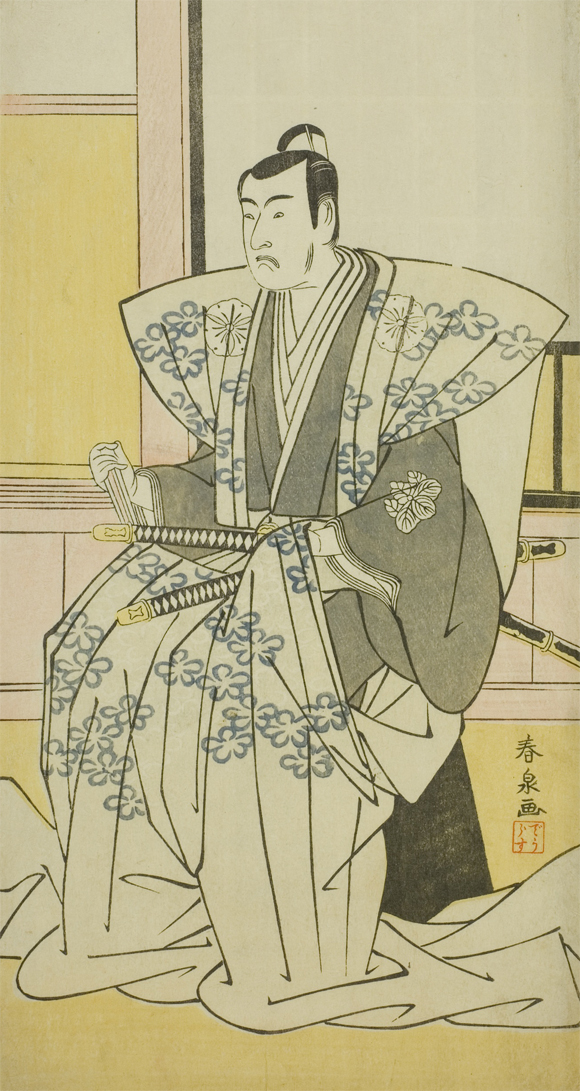
The Actor Matsumoto Kôshirô IV as Hatakeyama Shigetada in the Play "Edo Fuji Wakayagi Soga", Performed at the Nakamura Theater in the First Month, 1789 Print made by Ippitsusai Bunchô Print made by Ippitsusai Bunchô in 1769 Print made by Ippitsusai Bunchô in 1771 Print made by Katsukawa Shunshô (1782~1783) Print made by Torii Kiyonaga in 1788 The Ichikawa Somegorô line of actors The Ichikawa Komazô line of actors The Matsumoto Kôshirô line of actors |
|
|
| Contact | Main | Top | Updates | Actors | Plays | Playwrights | Programs | Links | FAQ | Glossary | Chronology | Illustrations | Prints | Characters | Derivatives | Theaters | Coming soon | News |