| SAKATA HANGORÔ II |
|
Stage names:
Guild: Shôgatsuya Line number: NIDAIME (II) Poetry name: Sankyô Existence: 1724 ~ 17th day of the 5th lunar month of 1782 [1] Connection: Father: Sengoku Hikosuke I's disciple Sengoku Hikojûrô Brother: Sakata Hangorô I's disciple Sakata Sajûrô I Brother-in-law: Mimasuya Sukejûrô II Disciples: Sakata Hangorô III, Sengoku Hikosuke II Career: 1730s: he started his career in Edo in koshibai. His first stage name was Sengoku Saroku. 23rd day of the 4th lunar month of 1735 [2]: Sakata Hangorô I died in Edo. 11th lunar month of 1742: he made his debut in ôshibai, becoming katakiyaku and taking the name of Sengoku Sajûrô at the Ichimuraza, where he performed in the kaomise drama "Furisode Shinoda no Zuma", which welcomed in Edo the Kamigata actor Onoe Kikugorô I. 1st lunar month of 1748: Sajûrô played at the Nakamuraza the role of Iwanaga Saemon in the new year sogamono drama "Kazari Ebi Yoroi Soga". 11th lunar month of 1749: Sengoku Sajûrô took the name of Sakata Hangorô II at the Nakamuraza, playing the role of Urabe Iga-no-Kami in the kaomise drama "Onnô Taiheiki". 11th lunar month of 1756: Hangorô became jitsuaku. 25th day of the 10th lunar month of 1761: his father Sengoku Hikojûrô died [3]. 11th lunar month of 1761: Hangorô played at the Nakamuraza the role of Akai Tôta, in reality Osada Tarô, in the kaomise drama "Nihongahana Hôgan Biiki", which celebrated the shûmei of Ichikawa Raizô I. 1st lunar month of 1762: Hangorô's rank in the Edo hyôbanki, jitsuaku section, was one black stroke above jô-jô-(hanshiro)kichi [visual]. 11th lunar month of 1762: Hangorô played at the Nakamuraza the roles of Yamaki Hachirô and Hacchô-tsubute no Kiheiji in the kaomise drama "Nagi no Ha Izu no Sugatami", which celebrated the shûmei of Ôtani Hiroemon III, Ichikawa Somegorô I and Nakajima Kanzaemon III. 1st lunar month of 1763: Hangorô's rank in the Edo hyôbanki, jitsuaku section, was one black stroke below jô-jô-kichi [visual]. 11th lunar month of 1763: Hangorô moved to the Ichimuraza and played the role of Ômori Hikoshichi in the kaomise drama "Shikai Nami Yawaragi Taiheiki". 1st lunar month of 1764: Hangorô's rank in the Edo hyôbanki, jitsuaku section, was jô-jô-kichi (superior - superior - excellent) [visual]. He shared the same rank with Sawamura Sôjûrô II. 5th lunar month of 1764: Hangorô played in the same theater the roles of Kajiwara Heiji Kagetaka and Gonshirô in the drama "Hirakana Seisuiki". 7th lunar month of 1764: Hangorô played in the same theater the roles of Edohei and Ippei's mother in the drama "Koi Nyôbô Somewake Tazuna". 11th lunar month of 1764: Hangorô played at the Ichimuraza the role of Benkei in the kaomise drama "Wakaki no Hana Suma no Hatsuyuki". 11th lunar month of 1765: Hangorô moved to the Nakamuraza and performed in the kaomise drama "Kagura Uta Amagoi Komachi", which celebrated the shûmei of Iwai Hanshirô IV. 11th lunar month of 1766: Hangorô moved to the Ichimuraza and played the roles of Takechi Hyûganosuke and Ukiyo Matahei in the kaomise drama "Higashiyama Dono Kabuki no Tsuitachi". 1st lunar month of 1767: Hangorô played in the same theater the role of Kudô Saemon Suketsune (this was the first time he could perform this prestigious role) in the new year sogamono drama "Soga Yawaragi Soga"; the roles of Soga Gorô Tokimune and Soga Jûrô Sukenari were played by Ichikawa Yaozô II and Ichimura Uzaemon IX. 7th lunar month of 1767: Hangorô played in the same theater the roles of Igami no Gonta and Kawatsura Hôgen in the drama "Yoshitsune Senbon Zakura". 11th lunar month of 1767: Hangorô moved to the Moritaza and performed in the kaomise drama "Sanada no Yoichi Banjaku no Iezuto", which celebrated the shûmei of Sanogawa Ichimatsu II and welcomed in Edo the Kamigata actor Yamashita Kyônosuke. 11th lunar month of 1768: Hangorô played at the Moritaza the role of the rebel Abe no Sadatô in the kaomise drama "Mutsuchidori Meika no Yumitori"; the roles of Sadatô's brother Abe no Munetô and Sadatô's enemy Minamoto no Yoshiie were played by Sakata Sajûrô I and Bandô Mitsugorô I. 2nd lunar month of 1769: the play "Sekitori Senryô Nobori", which was originally written for the puppet theater and staged for the first time in the 8th lunar month of 1767 in Ôsaka at the Takemotoza, was adapted for Kabuki for the first time, in Edo at the Moritaza; Hangorô played the roles of the sumôtori Tetsugadake and Senbagawa Kichibê [casting]. 4th lunar month of 1769: Hangorô played in the same theater the roles of Kô no Moronô, Okaru's mother, Amakawaya Gihei and Ôboshi Yuranosuke in the drama "Kanadehon Chûshingura". This production was a huge success and a long run (up to the 6th lunar month). 11th lunar month of 1769: Hangorô moved to the Ichimuraza, where he became the new zagashira, playing the roles of Bizen Heishirô, Date no Jirô and Kan'emon in the kaomise drama "Mutsu no Hana Ume no Kaomise", which welcomed in Edo the actors Onoe Kikugorô I, Ôtani Tomoemon I, Nakamura Kiyosaburô I and Onoe Tamizô I. 1st lunar month of 1770: Hangorô played in the same theater the role of Kudô Saemon Suketsune in the new year sogamono drama "Fuji no Yuki Kaikei Soga"; the roles of Soga Gorô Tokimune and Soga Jûrô Sukenari were played by Sanogawa Ichimatsu II and Ichimura Uzaemon IX. 11th lunar month of 1770: Hangorô moved to the Moritaza and played in the kaomise drama "Miyako Zome Giô Katsugi", which welcomed in Edo the Kamigata actors Nakamura Tomijûrô I and Nakamura Noshio I. 5th lunar month of 1771: Hangorô played in the same theater the roles of Tokaiya Ginpei, Taira no Tomomori and Igami no Gonta in the drama "Yoshitsune Senbon Zakura". Fall 1771: Hangorô went to Kyôto. 11th lunar month of 1771: Hangorô became tachiyaku and played the role of Goshikigumi Kurohei, in reality Kuryû Saemon, in the kaomise drama "Miyako Yoshino Mikado no Takadono", which was produced by Mimasu Tokujirô I in Kyôto at the Kitagawa no Shibai and celebrated the shûmei of Sawamura Sôjûrô III, Anegawa Minato II and Yamatoyama Rinzaemon II; Hangorô's others stage partners were Onoe Shinshichi I, Sawamura Kunitarô I, Ichikawa Tomozô I, Arashi Tôjûrô, Arashi Shichigorô II, Bandô Manzô, Yamashita Shungorô and Fujikawa Sango. 1st lunar month of 1772: Hangorô's rank in the Kyôto hyôbanki, tachiyaku section, was jô-jô-kichi (superior - superior - excellent) [visual]. 3rd lunar month of 1773: Hangorô went back to Edo to perform at the Ichimuraza. 11th lunar month of 1773: Hangorô played at the Ichimuraza the roles of Nenoi no Ôyata and Wada Yoshimori in the kaomise drama "Kaeri Kiso Kigoto no Hatsumono", which celebrated the shûmei of Ichikawa Danzô IV. 1st lunar month of 1774: Hangorô's rank in the Edo hyôbanki, tachiyaku section, was jô-jô-kichi (superior - superior - excellent) [visual]. He shared the same rank with Ichikawa Danjûrô V. 5th lunar month of 1774: the play "Natsu Matsuri Naniwa Kagami" was produced for the first time at the Ichimuraza; Hangorô played the role of Danshichi Kurobê [casting]. 11th lunar month of 1774: Hangorô became jitsuaku and performed at the Ichimuraza in Horikoshi Saiyô's kaomise drama "Chigo Sakura Jûsangane", which celebrated the shûmei of Segawa Kikunojô III. 9th lunar month of 1775: Hangorô played in the same theater the role of Ashiya Dôman in the drama "Ashiya Dôman Ôuchi Kagami". 11th lunar month of 1775: Hangorô played at the Ichimuraza the role of the villain Agenanosuke in the kaomise drama "Oyafune Taiheiki"; his stage partners were Ichikawa Ebizô III, Iwai Hanshirô IV, Ichikawa Yaozô II, Matsumoto Kôshirô IV and Nakamura Noshio I; this kaomise was a huge success, starting the 1st day of the 11th lunar month and ending the 15th day of the 12th lunar month. 3rd lunar month of 1776: Hangorô played in the same theater the role of the villain Ikyû in the drama "Sukeroku Yukari no Hatsuzakura"; the roles of Sukeroku, Agemaki and the shirozake seller Shinbê were played by Ichikawa Yaozô II, Iwai Hanshirô IV and Matsumoto Kôshirô IV; the performance was a huge success and a long run but, in the middle of the 5th lunar month, both Ichikawa Yaozô II and Hangorô fell sick and had to be replaced by Ichimura Uzaemon IX and Ichikawa Ebizô III. 7th lunar month of 1776: Hangorô played in the same theater the roles of Shiratayû and Takebe Genzô in the drama "Sugawara Denju Tenarai Kagami". 8th lunar month of 1776: Hangorô played in the same theater the roles of Kô no Moronô, Okaru's mother, Amakawaya Gihei and Ôboshi Yuranosuke in the drama "Kanadehon Chûshingura". 11th lunar month of 1776: Hangorô played at the Ichimuraza in the kaomise drama "Sugata no Hana Yuki no Kuronushi". Summer 1777: the book "Yakusha Sensakuron" ('About actors prying') was published in Edo. It gives some private information on actors. Edo readers learn that Hangorô lives with his spouse Okishi and his two children in the district of Motoôzaka-chô and his annual salary was 750 ryô. 8th lunar month of 1777: Hangorô played in the same theater the roles of Kô no Moronô, Okaru's mother and Ôboshi Yuranosuke in the drama "Kanadehon Chûshingura". 11th lunar month of 1777: Hangorô performed at the Ichimuraza in the kaomise drama "Chigo Torii Tobiiri Kitsune". 1st lunar month of 1778: Hangorô was the kanjiku for jitsuaku actors in the Edo hyôbanki. 4th lunar month of 1778: Hangorô played in the same theater the roles of Yukie and Karaki Masaemon in the drama "Igagoe Norikake Gappa". 11th lunar month of 1778: Hangorô performed at the Ichimuraza in Masuyama Kinpachi I's kaomise drama "Sakimasuya Ume no Kachidoki", which welcomed in Edo the actors Onoe Kikugorô I and Otowa Jirôza II and celebrated the shûmei of Ikushima Daikichi IV. 8th lunar month of 1779: Hangorô played in the same theater the roles of Dankurô and Saisaki Iga-no-Kami in the drama "Shin Usuyuki Monogatari". 11th lunar month of 1779: Hangorô moved to the Nakamuraza and played the roles of Tatara Hyôgonosuke, Kuryû Saemon and Matsumoto Sahei in the kaomise drama "Kaeribana Eiyû Taiheiki", which celebrated the shûmei of Yamashita Mangiku I and Sengoku Hikosuke II. This production was a tremendous success. 2nd lunar month of 1780: Hangorô played in the same theater the role of Hotei Ichiemon in "Gonin Otoko", the second part (nibanme) of the new year sogamono drama "Hatsumonbi Kuruwa Soga"; his stage partners were Ichikawa Monnosuke II (Karigane Bunshichi), Ichikawa Danjûrô V (Gokuin Sen'emon), Bandô Mitsugorô I (An no Heibê) and Nakamura Sukegorô II (Kaminari Shôkurô). 6th lunar month of 1780: tour in the province of Echigo with Matsumoto Kôshirô IV. 9th lunar month of 1780: Hangorô played at the Nakamuraza the roles of Teraoka Heiemon, Ono no Sadakurô and Amakawaya Gihei in the drama "Kanadehon Chûshingura". 1st lunar month of 1781: short tour to Kyôto; Hangorô performed at the Minamigawa no Shibai. Fall 1781: Hangorô went back to Edo. 11th lunar month of 1781: Hangorô played at the Ichimuraza the role of Ise no Asama Saemon in the kaomise drama "Mukashi Otoko Yuki no Hinagata", which celebrated the shûmei of Matsumoto Sanjûrô and Ichiyama Sukejûrô; the management of the theater had to struggle hard to find the money to pay the actors. Hangorô's stage partners were Iwai Hanshirô IV, Yoshizawa Ayame IV, Matsumoto Kôshirô IV, Nakamura Sukegorô II, Ichimura Uzaemon IX, Nakayama Tomisaburô I, Sawamura Chôjûrô IV and Onoe Monzaburô I. 1st lunar month of 1782: Hangorô played in the same theater the roles of Kakuju, Shiratayû and Takebe Genzô in the drama "Sugawara Denju Tenarai Kagami". 5th lunar month of 1782: Hangorô appeared on stage for the last time, in Edo at the Ichimuraza, where he played the role of Ikyû in the drama "Sukeroku Yukari no Edo Zakura"; his stage partners were Ichimura Uzaemon IX (Sukeroku), Iwai Hanshirô IV (Agemaki) and Matsumoto Kôshirô IV (the shirozake seller Shinbê). He fell ill and had to stop acting. 17th day of the 5th lunar month of 1782 [1]: Hangorô died in Edo. Comments: Sakata Hangorô II was one of the top-ranking Edo jitsuaku actor of the second half of the 18th century. He was outstanding in villain roles in the aragoto style but was also excellent in jitsugoto roles, like Ôboshi Yuranosuke in "Kanadehon Chûshingura". [1] The 17th day of the 5th lunar month of the 2nd year of the Tenmei era was the 27th of June 1782 in the western calendar. [2] The 23rd day of the 4th lunar month of the 20th year of the Kyôhô era was the 13th of June 1735 in the western calendar. [3] The 25th day of the 10th lunar month of the 11th year of the Hôreki era was the 21st of November 1761 in the western calendar. |

 |
|
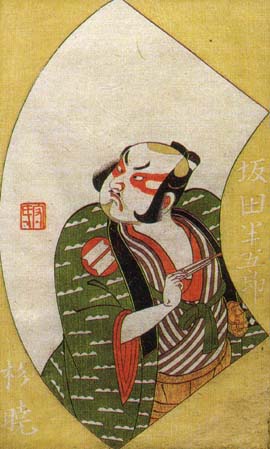
Sakata Hangorô II in a print made in 1770 by Ippitsusai Bunshô for the Ehon Butai Ôgi series of prints Print made by Ippitsusai Bunshô The Sakata Hangorô line of actors |
|
|
| Contact | Main | Top | Updates | Actors | Plays | Playwrights | Programs | Links | FAQ | Glossary | Chronology | Illustrations | Prints | Characters | Derivatives | Theaters | Coming soon | News |