| MIMASU DAIGORÔ I |
|
Stage names:
Guild: Masuya Line number: SHODAI (I) Poetry name: Ikkô Existence: 1718 ~ 25th day of the 9th lunar month of 1780 [1] Connections: Masters: Yoshizawa Tamazuma, Sagawa Bunzô II Brother: Mimasu Kanzô I Son: Mimasu Matsunosuke Adopted sons: Mimasu Daigorô II, Mimasu Tanin I Disciples: Mimasu Tokujirô I, Mimasu Matsugorô I, Mimasu Mitsugorô, Mimasu Uhachi, Mimasu Matsunojô, Mimasu Chôgorô, Mimasu Komazô, Mimasu Sakuzô, Mimasu Denzô, Mimasu Chazô Family map: the Yoshizawa Clan Career: 1718: born in Kyôto. Spring 1732: he became disciple of the actor Sagawa Bunzô II, who gave him the name of Sagawa Kuranosuke. he performed as a wakashugata in Nagoya for the zamoto Matsumoto Genjûrô. 11th lunar month of 1732: he became disciple of the wakaonnagata actor Yoshizawa Tamazuma and received the name of Yoshizawa Kuranosuke. He performed in Ôsaka in the drama "Mitsu no Hama Kogane no Irie", which was produced by Arashi San'emon III. 11th lunar month of 1734: Kuranosuke played the role of Tomogorô in the kaomise drama "Honchô Bugaku no Hajimari", which was produced by the zamoto Iwai Hanshirô III at the Naka no Shibai. 1735 ~ 1739: Yoshizawa Kuranosuke took the name of Yoshizawa Jûshirô and joined a travelling troupe (tabi shibai). He left the Kabuki world for a while in order to become a merchant. Later on, he gave up his business, took back the name of Yoshizawa Kuranosuke and went on tour. 11th lunar month of 1739: he became tachiyaku and took the name of Mimasu Daigorô I in Kyôto, performing in the kaomise drama "Keigoto Senri no Michi", which was produced by the zamoto Arashi Koroku I. 11th lunar month of 1741: Daigorô achieved a great success in Kyôto by playing the role of Nagao Gensuke in the kaomise drama "Chôseiden Wagô no Futahashira", which was produced by Sakata Ichitarô. 5th lunar month of 1742: Chikamatsu Monzaemon's play "Shinshû Kawanakajima Kassen" was adapted for Kabuki for the first time, in Kyôto at the Kitagawa no Shibai; Daigorô played the roles of Murakami Saemon Yoshikiyo and Hayami Genjûrô [more details]. 11th lunar month of 1742: Daigorô settled in Ôsaka and became katakiyaku, performing in the kaomise drama "Sangoku Denrai no Ishi", which was produced by Iwai Hanshirô III at the Kado no Shibai. 11th lunar month of 1744: Daigorô became jitsuaku and performed in the kaomise drama "Yamazaki Yojibê Imayô Sugata", which was produced by Arashi Sanjûrô II at the Kado no Shibai. 11th lunar month of 1749: Daigorô became zamoto and tachiyaku at the Ônishi no Shibai; he produced Izumiya Shôzô's kaomise drama "Kotobuki Kogane no Kachi Ikusa", which celebrated the shûmei of Murayama Heijûrô V and starred the actors Bandô Toyosaburô I, Arashi Sanjûrô II, Iwai Hanshirô III, Sanjô Namie I, Iwata Somematsu I and Nakamura Utaemon I. Fall 1749: Daigorô performed in the city of Sakai. 12th lunar month of 1750: Daigorô played at the Naka no Shibai the roles of Matahei and Nagoya Sanza in the drama "Keisei Tôyama Zakura" (similar to Chikamatsu Monzaemon's drama "Keisei Hangonkô"), which was produced by the zamoto Nakamura Jûzô I for the nadai Shioya Kuroemon [casting]. 11th lunar month of 1752: Daigorô became zamoto and produced at the Kado no Shibai the kaomise drama "Nagoya Ori Hinatsuru no Nishiki" in which he achieved a great success by playing the role of Matahei; his stage partners were Fujikawa Heikurô, Sakata Tôjûrô III, Arashi Koroku I, Fujikawa Hachizô I and Yoshizawa Sakinosuke II. 11th lunar month of 1752 ~ 8th lunar month of 1754: Daigorô was zamoto at the Kado no Shibai. 11th lunar month of 1754: Daigorô performed at the Naka no Shibai in the kaomise drama "Amaterasu Ômikami Iwado no Akebono", which was produced by Arashi San'emon IV. 11th lunar month of 1756: Daigorô went back to Kyôto and played at the Minamigawa no Shibai the role of the bashi Ishibe no Kinkichi, in reality Mata no Gorô Kagehisa, in the kaomise drama "Daimyô Bimandai Kuniiri Kamakura Kagami", which was produced by Sawamura Kunitarô I for the nadai Hayagumo Chôdayû. 11th lunar month of 1757: Daigorô played at the Minamigawa no Shibai the role of the sumôtori Ukiemon, in reality Genbachihyôe, in the kaomise drama "Ôyashiro Musubu no Sanban Tsuzuki", which was produced by Somematsu Matsujirô and Sawamura Kunitarô I for the nadai Hayagumo Chôdayû. 1st lunar month of 1758: first Kabuki adaptation of the puppet theater drama "Gion Sairei Shinkôki", which was simultaneously produced at the Minamigawa no Shibai [casting] and the Kitagawa no Shibai [casting]. It used its real title at the former theater but it was entitled "Keisei Niwatoriyama" at the latter theater; Daigorô played in the former theater the role of Konishi Zesai. Fall 1758: Daigorô went to Ôsaka. 11th lunar month of 1758: Daigorô became jitsuaku and performed in Namiki Shôzô I's kaomise drama "Arigatashi Fujiwara Keizu", which was produced by Nakayama Bunshichi I at the Kado no Shibai. 12th lunar month of 1758: premiere at the Kado no Shibai of Namiki Shôzô I's ni-no-kawari drama "Sanjikkoku Yofune no Hajimari"; for the very first time in Kabuki history, a mawari-butai, invented by Namiki Shôzô I, was built and used on the stage of a theater [more details]; Daigorô played the roles of Kawaura Ryûken and Sekiguchi Heita. 1st lunar month of 1761: premiere at the Kado no Shibai of Namiki Shôzô I's ni-no-kawari drama "Kiritarô Tengu no Sakamori"; Daigorô played the role of the hinin Dôtetsu, in reality Akuzenji Kugyô [more details]. 11th lunar month of 1761: Daigorô became zamoto and tachiyaku; he produced at the Naka no Shibai the kaomise drama "Miyo no Hana Yunzei Kagami". 12th lunar month of 1761: premiere at the Naka no Shibai of Takeda Haruzô's ni-no-kawari drama "Akiba Gongen Kaisen Banashi". It was the first drama in Kabuki history using gandô-gaeshi on stage; Daigorô played the roles of Tamashima Ittô and Tamashima Kôbê [casting]. 4th lunar month of 1762: first Kabuki adaptation of the 5-act puppet theater drama "Gosho Zakura Horikawa no Youchi", which was staged at the Naka no Shibai; Daigorô played the role of Ise no Saburô [casting]. 9th lunar month of 1762: Daigorô produced in the same theater the drama "Yoshitsune Senbon Zakura", in which he played the roles of Yazaemon, Tadanobu and the fox Genkurô; his stage partners in the roles of Yoshitsune and Yasuke was Arashi Sangorô II. 11th lunar month of 1762: Daigorô produced at the Naka no Shibai the kaomise drama "Uchide no Kozuchi Tezuma Urakata". 2nd lunar month of 1763: Daigorô produced in the same theater the drama "Keisei Hangonkô", in which he played the role of Matahei; his stage partners were Nakamura Tomijûrô I (Tôyama), Arashi Sangorô II (Shirojirô) and Iwata Somematsu I (Otoku). 11th lunar month of 1763: Daigorô produced at the Naka no Shibai a special kaomise program in 3 parts, which were entitled "Fuyu Gomori Kôbai Tazuna", "Sakigake Genpei Tsutsuji" [2] and "Futaba Musha Senbon Zakura". 9th lunar month of 1764: première in Ôsaka at the Naka no Shibai of "Hare Kosode Tsuzure no Nishiki", based on the puppet drama "Katakiuchi Tsuzure no Nishiki", which was produced by Daigorô. A similar play was staged one day before under a different title, "Oriawase Tsuzure no Nishiki", at the Kado no Shibai. The competition for the best performance and the best line-up was open between the 2 theaters. The performance at the Kado no Shibai was more successful than the one at the Naka no Shibai; Daigorô played at the Naka no Shibai the role of Shundô Jirôemon [casting]. 5th lunar month of 1766: first Kabuki adaptation of the puppet theater drama "Honchô Nijûshikô", which was performed in Ôsaka at the Naka no Shibai; Daigorô played the roles of Kôsaka Danjô and the kikori Yokozô (later Yamamoto Kansuke) [casting]. 1st lunar month of 1768: Daigorô's rank in the Ôsaka hyôbanki, tachiyaku section, was jô-jô-kichi (superior - superior - excellent) [visual]. 12th lunar month of 1768: Daigorô played the role of the sumôtori Hanaregoma Chôkichi in the drama "Futatsu Chôchô Kuruwa Nikki", which was produced by his adopted son Mimasu Tanin I at the Naka no Shibai [casting]. 5th lunar month of 1770: first Kabuki adaptation of Chikamatsu Hanji's gidayû kyôgen "Ômi Genji Senjin Yakata", which was staged in Ôsaka at the Naka no Shibai; Daigorô played the role of Sasaki Moritsuna [casting]. 27th of the 11th lunar month of 1770 [3]: his adopted son Mimasu Tanin I died. 1st lunar month of 1771: premiere at the Naka no Shibai of Namiki Shôzô I's drama "Kuwanaya Tokuzô Irifune Monogatari"; Daigorô played the roles of Tadotsu Ikkaku and Tadotsu Shinzô [casting]. 8th lunar month of 1771: Daigorô played at the Naka no Shibai the role of Fukashichi in the drama "Imoseyama Onna Teikin" [casting]. 9th lunar month of 1773: Daigorô played at the Kado no Shibai the role Matahei in the drama "Keisei Hangonkô", which was produced by the zamoto Ogawa Kichitarô I for the nadai Ôsaka Tazaemon; his stage partners were Arashi Hinasuke I (Otoku) and Nakayama Raisuke I (Shôgen). Fall 1774: Daigorô played for the last time the role Matahei in the drama "Keisei Hangonkô", which was staged in Kyôto at the Kitagawa no Shibai. 4th lunar month of 1775: premiere in Ôsaka at the Naka no Shibai of Nagawa Kamesuke I's drama "Hade Kurabe Ise Monogatari"; Daigorô played the roles of Wadasaku and Koyoshi [more details]. 1st lunar month of 1776: Daigorô's rank in the Ôsaka hyôbanki, tachiyaku section, was ô-jô-jô-kichi (grand - superior - superior - excellent). 5th lunar month of 1776: Daigorô played at the Naka no Shibai the role of Sabu in the drama "Natsu Matsuri Naniwa Kagami"; his stage partners were Arashi Kichisaburô I (Tokubê) and Arashi Hinasuke I (Danshichi Kurobê). 4th lunar month of 1777: premiere of Namiki Gohachi's drama "Tenmangû Natane no Gokû", co-written with Nakamura Akei and Tatsuoka Mansaku, which was staged at the Kado no Shibai; Daigorô played the roles of Ki no Haseo, Haji no Hyôe, Shiratayû and Hôsshôbô [casting]. Fall 1779: Daigorô went back to Kyôto. 11th lunar month of 1779: Daigorô performed in the kaomise drama "Kaikei Kikkegawara", which was produced by Somematsu Shichisaburô II. 1st lunar month of 1780: Daigorô's rank in the Kyôto hyôbanki, tachiyaku section, was kô-jô-jô-kichi (meritorious - superior - superior - excellent) [Visual]. Namiki Gohê's drama "Kinmon Gosan no Kiri" was produced for the first time in Kyôto; Daigorô played the role of Konomura Ôinosuke (in reality Sô Sokei) [casting]. 4th lunar month of 1780: Daigorô appeared on stage for the last time, in Kyôto, playing in the drama "Kiku Nagashi Kokka Taiheiki". 25th day of the 9th lunar month of 1780 [1]: Daigorô died. Comments: Mimasu Daigorô I was the founder of a great line of Kamigata actors. He was mainly a tachiyaku actor but he also performed many seasons in his career as a katakiyaku or a jitsuaku. He excelled in budôgoto roles. [1] The 25th day of the 9th lunar month of the 9th year of the An'ei era was the 22nd of October 1780 in the western calendar. [2] This was the premiere of "Ôgiya Kumagai". [3] The 27th of the 11th lunar month of the 7th year of the Meiwa era was the 12th of January 1771 in the western calendar. |

 |
|
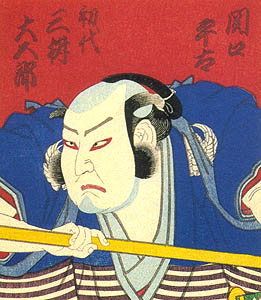
Mimasu Daigorô I playing the role of Sekiguchi Heita in a print made by Utagawa Toyokuni III (1862~1863) The Mimasu Daigorô line of actors |
|
|
| Contact | Main | Top | Updates | Actors | Plays | Playwrights | Programs | Links | FAQ | Glossary | Chronology | Illustrations | Prints | Characters | Derivatives | Theaters | Coming soon | News |