| NAKAMURA TOMIJÛRÔ II |
|
Stage names:
Guild: Tennôjiya Line number: NIDAIME (II) Poetry names: Keishi [4], Baika [3], Sankô [2] Blazon: Yattsu Yaguruma Existence: 1786 ~ 13th day of the 2nd lunar month of 1855 [1] Connections: Masters: Nakamura Utaemon III, Ichikawa Jinnosuke Adopted son: Nakamura Daikichi III Disciples: Nakamura Keijo, Nakamura Kamon 0.1, Nakamura Kikujûrô, Nakamura Noshio IV Career: 1786 ~ 1808: born in Ôsaka. He started his career in a troupe of children actors (kodomo shibai) as a disciple of Ichikawa Jinnosuke, who gave him the name of Ichikawa Kumatarô. 7th lunar month of 1808: his master Ichikawa Jinnosuke died. Fall 1812: he became disciple of the Kamigata star Nakamura Utaemon III. 11th lunar month of 1812: he received the name of Nakamura Sankô I at the Naka no Shibai, where he played the role of Konami in the classic "Kanadehon Chûshingura". 9th lunar month of 1813: Sankô played for the first time the role of the courtesan Akoya in the drama "Dan no Ura Kabuto Gunki", which was staged in Ôsaka at the Kado no Shibai; his stage partners in the roles of Shigetada and Iwanaga Saemon were Nakayama Hyakka and Nakamura Utaemon III. 11th lunar month of 1813: he settled in Edo and took the name of Nakamura Matsue III at the Nakamuraza, playing 3 roles in the drama "Okudôsha Bandô Junrei". 9th lunar month of 1814: Matsue played in the same theater the role of the courtesan Akoya in the drama "Dan no Ura Kabuto Gunki"; his stage partners in the roles of Shigetada and Iwanaga Saemon were Bandô Mitsugorô III and Nakamura Utaemon III. 1st lunar month of 1816: premiere at the Nakamuraza of the new year sogamono drama "Hiyoku no Chô Haru no Soga Giku". This new year drama mixed two sekai: it was a sogamono and a gonpachi-komurasakimono. The sogamono fell into oblivion and the gonpachi-komurasakimono was staged independently under the title "Sono Kouta Yume mo Yoshiwara" ("Gonge" and "Gonjô"); Matsue played the roles of Princess Maizuru, Tsukisayo, Chôbê's nyôbô and Kashiku [more details]. 1816: Matsue went back to Kamigata and performed at the Kitagawa no Shibai in Kyôto. 1st lunar month of 1819: Matsue played at the Kado no Shibai the role of the courtesan Akoya in the drama "Dan no Ura Kabuto Gunki"; his stage partners in the roles of Shigetada and Iwanaga Saemon were Ichikawa Ebijûrô I and Asao Kuzaemon I. 3rd lunar month of 1821: premiere at the Kado no Shibai of the drama "Kajiwara Heizô Kôbai Tazuna", a new version of the third act of "Miura no Ôsuke Kôbai Tazuna", revised by Kanazawa Ryûgoku I; Matsue played the role of Kozue [casting]. He also played the role of Hinadori in the drama "Imoseyama Onna Teikin"; his stage partners were Arashi Koroku IV (Omiwa, Koganosuke), Bandô Mitsugorô III (Daihanji, Iruka, Fujiwara no Tankai) and Nakamura Utaemon III (Fukashichi, Sadaka). 5th lunar month of 1821: Matsue played in the same theater the roles of Kaoyo and Okita in the drama "Taiheiki Chûshin Kôshaku". 7th lunar month of 1821: Matsue moved to the Naka no Shibai, where he played the role of Masaoka in the drama "Hagi ha Sendai Na ha Matsumoto", whose plot and characters belonged to the "Meiboku Sendai Hagi" world. 9th lunar month of 1821: Matsue was back at the Kado no Shibai, where he performed in the drama "Taiheiki Kikusui no Maki" but the performance was not a success because of a quarrel between Nakamura Utaemon III and Ichikawa Danzô V. 11th lunar month of 1821: he took back the name of Nakamura Sankô I at the Naka no Shibai, where he played the roles of Saemon's okugata and the nakai Ofune in the drama "Sanjikkoku Yofune no Hajimari". Fall 1822: Sankô went to Edo. 11th lunar month of 1822: Sankô performed at the Nakamuraza in the drama "Gohiiki Azuma Hyakkan", which celebrated the shûmei of Mimasu Gennosuke I and Sakata Hangorô IV; his stage partners were Matsumoto Kôshirô V, Bandô Mitsugorô III, Iwai Kumesaburô II, Arashi Kanjûrô I and Yamashina Jinkichi III. 1st lunar month of 1823: he took the name of Nakamura Matsue, using a different way to write Matsue. 3rd lunar month of 1823: Matsue played at the Nakamuraza the role of Masaoka in the drama "Kaeri Kuruwa Hana no Date Zome", whose plot and characters belonged to the "Meiboku Sendai Hagi" world. Fall 1823: Matsue went back to Kamigata. 11th lunar month of 1823: he took back the name of Nakamura Matsue III and triumphed at the Kitagawa no Shibai in Kyôto by playing the roles of Oritsu and Omatsu in the drama "Keisei Chigo-ga-Fuchi". He also played the role of the courtesan Akoya in the drama "Dan no Ura Kabuto Gunki", sharing the stage with the stars Ichikawa Ebijûrô I (Shigetada) and Nakamura Utaemon III (Iwanaga Saemon). 1st lunar month of 1824: he took back the name of Nakamura Sankô I. Spring 1825: he took back the name of Nakamura Matsue III. 1st lunar month of 1827: Matsue's rank in the Kamigata hyôbanki, wakaonnagata section, was jô-jô-kichi (superior - superior - excellent) [visual]. He was with Sawamura Kunitarô II the kanjiku for the onnagata actors. 5th lunar month of 1827: Matsue played for the first time the role of Osono in the drama "Hikosan Gongen Chikai no Sukedachi", which was staged at the Kita-Horie Ichi-no-Gawa Shibai in Ôsaka; his stage partner in the role of Rokusuke was Seki Sanjûrô II. The same play was staged with the same casting in the 6th lunar month at the Kita-Shinchi no Shibai. 7th lunar month of 1827: Matsue played at the Kado no Shibai the roles of Miyako and Ohaya in the drama "Futatsu Chôchô Kuruwa Nikki". 6th lunar month of 1828: tour in Miyajima. Matsue played among others the prestigious role of Akoya in the drama "Dan no Ura Kabuto Gunki". 9th lunar month of 1829: Matsue played at the Kado no Shibai the role of Otoku in Chikamatsu Monzaemon's drama "Keisei Hangonkô", which was produced by the zamoto Nakamura Umematsu; his stage partners were Nakamura Utaemon III (Matahei), Arashi Rikan II (Utanosuke) and Kataoka Nizaemon VII (Shôgen). The same play was staged with the same casting in the 11th lunar month at the Kitagawa no Shibai in Kyôto. 3rd lunar month of 1830: At the beginning of the month, Matsue played the roles of Osono, Tonase and Okaru in the classic "Kanadehon Chûshingura", which was staged in Ôsaka at the Kado no Shibai. He also played the role of the courtesan Agemaki in the drama "Sukeroku Yukari no Edo Zakura"; his stage partners in the roles of Sukeroku and Soga Jûrô were Ichikawa Hakuen II and Nakamura Utaemon III. In the middle of the 3rd lunar month, Matsue played the roles of Ohatsu and Okon in the dramas "Kagamiyama Gonichi no Omokage" and "Ise Ondo Koi no Netaba". He also performed the main role of the dance "Keisei Dôjôji", which commemorated the first anniversary of the passing away of Nakamura Noshio II and belonged to the "Musume Dôjôji" world, a role popularized by Nakamura Tomijûrô I. 4th lunar month of 1830: Matsue played 2 roles in the same theater in the drama "Ôtô-no-Miya Asahi no Yoroi". 6th lunar month of 1830: tour in Miyajima in the company of Nakamura Utaemon III. They performed in "Hirakana Seisuiki". 11th lunar month of 1830: Matsue played in Kyôto at the Kitagawa no Shibai the roles of Yae, Tonami and Kakuju in the classic "Sugawara Denju Tenarai Kagami". He also played the role of Osato in the "Sushiya" scene of the play "Yoshitsune Senbon Zakura". 1st lunar month of 1831: Matsue was back in Ôsaka, playing at the Naka no Shibai 3 roles in the drama "Keisei Shigeshige Yawa", which was produced by Nakamura Baika I. 3rd lunar month of 1831: the troupe performing at the Naka no Shibai moved to the Kado no Shibai. Matsue played the roles of Shinobu and Okoma in the dramas "Onna Setsuyô Emon Kagami" and "Koi Musume Mukashi Hachijô". 5th lunar month of 1831: Matsue played in the same theater the role of Itotaki in the drama "Musume Kagekiyo". The role of Kagekiyo was played by Nakamura Utaemon III. 7th lunar month of 1831: the troupe performing at the Kado no Shibai moved to the Naka no Shibai. Matsue played the roles of the Kiku-no-Mae and Sagami in the drama "Ichi-no-Tani Futaba Gunki". He also played the role of the courtesan Umegawa in "Koi Bikyaku Yamato Ôrai", sharing the stage with Nakamura Utaemon III in the role of Kameya Chûbê. 9th lunar month of 1831: Matsue played in the same theater the role of Namiji in the drama "Takane no Nami". 11th lunar month of 1831: Matsue, following his master and his troupe, moved to Kyôto, performing at the Kitagawa no Shibai in the kaomise drama. He played the roles of Okaru, Tonase and Osono in the classic "Kanadehon Chûshingura". 1st lunar month of 1832: Matsue, Utaemon and his troupe were back in Ôsaka, performing at the Naka no Shibai in the drama "Keisei Hana no Yamazaki", which was produced by Nakamura Tamanosuke II. 2nd lunar month of 1832: the troupe moved to the Kado no Shibai; Matsue played the role of Omiwa in the drama "Imoseyama Onna Teikin", which was produced by Sawamura Montarô. 9th lunar month of 1832: Matsue played in the same theater the role of Shigenoi in the drama "Koi Nyôbô Somewake Tazuna". 11th lunar month of 1832: Matsue performed at the Kado no Shibai in the kaomise drama "Nichiren Shônin Minori no Umi", which was produced by Nakamura Umematsu. He also performed in "Suda no Haru Geisha Katagi" and the dance "Tokiwa Akizuki no Aki". 1st lunar month of 1833: Nakamura Matsue III took the prestigious name of Nakamura Tomijûrô II, which has not been held since 8th lunar month of 1786, at the Kado no Shibai, performing in the new year ni-no-kawari drama "Keisei Chigo-ga-Fuchi". This was also the premiere of "Chichi Morai", staged as the second part of "Keisei Chigo-ga-Fuchi", in which Tomijûrô played the role of Koyuki [casting]. 2nd lunar month of 1833: tour in the province of Bizen. 3rd lunar month of 1833: Tomijûrô was back in Kyôto and played at the Kitagawa no Shibai the roles of Sadaka and Omiwa in the drama "Imoseyama Onna Teikin". Premiere at the Kitagawa no Shibai of "Hana Fubuki Koi no Tekagami"; Tomijûrô played the role of Koyuki [casting]. 5th lunar month of 1833: Tomijûrô was back in Ôsaka and played at the Kado no Shibai the role of Kinshôjo in Chikamatsu Monzaemon's drama "Kokusen'ya Gassen", which was produced by Nakamura Tamanosuke; the role of Watônai was played by Arashi Rikan II. 7th lunar month of 1833: Tomijûrô moved to Kyôto, performing at the Kitagawa no Shibai in the dramas "Kokusen'ya Gassen" and "Gokusaishiki Musume Ôgi". 12th lunar month of 1833: Tomijûrô was back in Ôsaka, playing at the Kado no Shibai the role of Sagami in the drama "Ichi-no-Tani Futaba Gunki", which was produced by Nakamura Tsurunosuke. 1st lunar month of 1834: his rank in the Kamigata hyôbanki was ô-jô-jô-kichi (grand - superior - superior - excellent) [Visual]. 3rd lunar month of 1834: Tomijûrô played in the same theater the role of princess Taema in the drama "Narukami Zakura"; the role of the wicked priest Narukami was played by Ichikawa Ebizô V. 10th lunar month of 1834: Tomijûrô played in the same theater the role of Otoku in Chikamatsu Monzaemon's drama "Keisei Hangonkô"; the role of Matahei, Otoku's husband, was played by Nakamura Shikan II. 11th lunar month of 1834: Tomijûrô played in Kyôto at the Kitagawa no Shibai the role of Sagami in the "Kumagai Jin'ya" scene of the classic "Ichi-no-Tani Futaba Gunki". He also played the role of Sekijo & Gotobê's wife in "Yoshitsune Koshigoejô"; the role of Gotobê was played by Nakamura Utaemon III. He also played the roles of Ofusa and Otoku in "Shinjû Kasane Izutsu" and "Ôtsue Miyage". 1st lunar month of 1835: Tomijûrô performed in Ôsaka at the Kado no Shibai in the drama "Keisei Iriai Zakura", which was produced by Nakamura Tsurunosuke. This was also the premiere of the dance "Wake Futatsu Ninin Dôjôji", which starred Tomijûrô and Nakamura Shikan II. 4th lunar month of 1835: Tomijûrô moved to the Naka no Shibai, where he played the role of Okon in the drama "Ise Ondo Koi no Netaba"; his stage partner in the role of Fukuoka Mitsugi was Nakamura Shikan II. 6th lunar month of 1835: Tomijûrô and Nakamura Shikan II settled in Kyôto. 9th lunar month of 1835: Tomijûrô played at the Kitagawa no Shibai the roles of Ohaya, Oyasu and Oseki in the dramas "Hikimado", "Hime Komatsu Ne-no-Hi no Asobi" and "Kiyomizu Seigen". 1st lunar month of 1836: premiere at the Naka no Shibai of Nishizawa Ippô's drama "Hana no Ani Tsubomi no Yatsufusa"; Tomijûrô played the roles of Princess Fuse and Hamaji [casting]. 8th lunar month of 1836: Tomijûrô played in the same theater 2 roles in the drama "Yorimasa Nue Monogatari". He also played the role of the courtesan Fujiya Azuma in the drama "Abura Uri Kuruwa Banashi". 10th lunar month of 1836: Tomijûrô performed in Ôsaka at the Kita-Shinchi no Shibai in the dramas "Mai Ôgi" and "Gosho Zakura Horikawa no Youchi". 2nd lunar month of 1837: Tomijûrô played at the Naka no Shibai the roles of Shigenoi, Osan and Koman in the drama "Keisei Tamate Zuna", which was produced by Nakamura Umetarô. 7th lunar month of 1837: Tomijûrô played at the Kita-Horie Ichi-no-Gawa Shibai the roles of Sadaka and Omiwa in the classic "Imoseyama Onna Teikin", which was produced by Arashi Kitsuzô. 8th lunar month of 1837: Tomijûrô played in Ôsaka at the Kita-Shinchi no Shibai the role of Princess Toki in the drama "Kamakura Sandaiki". 9th lunar month of 1837: Tomijûrô played at the Naka no Shibai the role of Princess Minazuru in the classic "Kiichi Hôgen Sanryaku no Maki". 11th lunar month of 1837: Tomijûrô played in Kyôto at the Minamigawa no Shibai the roles of Masaoka and the courtesan Takao in the drama "Meiboku Sendai Hagi". He also played the role of Kikuno in the drama "Godairiki"; the roles of Sasano Sangobê and Katsuma Gengobê were played by Asao Kuzaemon I and Mimasu Gennosuke I. He also played the role of Osan in the drama "Daikyôji"; the role of Mohê was played by Ichikawa Sukejûrô IV. 1st lunar month of 1838: Tomijûrô was back in Ôsaka, performing at the Kado no Shibai in the drama "Keisei Sato no Funauta", which celebrated the shûmei of Nakayama Ittoku III and Nakayama Yoshio III. 5th lunar month of 1838: Tomijûrô moved to the Naka no Shibai, playing the roles of Yûshide and Kozue in the dramas "Karukaya Dôshin Tsukushi no Iezuto" and "Kajiwara Heizô Kôbai Tazuna". 9th lunar month of 1838: Tomijûrô played in the same theater the role of Kuzu-no-Ha in the drama "Ashiya Dôman Ôuchi Kagami". 11th lunar month of 1838: Tomijûrô played in Kyôto at the Kitagawa no Shibai the roles of Sagami and Otani in the dramas "Kumagai Jin'ya" and "Igagoe Dôchû Sugoroku". He also played the role of the sarumawashi Koyoshi in the drama "Onna Sarumawashi". 1st lunar month of 1839: premiere at the Kado no Shibai of Nishizawa Ippô's drama "Keisei Hama no Masago"; Tomijûrô played the roles of Gion-no-Okaji, the keisei Ishikawaya Masagoji and Otaki [casting]. He also played the role of Masaoka in "Chiyo no Haru Hagi no Wakabae", a play with a script similar to the classic "Meiboku Sendai Hagi". 3rd lunar month of 1839: the play "Sesshû Gappô-ga-Tsuji" was staged for the first time in Ôsaka, at the Kado no Shibai; Tomijûrô played the roles of Tamate Gozen and Irihei's wife Osode [casting]. He also played the roles of Hinadori and Omiwa in the great drama "Imoseyama Onna Teikin". 8th lunar month of 1839: Tomijûrô played in the same theater the roles of Shimabara Kochô and Kozue in the dramas "Shimabara Zome Nanagusa Moyô" and "Kajiwara Heizô Kôbai Tazuna". 9th lunar month of 1839: Tomijûrô moved to the Naka no Shibai and played 3 roles, including the famous role of Hangaku, in the drama "Wada Gassen Onna Maizuru". 11th lunar month of 1839: Tomijûrô and all the actors playing at the Naka no Shibai moved to Kyôto. They performed at the Kitagawa no Shibai in the dramas "Keisei Sato no Funauta", "Wada Gassen Onna Maizuru", "Hirai Gonpachi", "Honchô Nijûshikô" and "Kuruwa Bunshô". 1st lunar month of 1840: Tomijûrô was back in Ôsaka, playing at the Naka no Shibai 4 roles in the new year ni-no-kawari drama "Keisei Setsugekka", which was produced by his disciple Nakamura Tomisuke. 3rd lunar month of 1840: Tomijûrô played in the same theater 4 roles in the drama "Futatsu Chôchô Kuruwa Nikki". 4th lunar month of 1841: Tomijûrô played at the Naka no Shibai the role of the courtesan Yûgiri in the drama "Yûgiri Kuruwa Bunshô"; his stage partner in the role of Fujiya Izaemon was Ichikawa Danzô V. 1st lunar month of 1842: Tomijûrô performed in the same theater in the drama "Keisei Tsukushi no Tsumagoto" and the dance "Keisei Dôjôji". 3rd ~ 4th lunar months of 1842: Tomijûrô played in the same theater the roles of Ohatsu and Okon in the dramas "Kagamiyama Gonichi no Omokage" and "Ise Ondo Koi no Netaba". He also performed the main role of the dance "Keisei Dôjôji". 1843: Tomijûrô was victim of the repressive sumptuary laws which were directed at the Kabuki actors. He was expelled from Ôsaka and had to settle for a while in the port of Sakai. 11th lunar month of 1845: Tomijûrô played in Kyôto at the Kitagawa no Shibai the role of Otomi in the drama "Ashiya Dôman Ôuchi Kagami". He also played the role of Ohaya in the drama "Futatsu Chôchô Kuruwa Nikki". He also played the roles of Sagami and Kiku-no-Mae in the drama "Ichi-no-Tani Futaba Gunki". He also played the role of Onoe in the drama "Kagamiyama"; the roles of Ohatsu and Iwafuji were played by Arashi Rikan III and Ichikawa Ebizô V. 5th lunar month of 1846: Tomijûrô played in the same Theater the role of Oginoya Yaegiri in Chikamatsu Monzaemon's drama "Komochi Yamanba". Spring 1847: tour in Ise (Furuichi Shibai). Summer 1847: tour in Nagoya (Tachibana no Shibai). 1st lunar month of 1849: his rank in the Kamigata hyôbanki was ô-goku-jô-jô-kichi (grand - extreme - superior - superior - excellent) [Visual]. 11th lunar month of 1849: Tomijûrô played in Nagoya at the Tachibana no Shibai the roles of Shizuka Gozen and Osato in the michiyuki and the "Sushiya" scene of the classic "Yoshitsune Senbon Zakura"; the roles of Yasuke and Tadanobu were played by Arashi Rikaku II. Tomijûrô also played the role of the courtesan Akoya in the drama "Dan no Ura Kabuto Gunki". 1st lunar month of 1850: Tomijûrô played for the last time the role of the courtesan Akoya, in Sakai at the Minami no Shibai, in the drama "Dan no Ura Kabuto Gunki". 11th lunar month of 1851: Tomijûrô played in Kyôto at the Kitagawa no Shibai the role of Sodehagi in the drama "Ôshû Adachi-ga-Hara", which was produced by the nadai Kameya Kumenojô and Hayagumo Chôdayû; his stage partners were Arashi Rikaku II (Abe no Munetô), Kataoka Ichizô I (Abe no Sadatô) and Jitsukawa Enzaburô I (Hachiman Tarô). 9th lunar month of 1853: Tomijûrô went to Edo in the company of the tachiyaku Nakamura Nakazô III. He played for the last time the role of Osono, in Edo at the Ichimuraza, in the drama "Kana Kyodai Musume no Adachi", whose plot and structure were very similar to "Hikosan Gongen Chikai no Sukedachi"; his stage partners in the roles of Rokusuke and Kyôgoku no Takumi were Arashi Kichisaburô III and Ôtani Tomoemon IV. 11th lunar month of 1853: Tomijûrô played in the same theater the roles of Shizuka Gozen and Owasa in the drama "Gosho Zakura Horikawa no Youchi". 11th lunar month of 1854: Tomijûrô played at the Ichimuraza the prestigious roles of Sodehagi and Omiwa in the dramas "Ôshû Adachi-ga-Hara" and "Imoseyama Onna Teikin". 1st lunar month of 1855: Tomijûrô went back to Kamigata but he fell seriously ill. 13th day of the 2nd lunar month of 1855 [1]: Tomijûrô died. Comments: Nakamura Tomijûrô II was a great onnagata trained in the Kamigata acting traditions. He was also an excellent dancer and a renowned musician. His best roles were Omiwa ("Imoseyama Onna Teikin"), Masaoka ("Meiboku Sendai Hagi") Osono ("Hikosan Gongen Chikai no Sukedachi") and Akoya ("Dan no Ura Kabuto Gunki"). "In the Bunka and Bunsei period the representative onnagata in Ôsaka and Kyôto was Nakamura Tomijûrô. He was exiled by the authorities from Ôsaka for extravagance. He tried to have his sentence revoked, and travelled up to Edo to appeal to the authorities, but in vain. Although he had been at the top of his profession, with no other onnagata to rival him, yet he was unable to return home, and spent his life in Sakai, the port near Ôsaka, where he was obliged to play in country theatres with inferior players. This must have been severe punishment for an actor of genius, who lived to be 70 years of age." (Zoë Kincaid in "Kabuki, the Popular Stage of Japan") [1] The 13th day of the 2nd lunar month of the 2nd year of the Ansei era was the 30th of March 1855 in the western calendar. [2] Used when he was called Nakamura Sankô I or Nakamura Matsue III. |

 |
|
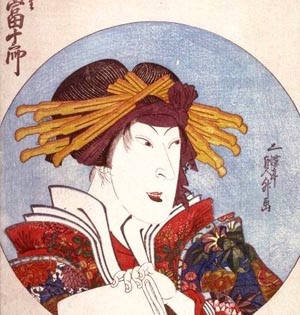
Nakamura Tomijûrô II playing the role of the courtesan Yûgiri in the drama "Kuruwa Bunshô" (commonly called "Yoshidaya") in a print made by Utagawa Sadamasu (1840~1842) The Nakamura Sankô line of actors The Nakamura Matsue line of actors The Nakamura Tomijûrô line of actors |
|
|
| Contact | Main | Top | Updates | Actors | Plays | Playwrights | Programs | Links | FAQ | Glossary | Chronology | Illustrations | Prints | Characters | Derivatives | Theaters | Coming soon | News |