| DAN NO URA KABUTO GUNKI (AKOYA) |
| Play title | Dan no Ura Kabuto Gunki  |
| Authors | Matsuda Bunkôdô Hasegawa Senshi |
| History |
The play "Dan no Ura Kabuto Gunki" was originally written for the puppet theater (Bunraku) and staged for the first time in the 9th lunar month of 1732 in Ôsaka at the Takemotoza. It was adapted for Kabuki the same month, in Kyôto at Miyako Mandayû's theater [casting]. It was staged in Ôsaka for the first time in the 3rd lunar month of 1733, at the Kado no Shibai [casting]. It was staged in Edo for the first time in the 11th lunar month of 1737, at the Kawarasakiza under the title "Urûzuki Ninin Kagekiyo" [casting]. Only one scene survived, the "koto torture" scene, and the role of Akoya was reserved to the elite of onnagata actors, able to play the traditional instruments of music. From 1950 to 1980, only the star Nakamura Utaemon VI was able to perform this role. The drama "Dan no Ura Kabuto Gunki" was revived as a tôshi kyôgen at the National Theatre in January 1997, with Bandô Tamasaburô performing the role of Akoya for the first time [casting]. |
| Structure |
The play "Dan no Ura Kabuto Gunki" was in 5 acts. The "koto torture" scene, commonly called "Akoya", was the third act. |
| Key words |
Akushichibyôe Kagekiyo Chichibu Shôji Shigetada Genpei Kassen Genpei-kassenmono Gidayû Kyôgen Hatakeyama Shigetada Horikawa Jidaimono Kagekiyomono Semeba Taira Kagekiyo Takeda Yakko |
| Summary |
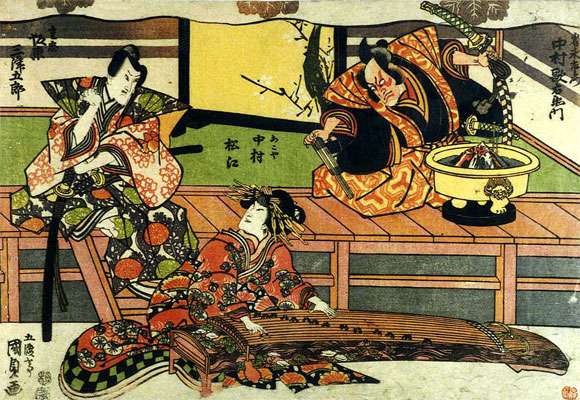
The drama opens in the law court of Horikawa. The rebel Akushichibyôe Kagekiyo, who was captured after his defeat, successfully ran away. Chichibu no Shôji Shigetada is in charge of discovering Kagekiyo's hiding place. The only way to learn about Kagekiyo's whereabouts is to question Kagekiyo's lover, the courtesan Akoya, who is brought to the court under the escort of Hanzawa Rokurô and some soldiers. She says that she has no idea where her lover is. Iwanaga Saemon Munetsura, an akattsura villain performed in the ningyôburi style, who assists Shigetada in his mission, would like to send her to his palace and physically torture her there. Shigetada rebukes him and reminds him that he is the one to lead the mission. Then, he asks Rokurô to bring the instruments he intends to use to question Akoya. Iwanaga takes this request as an opportunity to summon a large group of torturers, who come on stage holding various instruments of torture and performing their role in the comical takeda yakko style. Shigetada order them to leave the palace and Rokurô is back with 3 instruments of ... music: a shamisen, a koto and a kokyû. Akoya is ordered to plays these instruments. She reluctantly accepts and starts with the koto. Her song is about the love she feels for Kagekiyo. After the koto, she plays the shamisen and ends with the kokyû. Her performance is perfect. Even Iwanaga is under the spell of Akoya's music and his hands simulate the playing of an instrument. The true feelings and worries that Akoya expressed in her songs are the definitive proof that Shigetada was looking for: Akoya does not know for sure where her lover is hidden. A liar would not be able to create such a pure music. Shigetada orders the release of Akoya and holds back with his sword the villain Iwanaga, who unsheathes his sword for the final pose. |
 |
|
Bandô Mitsugorô III (top/left), Nakamura Matsue III (bottom) and Nakamura Utaemon III (top/right) playing the roles of Chichibu no Shôji Shigetada, Akoya and Iwanaga Saemon Munetsura in the drama "Dan no Ura Kabuto Gunki", which was staged in the 9th lunar month of 1814 at the Nakamuraza (print made by Utagawa Kunisada I) |
|
Utagawa Kunisada I's triptych (1st lunar month of 1833) |
|
|
| Contact | Main | Top | Updates | Actors | Plays | Playwrights | Programs | Links | FAQ | Glossary | Chronology | Illustrations | Prints | Characters | Derivatives | Theaters | Coming soon | News |