| NAKAMURA GENTARÔ |
|
Stage names:
Existence: ??? ~ ??? Connection: Masters: Nakamura Shichisaburô I, Iwai Hanshirô I Brother: Nakamura Gennosuke Disciple: Nakamura Takesaburô I Career: Before 1699: he started his career at an early age, becoming a disciple of Iwai Hanshirô I and performing wakashugata roles under the name of Iwai Gentarô. 3rd day of the 4th lunar month of 1699 [1]: his first master Iwai Hanshirô I died in Ôsaka. 11th lunar month of 1701: Gentarô played at the Kitagawa no Shibai the role of Tônai Jirô in the kaomise drama "Ima Komachi Eiga Guruma", which was produced by Kokon Shinzaemon. 2nd lunar month of 1702: Gentarô played in the same theater the role of Toranosuke in Chikamatsu Monzaemon's drama "Jorô Raigô Bashira". 7th lunar month of 1702: premiere in Kyôto at Miyako Mandayû's theater of Chikamatsu Monzaemon's drama "Mibu Aki no Nenbutsu", a follow-up of "Keisei Mibu Dainenbutsu", which was produced by Kokon Shinzaemon; Gentarô played the role of the koshô Hayato [more details]. Fall 1702: Gentarô went to Edo. 11th lunar month of 1702: he became disciple of Nakamura Shichisaburô I and wakaonnagata, took the name of Nakamura Gentarô and played at the Ichimuraza the role of Takiguchi's wife in the drama "Yorimasa Hôraizan"; the role of Takiguchi was played by Ikushima Shingorô. 3rd lunar month of 1707: Gentarô's rank in the Edo hyôbanki, wakaonnagata section, was jô (superior) [visual]. 11th lunar month of 1707: Gentarô played at the Yamamuraza the role of Murasame in the kaomise drama "Yukihira Obana Gitsune"; his stage partners in the roles of Murasame's lover Ariwara no Yukihira and Murasame's sister Matsukaze (also in love with Yukihira) were Ikushima Shingorô and Tsutsui Kichijûrô I. 1st lunar month of 1708: Gentarô's rank in the Edo hyôbanki, wakaonnagata section, was jô-jô (superior - superior) [visual]. 3rd day of the 2nd lunar month of 1708 [2]: his second master Nakamura Shichisaburô I died in Edo. 11th lunar month of 1708: Gentarô played at the Yamamuraza the role of Ayame in the kaomise drama "Yorimasa Shiki Samba". 3rd lunar month of 1709: Gentarô's rank in the Edo hyôbanki, wakaonnagata section, was jô-jô-(shiro)kichi (superior - superior - (white) excellent) [visual]. 7th lunar month of 1709: Gentarô played in the same theater the role of Princess Chûjô in the drama "Keisei Hibari Yama"; his stage partners were Ichikawa Danjûrô II, Yamanaka Heikurô I, Ikushima Shingorô, Ogawa Zengorô I and Nakamura Gentarô, who played the role of Princess Chûjô. 11th lunar month of 1709: Gentarô played at the Yamamuraza the role of Princess Shinobu in the kaomise drama "Taihei Okuni Kabuki", which celebrated the arrival in Edo of the Kamigata actors Asao Jûjirô I, Arashi Sanjûrô I and Fujikawa Buzaemon I. 11th lunar month of 1710: Gentarô moved to the Ichimuraza and played the role of Shirotae in the kaomise drama "Shusse Taiheiki", which celebrated the shûmei of Takii Hanshirô and welcomed in Edo the Kamigata actor Kirinami Takie. 3rd lunar month of 1711: Gentarô's rank in the Edo hyôbanki, wakaonnagata section, was jô-jô-kichi (superior - superior - excellent) [visual]. 11th lunar month of 1711: Gentarô played at the Ichimuraza the role of Nowaki in the kaomise drama "Shusse Taiheiki". Fall 1714: Gentarô went back to Kamigata. 11th lunar month of 1714: Gentarô played the role of the courtesan Takao in the drama "Bandai-ga-Ike no Tsurukame", which was produced by Arashi Sanjûrô I at the nadai Shioya Kuroemon's theater. He achieved a great success at the end of the program by performing in solo in a dôjôjimono. 1st lunar month of 1715: Gentarô's rank in the Ôsaka hyôbanki, wakaonnagata section, was jô-jô-kichi (superior - superior - excellent) [visual]. 2nd lunar month of 1716: Gentarô became zamoto and coproduced with Sugiyama Heihachi the kaomise drama "Chôja Mannengura" in Ôsaka. 24th day of the 4th lunar month of 1716 [3]: his brother Nakamura Gennosuke died. Fall 1716: Gentarô went to Edo. 11th lunar month of 1716: Gentarô played at the Nakamuraza the role of Tomoe Gozen in the kaomise drama "Mitsudomoe Katoku Biraki", which celebrated the shûmei of Arashi Kiyosaburô II. He fell ill and was replaced by Nakamura Sen'ya I. 11th lunar month of 1727: Gentarô made a stage comeback in Edo at the Ichimuraza, playing the role of Kôsaka Danjô's daughter Takane in the drama "Goshozome Kôyô Gunki". He was sick but he forced himself to perform. He most likely died soon afterwards but the the day of his death was not recorded. Comments: Nakamura Gentarô was born in Kamigata but settled in Edo while still a child. He became a talented wakaonnagata actor and an outstanding dancer, whose career spanned from the end of the Genroku era to the first year of the Kyôhô era. He excelled in keisei, nuregoto and budôgoto roles. He was treated by the Edo audience as one of their own and they refused to recognize any hint of Kamigata in his style. He was Genta-sama, the favourite of Edo" in the hyôbanki "Yakusha Tomoginmi" ("Friendly investigations in actors" published in 1707). "There is no one who can play Edo fûryû musume roles like him" (from "Yakusha Hako Denju", alias "the Treasure chest of secret arts", 1712). He was also the owner of a cosmetic shop in Edo in the district of Kanda Suda-chô. [1] The 3rd day of the 4th lunar month of the 12th year of the Genroku era was the 2nd of May 1699 in the western calendar. [2] The 3rd day of the 2nd lunar month of the 5th year of the Hôei era was the 24th of March 1708 in the western calendar. [3] The 24th day of the 4th lunar month of the 6th year of the Shôtoku era was the 13th of June 1716 in the western calendar. |

 |
|
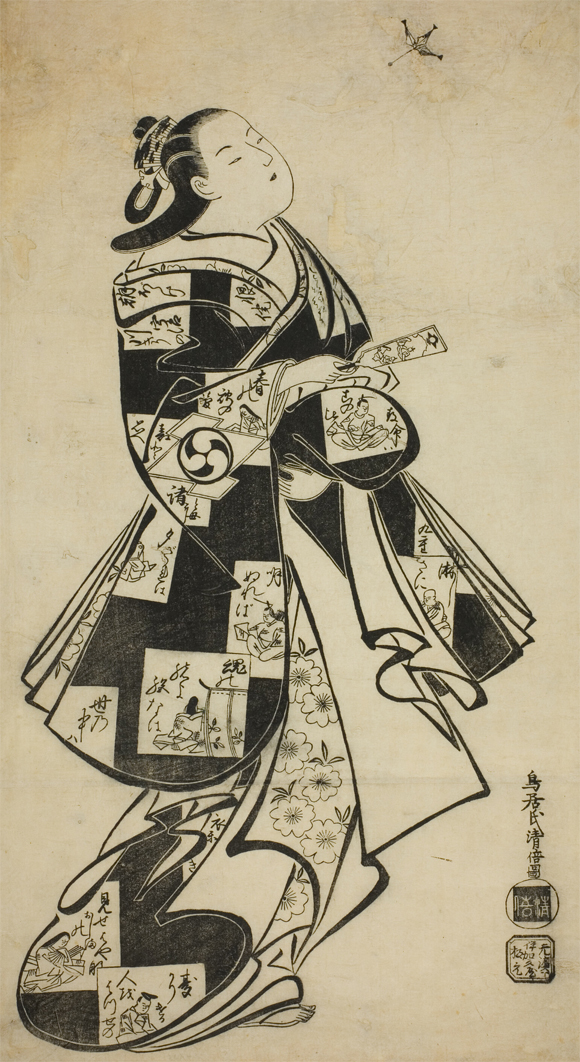
The Actor Nakamura Gentarô as a woman playing battledore and shuttlecockDate |
|
|
| Contact | Main | Top | Updates | Actors | Plays | Playwrights | Programs | Links | FAQ | Glossary | Chronology | Illustrations | Prints | Characters | Derivatives | Theaters | Coming soon | News |