| TAMIYA SHIROGORÔ |
|
Stage names:
Poetry name: Kôon Existence: 1685 ~ 1745 Connection: Son: Tamiya Jûzaburô I Career: 1702: first stage appearance in Ôsaka; he performed as a wakaonnagata at Matsumoto Nazaemon III's theater under the name of Takii Hannosuke. 1st lunar month of 1705: Hannosuke played in Kyôto at Miyako Mandayû's theater the role of Agemaki in Chikamatsu Monzaemon's new year drama "Keisei Kogane no Yodogoi". Fall 1706: Hannosuke went to Edo with Tomizawa Chiyonosuke and Kumamoto Izaemon. 11th lunar month of 1706: Hannosuke played at the Moritaza the role of Tomoe Gozen in the kaomise drama "Keisei Azuma Kagami"; his stage partners were Ichikawa Danzô I, Miyazaki Denkichi, Miyazaki Jûshirô I, Katsuyama Matagorô, Tamon Shôzaemon II, Matsumoto Kantarô, Tomizawa Chiyonosuke and Kumamoto Izaemon. 11th lunar month of 1708: Hannosuke played at the Ichimuraza the role of Momoyo-no-Mae in the kaomise drama "Shusse Taiheiki". 11th lunar month of 1710: Takii Hannosuke took the name of Takii Hanshirô at the Ichimuraza, playing the role of Nitta Yoshisada in the kaomise drama "Shusse Taiheiki". 11th lunar month of 1711: Hanshirô played at the Ichimuraza the role of Nitta Yoshisada in the kaomise drama "Shusse Taiheiki". 2nd lunar month of 1714: the love affair, which involves Ejima, a court lady who served the mother of the Shôgun, and the actor Ikushima Shingorô, was discovered in the backstage of the Yamamuraza. This incident, which broke the boundaries between samurai and commoner, was a serious crime for the authorities, which decided to deal ruthlessly with the culprits: Ejima and Ikushima Shingorô were exiled to different places, those in the Shôgun's household who were held responsible were executed, the Yamamuraza was definitively closed and its management was heavily fined; Hanshirô, who was involved to a small extent, was also condemned and had to stop acting [more details]. 3rd lunar month of 1715: Hanshirô was pardoned. He did not return to Edo and joined a travelling troupe (tabi shibai). Spring 1718: he took the name of Tamiya Shirogorô in Ise [1]. Summer 1718: Shirogorô went back to Ôsaka to perform at the Kita no Shibai. 11th lunar month of 1718: Shirogorô played at the Naka no Shibai the role of Hiki Sawaemon in Azuma Sanpachi's kaomise drama "Sumiyoshi Tanjôseki", which was produced by Takeshima Kôzaemon II. 1st lunar month of 1719: Shirogorô's rank in the Ôsaka hyôbanki, tachiyaku section, was jô-jô-(shiro)kichi (superior - superior - (white) excellent) [visual]. He shared the same rank with Yamamura Kazaemon, Takenaka Tôzaburô, Murayama Heijûrô II and Sugiyama Kanzaemon III. 11th lunar month of 1720: Shirogorô played in Ôsaka at the Higashi no Shibai the roles of Tokiwagi Jônosuke [2] and Higashitsuji Sakyô in Kyôya Yagoshirô's kaomise drama "Kogane no Ikioi" and in the kiri kyôgen "Nanshoku Kamo Samurai Jûshichikinenki", which were produced by Arashi San'emon III. 6th lunar month of 1732 ~ 1734: tour in Ise and long stay in Nagoya; Shirogorô's travelling and stage partners were Fujioka Daikichi, Ogino Yaegiri I, Arashi Sanjûrô I, Sakakiyama Fujisaburô, Tatsuoka Someemon, Sawamura Sôgorô I, Sagawa Bunzô II, Fukuda Dan'emon, Ôtori Michiemon and Matsushima Hyôtarô. 11th lunar month of 1734: Shirogorô played in Ôsaka at the Kado no Shibai the role of Tada Katsuemon in the kaomise drama "Shin Yakata In'yô no Ishizue"; his stage partners were Sawamura Otoemon I, Izumikawa Sennosuke, Nakayama Shinkurô I, Yamashita Matatarô I, Kamakura Heikurô I and Matsushima Moheiji. 1st lunar month of 1735: Shirogorô's rank in the Ôsaka hyôbanki, tachiyaku section, was jô-jô-kichi (superior - superior - excellent) [visual]. He shared the same rank with Anegawa Shinshirô I, Sawamura Otoemon I, Arashi Sangorô I and Ichiyama Sukegorô I. 11th lunar month of 1736: Shirogorô played at the Ônishi no Shibai in the kaomise drama "Banshû Onna Narihira". 11th lunar month of 1738: Shirogorô played in the kaomise drama "Neko no Koneko", which was produced in Kyôto at Hoteiya Umenojô's theater (Minamigawa no Shibai) by Mizuki Tatsunosuke II. 12th lunar month of 1740: Shirogorô performed in the drama "Chinpô Sandai Gatana", which was produced by Sakakiyama Jûtarô I and starred Sakakiyama Koshirô I and Sakakiyama Shirotarô I. The title of this drama, literally "The Rare Treasure - Three Generations of Swords" [3], was an allusion to the three generations of actors of the Sakakiyama clan sharing the same stage. 8th lunar month of 1741: the play "Shin Usuyuki Monogatari", which was originally written for the puppet theater, was adapted for Kabuki for the first time, in Kyôto at Hayagumo Chôdayû's theater; Shirogorô played the role of Sonobe Hyôe [casting]. 11th lunar month of 1741: Shirogorô played in Kyôto at Kameya Kumenojô's theater the role of Shimazaki Sadaemon in the kaomise drama "Chôseiden Wagô no Futahashira", which was produced by Sakata Ichitarô. 5th lunar month of 1742: Chikamatsu Monzaemon's play "Shinshû Kawanakajima Kassen" was adapted for Kabuki for the first time, in Kyôto at the Kitagawa no Shibai; Shirogorô played the role of Yamamoto Kansuke's mother [more details]. 11th lunar month of 1742: Shirogorô played in Kyôto in the kaomise drama "Ômi Genji Taihei no Kachidoki", which was produced by Hanakawa Ichinojô at Hayagumo Chôdayû's theater and welcomed in the Imperial City the actors Nakamura Utaemon I and Tsuuchi Monzaburô I. 11th lunar month of 1743: Shirogorô played at Hoteiya Umenojô's theater the role of Aoto Saemon Fujitsuna in the kaomise drama "Yomeiri Ôshimadai", which was produced by Nakamura Kumetarô I and celebrated the shûmei of Sanjô Mankatsu. 11th lunar month of 1744: Shirogorô played in Kyôto at Miyako Mandayû's theater the role of Taema Tomoemon in the kaomise drama "Hakata Ori Imose no Karanishiki"; his stage partners were Fujioka Daikichi, Matsumoto Tomojûrô I, Sawamura Chôshirô, Sadoshima Chôgorô I, Mihogi Gizaemon I, Nakamura Danzô, Tatsuoka Hisagiku, Sanogawa Hanazuma II, Sakakiyama Danshirô I, Takenaka Heikichi, Ikushima Kashiwagi I, Nakamura Matsubê I, Nakamura Kiyosaburô I and Fujioka Gengorô. 1st lunar month of 1745: Shirogorô's name appeared in a Kabuki hyôbanki for the last time, in Kyôto in the tachiyaku section. His rank was jô-jô-kichi (superior - superior - excellent) and he shared the same rank with Sakakiyama Shirotarô I, Fujioka Daikichi and Yamamoto Kyôshirô I. 2nd lunar month of 1745: Shirogorô appeared on stage for the last time, in Kyôto at Miyako Mandayû's theater, playing the role of farmer Magosaku in the new year drama "Keisei Sakura Gassen". Comments: Tamiya Shirogorô was an important tachiyaku of the first half of the 18th century, the founder of the Tamiya clan. His field of excellence was jitsugoto. He also compiled the book "Zoku Nijinshû", a sequel to Kaneko Ikkô's book "Nijinshû" ("Dust in the Ears"). [1] He most likely became tachiyaku around the same time. [3] It had also a different suggestive meaning because the word chinpô is the penis in old Japanese. |

 |
|
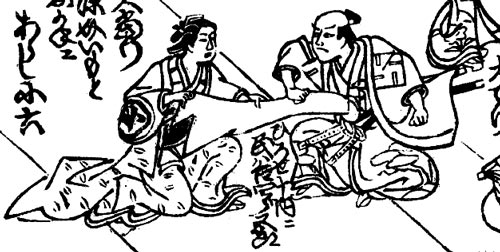
Arashi Koroku I (left) and Tamiya Shirogorô (right) performing in the kaomise drama "Senzai Yakata Kogane no Shikigawara", which was staged in the 11th lunar month of 1739 in Kyôto at Ebisuya Kichirôbê's theater |
|
|
| Contact | Main | Top | Updates | Actors | Plays | Playwrights | Programs | Links | FAQ | Glossary | Chronology | Illustrations | Prints | Characters | Derivatives | Theaters | Coming soon | News |