| NAKAMURA KAROKU I |
|
Stage names:
Other name:
Nickname: Keisei Karoku Guild: Harimaya Line number: SHODAI (I) Poetry names: Baishi, Shikin, Shikin, Shûka, Baidô Existence: 1779 ~ 1st day of the 7th lunar month of 1859 [1] Connections: Masters: Nakamura Tamasuke (Nakamura Utaemon III), Nakamura Noshio III Sons: Nakamura Tsunejirô, Bandô Shûka II (Nakamura Karoku II), Nakamura Karoku III Sons-in-law: Arashi Rikan III, Ichikawa Kodanji IV, Kataoka Nizaemon VIII, Yamashita Sankatsu Grandsons: Nakamura Kichiemon I, Nakamura Tokizô III, Nakamura Kanzaburô XVII, Kataoka Tôkichi, Kataoka Shigejirô, Kataoka Nizaemon X, Kataoka Nizaemon XI Great-grandsons: Nakamura Tokizô IV, Yorozuya Kinnosuke, Nakamura Shidô I, Nakamura Kashô II, Nakamura Kazuo, Nakamura Kanzaburô XVIII, Kataoka Nizaemon XII Great-great-grandsons: Matsumoto Hakuô II (Kôshirô IX), Nakamura Kichiemon II, Nakamura Manju (Nakamura Tokizô V), Nakamura Matagorô III, Nakamura Karoku V, Nakamura Shidô II, Nakamura Kinnosuke II, Nakamura Kankurô VI, Nakamura Shichinosuke II, Kataoka Gadô V, Ichimura Yoshigorô II, Kataoka Roen VI Great-great-great-grandsons: Matsumoto Kôshirô X, Nakamura Tokizô VI, Nakamura Mantarô, Nakamura Kashô IV, Nakamura Tanenosuke, Nakamura Yonekichi V, Nakamura Ryûnosuke, Nakamura Hayato, Ichimura Kakitsu IX, Kataoka Shinnosuke, Kataoka Takatarô, Nakamura Kantarô III, Nakamura Chôzaburô II, Nakamura Haruki, Nakamura Natsuki Great-great-great-great-grandsons: Ichikawa Somegorô VIII, Onoe Kikunosuke VI, Nakamura Tanetarô V, Nakamura Hidenosuke, Nakamura Baishi V Career: 1779 ~ 1804: born in Ôsaka. He was the son of Tanbaya Nisuke, a bantô for the Mitsui Company in Ôsaka. Then, he was adopted by Harimaya Sakubê. He started his career as a disciple of Nakamura Noshio III, who gave him the name of Nakamura Moshio I. End of 1803 ~ Beginning of 1804: he became disciple of Nakamura Utaemon III and received the name of Nakamura Karoku I. 1st ~ 9th lunar months of 1806: Karoku became zamoto at the Kado no Shibai; he produced the dramas "Iroha Uta Homare no Meiboku" (1st lunar month), "Kokusen'ya Gassen" (3th lunar month) and "Ichi-no-Tani Futaba Gunki" (8th lunar month). 11th lunar month of 1823: Karoku played at the Kitagawa no Shibai the role of Akoya in the drama "Dan no Ura Kabuto Gunki"; his stage partners were Nakamura Utaemon III (Iwanaga Saemon) and Ichikawa Ebijûrô I (Shigetada). 1st lunar month of 1827: Karoku's rank in the Kamigata hyôbanki, wakaonnagata section, was jô-jô-kichi (superior - superior - excellent) [visual]. Fall 1827: Karoku went to Edo with the actors Onoe Kikujirô I, Sakata Hangorô IV and Nakamura Kinji. 11th lunar month of 1827: Karoku performed at the Kawarasakiza in the kaomise drama "Muro no Ume Hôgan Biiki" [2]. 6th lunar month of 1828: Karoku played in the same theater the roles of Otane and Nureginu in the drama "Honchô Nijûshikô". 10th lunar month of 1828: the Kabuki world was targeted by the authorities, which implements some sumptuary laws. Karoku and others actors were punished because of their ostentatious luxurious way of life. Karoku was placed for a little while under house arrest in a shop located in the district of Kobiki-chô. 11th lunar month of 1828: Karoku performed at the Kawarasakiza in Mimasuya Nisôji's kaomise drama "Sakigake Genji no Kibamusha", which welcomed in Edo the actors Sawamura Gennosuke II, Arashi Danpachi and Yoshizawa Enjirô; his yearly salary was 600 ryô. 13th day of the 4th lunar month of 1831 [3]: his first master Nakamura Noshio III died. 4th lunar month of 1832: Karoku appeared on stage in Edo for the last time, at the Nakamuraza, where he performed in the dance "Oni Yarai". Then, he went back to his native Kamigata. 8th lunar month of 1832: Karoku was back in Ôsaka and performed at the Kado no Shibai. 11th lunar month of 1832: Karoku performed at the Minamigawa no Shibai in the kaomise drama "Keisei Shina Sadame". 1st lunar month of 1833: Karoku's rank in the Kamigata hyôbanki, wakaonnagata section, was (shiro)itaru-jô-jô-kichi ((white) unique - superior - superior - excellent) [Visual]. He played at the Naka no Shibai the roles of the courtesan Enoshima, Asaka and Kimi-no-Kata in the drama "Hime Kurabe Futaba Ezôji". 6th lunar month of 1833: Karoku played the role of Masaoka in the drama "Meiboku Sendai Hagi", which was staged in the precincts of the Inaba Yakushi Temple in Kyôto. He also played the role of Sankatsu in the drama "Mai Ôgi"; the role of Hanshichi was played by Ogawa Kichitarô III. 1st lunar month of 1834: Karoku's rank in the Kamigata hyôbanki, wakaonnagata section, was itaru-jô-jô-kichi (unique - superior - superior - excellent) [Visual]. 6th ~ 7th lunar months of 1835: tour in Nagoya and Kuwana with Arashi Rikan II, Arashi Sangorô IV and Kataoka Gashô. 1st lunar month of 1842: Karoku's rank in the Kamigata hyôbanki, wakaonnagata section, was (shiro)ô-jô-jô-kichi (almost grand - superior - superior - excellent) [Visual]. 3rd lunar month of 1846: Karoku played at the Kado no Shibai the roles of Kaoyo Gozen, Ichimonjiya Ohana and Tonase in the drama "Kanadehon Chûshingura". 5th lunar month of 1849: Karoku played at the Chikugo no Shibai the roles of Osai, Oseki and Oichi in the dramas "Akiba Gongen Kaisen Banashi", "Futatsu Chôchô Kuruwa Nikki" and "Godairiki Koi no Fûjime"; his stage partners were Ichikawa Ebizô V, Mimasu Daigorô IV, Kataoka Gadô II and Sawamura Kitô II. Summer 1849: tour in Nagoya; Karoku played the role of Osono in the drama "Hikosan Gongen Chikai no Sukedachi", which was staged in the precincts of the Seijuin Temple; the role of Rokusuke was played by Arashi Rikan III. 1st lunar month of 1851: Karoku played at the Kado no Shibai the roles of Asaka and Okoma in the drama "Hime Kurabe Futaba Ezôji". 1st lunar month of 1855: Karoku's rank in the Kamigata hyôbanki, wakaonnagata section, was shin-jô-jô-kichi (truly - superior - superior - excellent) [Visual]. 3rd lunar month of 1859: Karoku played at the Naka no Shibai the role of Matsuômaru's wife Chiyo in the drama "Sugawara Denju Tenarai Kagami"; the role of Matsuômaru was played by Arashi Kichisaburô III. The same drama was staged with the same casting in the 5th lunar month in Kyôto at the Higashigawa no Shibai. 6th lunar month of 1859: Karoku appeared on stage for the last time, at the Wakayama no Shibai in the province of Kishû, playing the roles of Masaoka and Omine in the dramas "Meiboku Sendai Hagi" and "Ise Ondo Koi no Netaba". He suddenly fell ill. 1st day of the 7th lunar month of 1859 [1]: Karoku died. Comments: Nakamura Karoku I was a great Kamigata onnagata actor, who excelled in keisei roles and was therefore nicknamed "Keisei Karoku". "Nakamura Karoku, another onnagata of distinction, was the son of a clerk connected with the Mitsui Company in Ôsaka. He was a large, handsome man, and had blood relations with many actor families. His first wife died; he married a second half his age, and had altogether twelve children. One daughter married the third Arashi Rikan, another became the wife of Ichikawa Kodanji, while a third was the wife of Kataoka Nizaemon, the eighth. He had a habit of coughing when crossing a bridge near his home to let his household know of his approach, and was considered very extravagant because there were always two candles burning at the entrance to his house that a bright welcome should be waiting him when he returned from the theatre." (Zoë Kincaid in "Kabuki, the Popular Stage of Japan") [1] The 1st day of the 7th lunar month of the 6th year of the Ansei era was the 30th of July 1859 in the western calendar. [2] Another possible reading of this title could be "Muro no Ume Hangan Biiki". This drama was premiered in the 11th lunar month of 1817 at the Miyakoza. [3] The 13th day of the 4th lunar month of the 2nd year of the Tenpô era was the 25th of May 1831 in the western calendar. |

 |
|
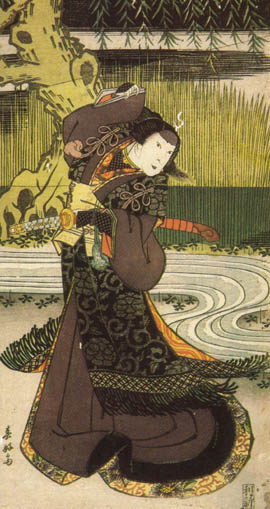
Nakamura Karoku I in the drama "Keisei Ômon Guchi", which was staged in the 1st lunar month of 1823 at the Kado no Shibai (print made by Shunkôsai Hokushû) Print made by Shunkôsai Hokushû in 1823 Print made by Shumbaisai Hokuei in 1832 The Nakamura Moshio line of actors The Nakamura Karoku line of actors |
|
|
| Contact | Main | Top | Updates | Actors | Plays | Playwrights | Programs | Links | FAQ | Glossary | Chronology | Illustrations | Prints | Characters | Derivatives | Theaters | Coming soon | News |