| ÔTANI HIROJI I |
|
Stage name:
Guild: Maruya Line number: SHODAI (I) Poetry name: Jicchô Existence: 1699 ~ 25th day of the 5th lunar month of 1747 [1] Connections: Father: Ôtani Hiroemon I Son: Ôtani Saizô Son-in-laws: Onoe Kikugorô I, Ogino Izaburô I Disciples: Ôtani Hiroji II, Ôtani Hirohachi I, Ôtani Rokuzô, Ôtani Masugorô, Ôtani Hikosaburô (?) Career: Winter 1702: he made his first appearance on stage, in Edo at the Moritaza, where he received the name of Ôtani Hiroji I. 11th lunar month of 1710: Hiroji became katakiyaku and played at the Yamamuraza the role of Yokogumo Ôji in the kaomise drama "Jinriki Teika Azuma Asobi". 11th lunar month of 1711: Hiroji played at the Yamamuraza the role of Ukijima Kanzô in the kaomise drama "Shida Konjiki no Uroko". 11th lunar month of 1713: Hiroji became jitsuaku, like his father Ôtani Hiroemon I, and played at the Nakamuraza the role of Tsukamakiya Goroshichi in the kaomise drama "Onna Kusunoki Taiheiki". 11th lunar month of 1714: Hiroji played at the Moritaza the role of Kamakura Gongorô Kagemasa in the kaomise drama "Onna Ryûko Futatsu Gashira". 11th lunar month of 1715: Hiroji played at the Nakamuraza the role of Motoi no Hayata in the kaomise drama "Kogane no Kaburi Konrei Yorimasa". 11th lunar month of 1716: Hiroji moved to the Ichimuraza and achieved a great success by playing the role of Toriumi Yasaburô in the kaomise drama "Yoroi Kurabe Ôshû Gane". 11th lunar month of 1717: Hiroji played at the Ichimuraza the role of Tori-no-Umi in the kaomise drama "Kinkazan Yoroi Biraki". 11th lunar month of 1719: Hiroji played at the Nakamuraza the role of Katagiri Yashichi in the kaomise drama "Nyohitsu Taiheiki", which commemorated the 6th anniversary (7th memorial service) of the passing away of Nakamura Denkurô I and celebrated the shûmei of Tamazawa Kôjûrô. 1st lunar month of 1720: first Kabuki adaptation of Chikamatsu Monzaemon's puppet theater shinjûmono "Shinjû Kasane Izutsu", which was written in 1707. The same play was simultaneously produced in the 3 Edo theaters and commemorated the 16th anniversary (17th memorial service) of the suicide of the couple Tokubê and Ofusa, whose roles were played by Hiroji and Sanogawa Mangiku at the Nakamuraza [more details]. 2nd lunar month of 1720: Hiroji's rank in the Edo hyôbanki, tachiyaku section, was jô-jô-kichi (superior - superior - excellent) [visual]. 19th day of the 2nd lunar month of 1721 [2]: his father Ôtani Hiroemon I died. 9th lunar month of 1723: the Nakamuraza produced a special program to celebrate the departure of Hiroji to Kamigata; he played the role of Osaragi Saburobê in the drama "Wakaura Osana Komachi". Fall 1723: Hiroji went to Kamigata. 11th lunar month of 1723: great kaomise program at the Kado no Shibai in Ôsaka to celebrate the arrival of Hiroji in this city; the zamoto Arashi San'emon III produced the kaomise drama "Kogane no Hanagata", in which Hiroji played the role of Fujikata Manzô. 1st lunar month of 1724: Hiroji's rank in the Ôsaka hyôbanki, tachiyaku section, was jô-jô-kichi (superior - superior - excellent) [visual]. Premiere at the Kado no Shibai of "Edoe Ukiyo Soga", an Edo-flavored new year drama; Hiroji played the roles of Kobayashi no Asahina and Osaragi Sabu (Kurofune Chûemon) [casting]. Fall 1724: Hiroji settled in Kyôto. 11th lunar month of 1724: Hiroji played the roles of Fujikata Manzô and the yakko Tagohei in the kaomise drama "Ôjigawa Kogane no Mizuguruma", which was produced by the zamoto Segawa Kikunojô I for the nadai Miyako Mandayû. 11th lunar month of 1725: Hiroji played in Kyôto at Kameya Kumenojô's theater the role of Hiyoku Gonpachi in Azuma Sanpachi's kaomise drama "Senzai Gura Sangai Matsu", which was produced by the zamoto Arashi Jûjirô. 1st lunar month of 1726: Hiroji's rank in the Kyôto hyôbanki, tachiyaku section, was jô-jô-kichi (superior - superior - excellent) [visual]. 11th lunar month of 1726: Hiroji played the role of Kumagai in the kaomise drama "Shinzô Kishi no Himematsu", which was produced by Sanogawa Mangiku for the nadai Hayagumo Chôdayû. Fall 1727: Sanogawa Mangiku produced in the same theater the drama "Onna Tosa Nikki", which celebrated the coming departure of Hiroji . Fall 1727: Hiroji went back to Edo along with the Kamigata actor Kirinami Onoe. 11th lunar month of 1727: Hiroji played at the Nakamuraza the role of Ômori Hikoshichi in the kaomise drama "Yatsumune Taiheiki" [more details]. 11th lunar month of 1729: great kaomise at the Nakamuraza; the 4 tachiyaku Bandô Hikosaburô I, Sawamura Sôjûrô I, Ichikawa Danjûrô II and Hiroji performed together in the kaomise drama "Ume Goyomi Konrei Nagoya"; Hiroji achieved a great success by playing the role of Fuwa Banzaemon, confronting Ichikawa Danjûrô II in the role of Nagoya Sanza. Fall 1730: The actors Sawamura Sôjûrô I, Ogino Izaburô I, Bandô Hikosaburô I, Ichikawa Danjûrô II and Hiroji performed together in the play "Meigetsu Gonin Otoko" ('Five men under the August moon'), which was staged in the same theater [casting]. 11th lunar month of 1730: Hiroji performed at the Nakamuraza in the kaomise drama "Irifune Hiru-ga-Kojima". 1st lunar month of 1731: Hiroji played in the same theater the role of Nagoya Saburozaemon in the new year drama "Keisei Fukubiki Nagoya" ("The courtesan, the Tombola Drawing and Nagoya Sanza") [casting]. 11th lunar month of 1732: Hiroji played at the Ichimuraza the roles of Miura Daisuke and Matano Gorô in the kaomise drama "Tsuwamono Kongen Hiru-ga-Kojima". 11th lunar month of 1735: Hiroji played at the Ichimuraza the role of Ôtomo Onohachi in the kaomise drama "Kongen Nana Komachi". 9th lunar month of 1736: Hiroji played in the same theater the role of Meaka no Fudô ('red-eyed Fudô') in the drama "Yonin Fudô" ('The Four Deities Fudô'); his stage partners in the roles of Meguro no Fudô ('black-eyed Fudô'), Mejiro no Fudô ('white-eyed Fudô') and Meao no Fudô ('blue-eyed Fudô') were Ichikawa Ebizô II, Ichikawa Danjûrô III and Ichimura Takenojô IV. 11th lunar month of 1736: Hiroji and the Segawa brothers, Kikunojô and Kikujirô, moved to the Nakamuraza and performed in the kaomise drama "Kuni no Tomi Sesshôseki". 9th lunar month of 1737: the Nakamuraza produced a special program to celebrate the coming departure of Hiroji, Segawa Kikunojô I and Segawa Kikujirô I to Kamigata; The three actors performed together in the drama "Ashiya Dôman Ôuchi Kagami". 11th lunar month of 1737: great kaomise program produced by Miyako Mandayû in Kyôto to celebrate the arrival of Hiroji; he played the role of Sano Genzaemon in the kaomise drama "Kuni no Tomi Sakae no Hachinoki". 11th lunar month of 1738: Hiroji played in Kyôto the role of Ikoma Hideemon in the kaomise drama "Ichi no Tomi Hôrai Yakata", which was produced by Nakamura Tomijûrô I for the nadai Kameya Kumenojô. 1st lunar month of 1739: Hiroji played in the same theater the roles of Imagawa Ryôshun, Hatakeyama Masanaga and Edohei in the new year drama "Keisei Arashiyama". 11th lunar month of 1739: Hiroji played the role of Ise no Saburô in the kaomise drama "Muromachi-dono Chôhô Denki", which was produced by Sanogawa Ichimatsu I for the nadai Miyako Mandayû; his stage partners were Yamanaka Heijûrô I (Nikki Danjô), Onoe Kikugorô I (Enju) and Sawamura Otoemon I (Ôuchi Kamon). Fall 1740: Hiroji settled in Ôsaka. 11th lunar month of 1740: Hiroji played at the Naka no Shibai the role of Kôsaka Danjô in the kaomise drama "Shinra Genji Shimada Gunpô", which was produced by Sanogawa Hanazuma II. Fall 1741: Hiroji went back to Edo. 11th lunar month of 1741: Hiroji played at the Ichimuraza the role of Ôe no Iwato Saemon in the kaomise drama "Sugatae Onna Narihira". 7th lunar month of 1742: the play "Keisei Hangonkô" was staged for the first time in Edo, at the Nakamuraza. Hiroji played the role of Matahei [casting]. 11th lunar month of 1743: Hiroji played at the Nakamuraza the role of Ashikaga Takauji in the kaomise drama "Funayosooi Mitsugi Taiheiki". 1st lunar month of 1744: Hiroji's rank in the Edo hyôbanki, tachiyaku section, was ô-jô-jô-kichi (grand - superior - superior - excellent) [Visual]. 2nd lunar month of 1744: premiere at the Nakamuraza of the Nagauta-based dôjôjimono "Momo Chidori Musume Dôjôji". The leading female role was played by Segawa Kikunojô I and his two stage partners were Ichikawa Ebizô II and Hiroji. 11th lunar month of 1744: Hiroji was expected to perform at the Nakamuraza in the kaomise drama "Kachô Taiheiki" but he suddenly fell ill and had to retire. 25th day of the 5th lunar month of 1747 [1]: Hiroji died in Edo [3]. Comments: Ôtani Hiroji I was an outstanding tachiyaku, who made a very successful career during the first half of the eighteenth century. He was one of the 4 stars called Shitennô ("the big four", this expression comes from the four Deva kings in Buddhism) by the Edo audience (the three others were Sawamura Sôjûrô I, Bandô Hikosaburô I and Ichikawa Danjûrô II). His fame was not limited to Edo and he made 2 successful tours in the Kamigata cities of Ôsaka and Edo. [1] The 25th day of the 5th lunar month of the 4th year of the Enkyô era was the 2nd of July 1747 in the western calendar. [2] The 19th day of the 2nd lunar month of the 6th year of the Kyôhô era was the 16th of March 1721 in the western calendar. [3] Ôtani Hiroji I's tombstone was located in the cemetery of the Taisenji Temple in the district of Asakusa. |

 |
|
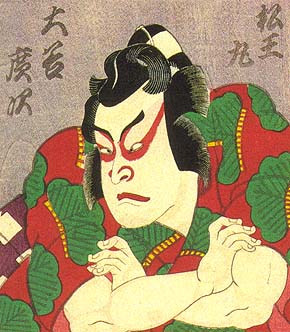
Ôtani Hiroji I playing the role of Matsuômaru in a print made by Utagawa Toyokuni III (1862~1863) The Ôtani Hiroji line of actors |
|
|
| Contact | Main | Top | Updates | Actors | Plays | Playwrights | Programs | Links | FAQ | Glossary | Chronology | Illustrations | Prints | Characters | Derivatives | Theaters | Coming soon | News |