| BANDÔ JUTARÔ I |
|
Stage names:
Guilds: Narutaya, Kamiya, Kameya, Yaoya Line number: SHODAI (I) Poetry names: Kaseki (?), Tôshi, Ganshi Existence: 1769 ~ 24th day of the 12th lunar month of 1840 [1] Connection: Adoptive father: Bandô Iwagorô Disciples: Bandô Jusaburô I, Bandô Kunigorô III, Bandô Kunigorô IV, Bandô Hanazuma Career: 1769 ~ 1791: born in Ôsaka. His father was the sumôtori Edozaki Kosaburô. He started his career around 1788 as a musumegata performing in hama shibai (stage name unknown). He was adopted by Bandô Iwagorô at the beginning of the 1790s. 11th lunar month of 1791: he made his debut in ôshibai, taking the name of Bandô Jûtarô and playing as a wakaonnagata at the Naka no Shibai the role of Princess Tsukimitsu in the drama "Fûryû Ôeyama", which ended the kaomise program "Furisode Shuten Dôji", which was produced by Hanagiri Tomimatsu II and celebrated the arrival in Ôsaka of the Edo star Sawamura Sôjûrô III. 11th lunar month of 1792: Jûtarô became tachiyaku and zamoto; he produced at the Naka no Shibai the kaomise drama "Chûshin Futabagura". 2nd lunar month of 1794: premiere at the Naka no Shibai of Namiki Gohei I's drama "Shima Meguri Uso no Kikigaki"; the last scenes were a sewamono drama, which was staged independently in the 5th lunar month of 1794 under the title "Godairiki Koi no Fûjime"; Jûtarô played the role of Chishima Mantarô [more details]. 17th day of the 8th lunar month of 1795 [2]: his adoptive father Bandô Iwagorô died. 1800s ~ beginning of the 1810s: he performed mainly in hama shibai (Ôsaka venues like the Wakadayû no Shibai or the Takeda no Shibai) or in travelling troupes performing in miyaji shibai around Kyôto. 2nd lunar month of 1806: the play "Kamakura Sandaiki" was staged for the first time in Kyôto, in the precincts of the Inaba Yakushi temple; the main roles were played by Yamashina Jinkichi II (Princess Toki), Mimasu Seibê (Takatsuna) and Jûtarô (Miuranosuke). 4th lunar month of 1812: Jûtarô and 20 Kamigata actors (including Ôtani Tomoemon II and Nakayama Bungorô I) moved to Edo. They performed at the Moritaza in the dramas "Tomoyobi Kawasu Shimabara no Saiken" and "Ise Ondo Koi no Netaba" (Jûtarô played the role of Fukuoka Mitsugi). 5th lunar month of 1812: Jûtarô played in the same theater the roles of Abe no Sadatô and Sodehagi in the drama "Zôhô Adachigahara" (similar to "Ôshû Adachi-ga-Hara"); the roles of Abe no Munetô was played by Ôtani Tomoemon II. Summer 1812: Jûtarô went back to Kamigata. Winter 1817: Jûtarô joined a troupe of several Kamigata actors, led by Kataoka Nizaemon VII, who travelled together up to Edo. 3rd lunar month of 1817: Jûtarô played at the Kiriza in the drama "Shinbutai Megumi no Ishizue"; his Edo stage partners were Suketakaya Takasuke II, Ichikawa Dannosuke III and Iwai Kumesaburô II. 4th lunar month of 1817: Jûtarô played in the same theater the role of Jihizô in the drama "Honchô Nijûshikô". 5th lunar month of 1817: Jûtarô played in the same theater the role of the yakko Chienai in the drama "Kiichi Hôgen Sanryaku no Maki". 6th lunar month of 1817: premiere in ôshibai of the puppet drama "Hana no Ueno Homare no Ishibumi", which was staged in Edo at the Kiriza; Jûtarô played the role of the uba Otsuji [more details]. Fall 1817: Jûtarô went to Kyôto. 11th lunar month of 1817: Jûtarô played at the Kitagawa no Shibai the roles of Fujiwara no Kamatari and the fisherman Fukashichi, in reality Kanawa Gorô Imakuni, in the drama "Imoseyama Onna Teikin". 1st lunar month of 1818: Jûtarô played in the same theater the role of Sakuramaru in the drama "Sugawara Denju Tenarai Kagami"; the roles of Matsuômaru and Umeômaru were played by Kataoka Nizaemon VII and Arashi Sangorô III. 8th lunar month of 1822: tour in Nagoya with a troupe led by the Edo star Iwai Hanshirô V; his stage partners were Nakayama Shinkurô III and Nakayama Icchô IV; they performed at the Tachibana no Shibai in "Ranjatai Nitta Keizu" and "Edo Murasaki Naniwa no Iroage". 1st lunar month of 1824: Jûtarô's rank in the Kamigata hyôbanki, tachiyaku section, was jô-jô-kichi (superior - superior - excellent) [visual]. 11th lunar month of 1825: he replaced the first ideogram of his first name Jû (serious) by the ideogram Ju (longevity):
You need a Japanese Language Kit installed within your system in order to be able to read the characters 11th lunar month of 1826: Jutarô played at the Minamigawa no Shibai the roles of Koyoshi and Kujaku Saburô in the drama "Hade Kurabe Ise Monogatari". 1st lunar month of 1827: Jutarô's rank in the Kamigata hyôbanki, tachiyaku section, was (shiro)itaru-jô-jô-kichi ((white) unique - superior - superior - excellent). 11th lunar month of 1827: Jutarô played at the Takeda no Shibai the roles of Tokushima Chikara and Osai in the drama "Azuma Kaidô Chaya Musume"; his main stage partner was Fujikawa Tomokichi II. 1st lunar month of 1828: Jutarô's rank in the Kamigata hyôbanki, tachiyaku section, was (shiro)itaru-jô-jô-kichi ((white) unique - superior - superior - excellent) [Visual]. 1st lunar month of 1829: Jutarô played at the Naka no Shibai the roles of Dankurô, Sonobe Hyôe and Magaki in the drama "Shin Usuyuki Monogatari". 5th lunar month of 1829: Jutarô played at the Naka no Shibai the roles of Enju and Hatakeyama Shigetada in the drama "Hirakana Seisuiki". He also played the role of Tokubê in the drama "Natsu Matsuri Naniwa Kagami"; the roles of Danshichi Kurobê and Tsuribune Sabu were played by Ichikawa Hakuen II and Ichikawa Danzô V. 1st lunar month of 1830: Jutarô's rank in the Kamigata hyôbanki, tachiyaku section, was (shiro)ô-jô-jô-kichi (almost grand - superior - superior - excellent). 11th lunar month of 1830: Jutarô played at the Minamigawa no Shibai the role of Saginuma Tarô in the drama "Ehon Utô Monogatari". 1st lunar month of 1831: Jutarô's rank in the Kamigata hyôbanki, jitsuaku/katakiyaku section, was (shiro)ô-jô-jô-kichi (almost grand - superior - superior - excellent). 1st lunar month of 1832: Jutarô's rank in the Kamigata hyôbanki, jitsuaku/katakiyaku section, was ô-jô-jô-kichi (grand - superior - superior - excellent). 1st lunar month of 1833: premiere of "Chichi Morai" at the Kado no Shibai; Jutarô played the role of Iwakiya Tôzaburô [casting]. 3rd lunar month of 1833: premiere at the Kitagawa no Shibai of "Hana Fubuki Koi no Tekagami"; Jutarô played the role of Iwakiya Tôzaburô [casting]. 1st lunar month of 1834: Jutarô's rank in the Kamigata hyôbanki, jitsuaku/katakiyaku section, was (shiro)goku-jô-jô-kichi (almost extreme - superior - superior - excellent). 1st lunar month of 1836: Jutarô's rank in the Kamigata hyôbanki, jitsuaku/katakiyaku section, was shin-jô-jô-kichi (truly - superior - superior - excellent) [Visual]. Premiere at the Naka no Shibai of Nishizawa Ippô's drama "Hana no Ani Tsubomi no Yatsufusa" Jutarô played the role of Inuyama Dôsetsu Tadatomo [casting]. Fall 1839: Jutarô went to Edo. 11th lunar month of 1839: Jutarô played at the Kawarasakiza the role of Otsugi in the drama "Seishû Akogi-ga-Ura". Fall 1840: Jutarô went back to Ôsaka. He played at the Ônishi no Shibai the roles of Sadaka and Soga no Iruka in the drama "Imoseyama Onna Teikin". This was his last stage appearance. 24th day of the 12th lunar month of 1840 [1]: Jutarô died in Ôsaka. His tombstone was located in the cemetery of the Honkakuji Temple. Comments: Bandô Jutarô I was a talented and popular Ôsaka actor, who achieved fame for himself in Kamigata from the 1820s to the end of the 1830s. He was able to play a wide range of roles, either as a tachiyaku, onnagata or jitsuaku. He also excelled in wagoto. All his features were outstanding: appearance on stage, acting style, articulation, declamation, elocution, ... [1] The 24th day of the 12th lunar month of the 11th year of the Tenpô era was the 16th of January 1841 in the western calendar. [2] The 17th day of the 8th lunar month of the 7th year of the Kansei era was the 29th of September 1795 in the western calendar. |

 |
|
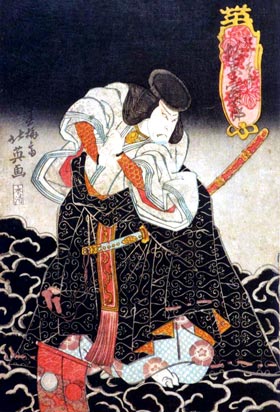
Bandô Jutarô I playing the role of Kiritarô in the new year drama "Keisei Hanafusa Sôshi", which was staged in the 1st lunar month of 1835 at the Naka no Shibai (print made by Shunbaisai Hokuei) Print made by Ryûsai Shigeharu in 1830 Print made by Urakusai Nagahide in 1838 The Bandô Jutarô line of actors |
|
|
| Contact | Main | Top | Updates | Actors | Plays | Playwrights | Programs | Links | FAQ | Glossary | Chronology | Illustrations | Prints | Characters | Derivatives | Theaters | Coming soon | News |