| ICHIKAWA DANJÛRÔ I |
|
Stage names:
Pen name:
Guild: Naritaya Line number: SHODAI (I) Poetry name: Saigyû Existence: 1660 ~ 19th day of the 2nd lunar month of 1704 [1] Connection: Sons: Ichikawa Ebizô II (Danjûrô II), Ichikawa Sen'ya Grandson: Ichikawa Ebizô III (Danjûrô IV) Great-grandson: Ichikawa Hakuen I (Danjûrô V) Great-great-grandson: Ichikawa Momotarô Great-great-great-grandson: Ichikawa Ebizô V (Danjûrô VII) Great-great-great-great-grandson: Ichikawa Danjûrô VIII, Ichikawa Danjûrô IX, Ichikawa Ebizô VII, Ichikawa Ebizô VIII, Ichikawa Komazô VI, Ichikawa Saruzô I, Ichikawa Kôzô Disciples: Ichikawa Danzô I, Ichikawa Sôzaburô I, Mimasuya Sukejûrô I, Ichikawa Danshirô I, Ichikawa Kiyotarô, Ichikawa Kaoru I, Ichikawa Hikogorô, Ichikawa Shikibu, Ichikawa Taijirô, Ichikawa Jûgorô, Ichikawa Kodanji I, Ichikawa Wakamatsu, Ichikawa Takenosuke, Ichikawa Chôjûrô, Ichikawa Danjirô I, Ichikawa Dannojô I Career: 1660: born in Edo in the district of Izumi-chô. His father, named Horikoshi Jûzô, was an otokodate. "His father was a samurai in the province of Kii, named Horikoshi. When the daimyô he served was defeated in battle, Danjûrô's father became a rônin and lived in retirement in the district. Afterwards he moved to a village in the province of Shimôsa, where he became a farmer. He went to Edo in 1644, and called himself after the village he had left. He was a man of strong character, skilled in writing, an adept at figures. It was very natural, possessed of such accomplishments, that he should become popular among his neighbours in Edo, and he was chosen to represent the landlords of his locality. He was good at business and made a fortune for himself. There were in Edo in those rough-and-ready times men called otokodate, or chivalrous men of the people, who did not fear the blustering two-sworded samurai, who too often attempted to intimidate the peaceful citizens. Danjûrô's father associated himself with these brave spirits, who were always ready to defend the helpless and to protect the interests of the middle and lower classes." (Zoë Kincaid in "Kabuki, the Popular Stage of Japan") 1673: he appeared of stage for the first time, playing under the name of Ichikawa Ebizô the role of Sakata Kintoki in the drama "Shitennô Ochigodachi", which was staged at the Nakamuraza. This was the first time in Kabuki that an actor uses a kumadori make-up, made up of black and red lines. The aragoto style originated from this performance, which was a triumphant success. 5th lunar month of 1675: Ichikawa Ebizô took the name of Ichikawa Danjûrô, playing for the first time the role of Soga Gorô Tokimune in the drama "Kachidoki Homare no Soga", which was staged at the Yamamuraza; his stage partners in the roles of Kudô Saemon Suketsune and Soga Jûrô Sukenari were Nagashima Isoemon and Miyazaki Denkichi. This play was the first sogamono in Kabuki history. The ideogram for "Dan" was not yet the one that will be the official ideogram used by the Ichikawa Danjûrô line of actors:
You need a Japanese Language Kit installed within your system in order to be able to read the characters 1st lunar month of 1676: Danjûrô played the role of Soga Gorô Tokimune in the drama "Soga Ryôsha no Tamamono", which was staged at the Nakamuraza; his stage partners in the roles of Kudô Saemon Suketsune and Soga Jûrô Sukenari were Wakayama Jûjirô and Nakamura Shichisaburô I. 3rd lunar month of 1680: the very first sayaate scene in Kabuki history was staged at the Ichimuraza in the drama "Yûjoron" [2]; Danjûrô played the role of Fuwa Banzaemon [more details]. 8th lunar month of 1682: Danjûrô achieved a great success at the Ichimuraza by playing the role of Gotô Saemon in the drama "Oguri Chûkô Guruma", whose plot and characters belonged to the "Oguri Hangan" world; his stage partner in the role of Ike no Shôji was Noda Kuranosuke. 3rd lunar month of 1683: Danjûrô wrote the script and played the role of Fuwa Banzaemon in the drama "Nyojaku Nigabyakudô", which was staged at the Moritaza; his stage partners were Ichikawa Shinkurô (Nagoya Sanza), Takenaka Shôdayû (the courtesan Katsuragi) and Miyazaki Denkichi (Umezu Kamon). 3rd lunar month of 1684: Danjûrô played for the first time the role of the wicked priest Narukami in the drama "Kadomatsu Shitennô" ("Narukami"), which was staged at the Nakamuraza. He was the author of the play and his stage partner in the role of Princess Taema was the onnagata actor Itô Kodayû II. 5th lunar month of 1684: Danjûrô wrote the script and played in the same theater the role of Fuwa Banzaemon in the drama "Fuwa Sokushin no Ikazuchi"; his stage partners were Katsuyama Hikoshirô (Nagoya Sanza) and Nakayama Kiyonosuke (the courtesan Katsuragi). 3rd lunar month of 1685: Danjûrô played the role of Konpei in the drama "Gyoran Kaichô Kompei Dôshin", which was staged at the Ichimuraza. He achieved a great success in duo with Itô Kodayû II in the role of the daughter of the dragon king; his others stage partners were Murayama Heijûrô, Saruwaka Sanzaemon, Ôkuma Utaemon and Ichimura Wakadayû. 1686: Danjûrô played one more time the role of Fuwa Banzaemon at the Nakamuraza in the drama "Fuwa Sokushin no Ikazuchi". This was a huge success. 3rd lunar month of 1688: Danjûrô played the role of Soga Gorô Tokimune in the drama "Jidai Kyôdai Soga", which was staged at the Yamamuraza; his stage partner in the role of Soga Jûrô Sukenari was Miyazaki Denkichi. The two actors moved the 21st day at the Nakamuraza to perform the same roles in the drama "Yakko Asahina Ôiso Gayoi"; their stage partners in the roles of the courtesan Ôiso no Tora (Jûrô's lover) and Asahina were Takenaka Shôdayû and Nakamura Denkurô I. This was the first Kabuki play with both the character of Asahina and a kamisuki scene between Jûrô and Tora. 3rd lunar month of 1689: Danjûrô played in the same theater the role of Fuwa Banzaemon in the drama "Nagoya Taizen". 2nd lunar month of 1690: Danjûrô played in the same theater the role of Araoka Genta Saemon in the drama "Daikichi Bushi Kagami". The tachimawari of this play was a great success. 7th lunar month of 1690: Danjûrô played in the same theater the role of Kinpira in the drama "Kinpira Kôron". 11th lunar month of 1691: Danjûrô played at the Moritaza the leading eponymous role of the drama "Shuten Dôji". 1st lunar month of 1692: Danjûrô performed in the same theater in the drama "Asahina Hyaku Monogatari". 11th lunar month of 1692: Danjûrô performed at the Moritaza in the drama "Nihon Daikyû Shinzei Hachirô" but it was not a success. The play was replaced by one whose plot and characters belonged to the "Nagoya Sanza-Fuwa Banzaemon" world (fuwa-nagoyamono). 1st lunar month of 1693: Danjûrô performed in the same theater in the drama "Fuwa Banzaemon Shimabara Kitsune". 3rd lunar month of 1693: Danjûrô performed in the same theater in the drama "Chûjô Hime". 5th lunar month of 1693: Danjûrô moved to the Nakamuraza, changed the ideogram for "Dan" in his first name (==> check 1675) and played the role of Kazusanosuke in the drama "Shinsen Sesshôseki"; his stage partners were Sodeoka Masanosuke II (Tamamo-no-Mae), Nakamura Denkurô I (a fox looking like Miuranosuke) and Tanishima Mondo (Miuranosuke). Fall 1693: Danjûrô moved to Kyôto. 11th lunar month of 1693: Danjûrô played the role of Ôhara Jirozaemon in the drama "Hako Denju", which was produced by Murayama Heiemon III; his stage partners were Mizuki Tatsunosuke I, Yamatoya Jinbê II, Tomizawa Samanosuke, Otowa Katsunojô and Uemura Takenojô. 1st lunar month of 1694: Danjûrô performed in the same theater in the drama "Genji Musha Homare no Seiriki", exhibiting the aragoto style for the Kyôto audience. He also achieved a great success in duo with the onnagata Itô Shôdayû in the dance drama "Meguriai Koi no Tanabata", playing the roles of Prince Hikoboshi and Princess Ori-hime, who could meet only once a year during the night of Tanabata. 3rd lunar month of 1694: Danjûrô played in the same theater the role of the wicked priest Narukami in the drama "Narukami Yûjoron"; the role of Princess Taema was played by Mizuki Tatsunosuke I. 9th lunar month of 1694: Danjûrô played in the same theater the role of the warrior Kumagai Jirô Naozane in the drama "Kumagai Nagori no Sakazuki"; his stage partners were Mizuki Tatsunosuke I (Tomoe-no-Mae), Yamatoya Jinbê II (Taira no Tadanori), Murayama Heiemon III (Iga Heinai Saemon), Sakata Tôkurô (Taira no Michimori), Iwai Hananojô (Michimori's wife), Onoe Taganojô I (Taira no Atsumori), Tomizawa Samanosuke (Kumagai's wife) and Uemura Takenojô (Kumagai's son). Fall 1694: Danjûrô went back to Edo. 11th lunar month of 1694: Danjûrô performed at the Yamamuraza in the drama "Kinpira Kadan Yaburi"; his yearly salary was 500 ryô. 1st lunar month of 1695: his rank in the Edo hyôbanki, katakiyaku section, was jô-jô-kichi (superior - superior - excellent) [visual]. He performed in the same theater in the drama "Katsuragi Kôkiden", which was a big success. 3rd lunar month of 1695: Danjûrô performed in the same theater in the drama "Usuyuki Emon Zakura". 4th lunar month of 1695: Danjûrô performed in the same theater in the drama "Tsuwamono Kongen Soga". 7th lunar month of 1695: Danjûrô performed in the same theater in the drama "Isshin Niga Byakudô". 10th lunar month of 1695: Danjûrô performed in the same theater in the drama "Izumo no Ôyashiro". 11th lunar month of 1695: Danjûrô performed at the Yamamuraza in the drama "Kaomise Jûnidan"; his stage partner was the great Kamigata onnagata Ogino Sawanojô, who has left the Ichimuraza to join the Yamamuraza. This was the beginning of a great duo, the first goruden konbi in Kabuki history. 4th lunar month of 1696: Danjûrô and Ogino Sawanojô achieved a great success in the same theater by playing the roles of the wicked priest Narukami and Princess Taema in the drama "Narukami Shônin Sansesô Taema no Chûjô Hime" ("Narukami"). 11th lunar month of 1696: Danjûrô played at the Nakamuraza in the drama "Neko no Koneko", commonly called "Onna Narukami"; his stage partners were Ogino Sawanojô (who played the leading role of the nun Narukami), Nakamura Shichisaburô I, Nakajima Kanzaemon I, Nakamura Denkurô I, Sodeoka Masanosuke II and Ôtani Hiroemon I. 1st lunar month of 1697: premiere at the Nakamuraza of Mimasuya Hyôgo's drama "Sankai Nagoya", which included the first bombastic "Shibaraku" scene in Kabuki history [more details]. This drama opened with "Shibaraku", had a sayaate scene ("Fuwa") in the middle and ended with a spectacular scene with the Chinese Deity Shôki Daijin; Danjûrô played the roles of Fuwa Banzaemon [illustration] and Shôki Daijin. 3rd lunar month of 1697: Sawanojô and Danjûrô played in the same theater the roles of Tamakura and Yagorô in the drama "Kantô Koroku". 5th lunar month of 1697: premiere at the Nakamuraza of Mimasuya Hyôgo's drama "Tsuwamono Kongen Soga", which celebrated the hatsubutai of his son Ichikawa Kuzô I, had the first "Fudô" scene in Kabuki history [3] and included a spectacular kusazuribiki scene; Danjûrô played the role of Soga Gorô Tokimune [more details]. 6th lunar month of 1698: Sawanojô and Danjûrô play in the same theater the roles of Asaka and Kamata Hyôe in the drama "Ryûjo Sanjûnisô" (written by Danjûrô using the pen name Mimasuya Hyôgo); the role of the villain Taira no Kiyomori was played by Yamanaka Heikurô I. 9th lunar month of 1698: Sawanojô and Danjûrô play in the same theater the roles of Princess Taema and the wicked priest Narukami in the drama "Genpei Narukami Denki" (also called "Kumo no Taema Nagori no Tsuki"). This was Ogino Sawanojô's last performance, who retired from the stages and opened an incent and perfume shop in Edo. 11th lunar month of 1698: Danjûrô played at the Nakamuraza the role of Satô Tadanobu in the drama "Yoshino Shizuka Goban Tadanobu"; the role of the monk warrior Yokawa no Zenji Kakuhan was played by Ôtani Hiroemon I. 1st lunar month of 1699: Danjûrô's rank in the Edo hyôbanki, tachiyaku section, was jô-jô (superior - superior) [visual]. He played in the same theater the role of Hachimune Ikaranosuke in the drama "Onna Hida no Takumi". 3rd lunar month of 1699: Danjûrô played in the same theater the role of Ukishima Danjô in the drama "Kongen Shinoda Wagô no Tama". 5th lunar month of 1699: Danjûrô played in the same theater the roles of Fuwa Banzaemon (wearing a shiraga wig) and the nyûdô Banrei in the drama "Katsuragi Sayo Arashi"; the roles of Nagoya Sanza and the courtesan Katsuragi were played by Murayama Shirôji and Kishida Kogenji. This performance was a huge success. 7th lunar month of 1699: Danjûrô wrote the script and played in the same theater the role of Kôga no Saburô in the drama "Isshin Gokai no Tama" [4]. 9th lunar month of 1699: last performance at the Nakamuraza for Danjûrô, who performed in a farewell sogamono. 11th lunar month of 1699: Danjûrô moved to the Moritaza and performed in the drama "Tôsei Okuni Kabuki", which celebrated the arrival of the Kamigata actor Uemura Kichisaburô and the end of the retirement of Ogino Sawanojô. The script was written by Danjûrô under his pen name of Mimasuya Hyôgo. The performance was a tremendous success. 1st lunar month of 1700: Danjûrô's rank in the Edo hyôbanki, tachiyaku section, was jô-jô-kichi (superior - superior - excellent) [visual]. He wrote the script and played in the same theater the role of Kamakura Gongorô Kagemasa in the drama "Kagemasa Ikazuchi Mondô". 3rd lunar month of 1700: Danjûrô wrote the script and played in the same theater the role of Kumedera Danjô Saemon in the drama "Wakoku Gosuiden". 5th lunar month of 1700: Danjûrô played in the same theater the role of Soga Gorô Tokimune in the drama "Dainihon Tekkai Sennin"; the roles of Soga Jûrô Sukenari and the courtesan Ôiso no Tora (Jûrô's lover) were played by Miyazaki Denkichi and Ogino Sawanojô. 11th lunar month of 1700: Danjûrô moved to the Nakamuraza and played the role of Kinpira in the kaomise drama "Kinpira Rokujô Gayoi". His son Ichikawa Kuzô I, playing the role of Kaidômaru, delivered his first lines during this performance. 1st lunar month of 1701: Danjûrô played in the same theater the role of Yamagami Gennai Saemon [print] in the drama "Keisei Ôshôkun" [5]. 3rd lunar month of 1701: Danjûrô wrote the script and played in the same theater the role of Umezu Rokurô in the drama "Shusse Sumidagawa". 5th lunar month of 1701: Danjûrô wrote the script and performed in the same theater in the drama "Nihon Gion Shôja". 7th lunar month of 1701: Danjûrô wrote the script and performed in the same theater in the drama "Imayô Shuten Dôji". 11th lunar month of 1701: Danjûrô played at the Nakamuraza the role of Fuwa Banzaemon in the kaomise drama "Keisei Ikazuchi Mondô". 1st lunar month of 1702: Danjûrô performed in the same theater in the new year drama "Kamadagaie no Daikoku Bashira". 2nd lunar month of 1702: Danjûrô wrote the script and played in the same theater the role of the monk warrior Musashibô Benkei in the drama "Hoshiawase Jûnidan", which was the first adaptation to Kabuki of the Nô play "Ataka". This work will inspire Ichikawa Ebizô V and the playwright Namiki Gohei III for the creation of the masterpiece dance-drama "Kanjinchô" in 1840. The performance was a huge success and a long run (from the 2nd day of the 2nd lunar month to the 25th day of the 6th lunar month). 7th lunar month of 1702: Danjûrô and his son Ichikawa Kuzô I achieved a great success by playing in the same theater the roles of the 2 Benkei ("Ninin Benkei") in the drama "Shinpan Takadachi Benkeijô". 10th lunar month of 1702: Danjûrô played in the same theater the role of Kumedera Danjô in the drama "Yûgao no Kannon Hôben". There was another Kumedera Danjô in this play, which was played by Ichikawa Danshirô I. 11th lunar month of 1702: Danjûrô moved to the Moritaza (for a yearly salary of 700 ryô) and played the role of Araoka Genta in the kaomise drama "Tenchijin Tsutsumamori". His son played for the first time the superhero role in a "Shibaraku" scene. 4th lunar month of 1703: Danjûrô wrote the script and played in the same theater the roles of Ôtomo no Kuronushi and the Deity Fudô in the drama "Naritasan Bunshin Fudô". 7th lunar month of 1703: Danjûrô wrote the script and played in the same theater the role of Ôhara Gotô Saemon in the drama "Oguri Jûnidan". 11th lunar month of 1703: Danjûrô moved to the Ichimuraza and played the role of Ishiyama Genta Saemon in the kaomise drama "Genji Rokujûjô" (he wrote the script). The same play was staged in the 1st lunar month of 1704. 2nd lunar month of 1704: Danjûrô wrote the script and performed in the same theater in the drama "Watamashi Jûnidan". 19th day of the 2nd lunar month of 1704 [1]: Danjûrô was stabbed by the actor Ikushima Hanroku in his dressing room and died a violent death. Comments: Ichikawa Danjûrô I was the founder of the most famous line of Edo actors and the official creator of the aragoto acting style. "The people had begun to grow tired of plays dealing with the effeminate and luxurious life of the gay quarters; they wearied of sentimentality, and welcomed performances that were more manly and possessed a militaristic appeal. Danjûrô, the first, seized the opportunity to please the citizens of Edo, originated the exaggerated artificial style now inseparably linked with the Danjûrô line." (Zoë Kincaid in "Kabuki, the Popular Stage of Japan") He was also a talented playwright who wrote around 50 scripts under the name of Mimasuya Hyôgo (sometimes cosigned with Nakamura Seizaburô or Nakamura Seigorô). "He felt that playwriting and acting were like the two wheels of the same cart, but that actors who write are actors before they are dramatists. He was consistent in his belief that play were merely the means whereby a performance could be extracted from an actor. The ultimate aim of any play, he argued, is to please the audience" (Samuel Leiter, "New Kabuki Encyclopedia"). "Ichikawa Danjûrô, of Edo, established the school of aragoto, or rough acting--made out of the cloth of exaggeration, the grotesque, picturesque, unnatural, unreal. He was followed by eight members of his family, who carried on his traditions. Many of the Ichikawa actors were men of genius, who not only handed on their theatre inheritance but added new features. No other actor line has had such a powerful influence upon Kabuki as the nine members of this family." (Zoë Kincaid in "Kabuki, the Popular Stage of Japan") He created the first version of 2 of the most famous plays belonging to the Kabuki Jûhachiban collection: "Narukami" (1st lunar month of 1684) and "Shibaraku" (1st lunar month of 1697). He performed the first sayaate and kusazuribiki scenes in Kabuki history. He was the first actor to portray the deity Fudô Myôô (5th lunar month of 1697), whom he worshipped with deep devotion during all his career and who granted several of his wishes: birth of his son, a salary of 400 ryô (in fact it is said that his salary went up to 800 ryô, an enormous amount of money at that time) or fame in Kamigata. His yagô Naritaya came from the Narita Fudôson temple dedicated to the cult of the deity Fudô Myôô. "In an old book there is a description of his stage methods. He was asked to attend a social function in the mansion of a certain nobleman, and requested to give some aragoto piece. He took down the upper part of his kimono and performed as Kagekiyo--the hero of several Nô dramas-and his actions were so spirited that he broke all the shôji, or white paper screens. The guests were anxious to know what the host would think of the entertainer's destructive methods, but, contrary to their expectations, the daimyô was pleased and presented him with a costly gift. Danjûrô is said to have made the comment after his strenuous acting that if an actor was afraid in the presence of a daimyô he could not play aragoto." (Zoë Kincaid in "Kabuki, the Popular Stage of Japan") Ichikawa Danjûrô I was the first Kabuki actor to write haiku and hold a haimyô. Ichikawa Danjûrô I, Nakamura Shichisaburô I and Nakamura Denkurô I were in Edo the leading triumvirat of Genroku stars. Ichikawa Danjûrô I performed in Kamigata in 1693~1694 but he could not perform with the Kyôto star Sakata Tôjûrô I. "An account is given in "Kabuki Koto Hajime", or Beginnings of Kabuki, of Danjûrô's meeting with Tôjûrô. Danjûrô went to the theatre to see Tôjûrô act, but found that he was absent on account of illness. Danjûrô greatly regretted that he was unable to see Tôjûrô on the stage. But on the following day a messenger came from Tôjûrô inviting him to dinner at a restaurant. When Danjûrô reached the place, Tôjûrô failed to make an appearance, and after he had waited for a long time and was beginning to grow impatient he saw his host in ordinary dress arranging flowers in another room without as much as casting a glance in the direction of his guest, as unconcerned as though quite unaware of his presence. This made Danjûrô angry, and he was just on the point of retiring when a messenger from Tôjûrô apologised for the delay and said he would join him immediately. He had changed his clothing, wearing his very best, and received his guest in the most dignified manner. Danjûrô was so much impressed by his appearance that he said there was no necessity to see him act, and left for Edo the next day. The gossip of the time said that Tôjûrô planned to overawe his Edo rival, and had determined that no Edo actor should carry away laurels from Kyôto during his lifetime, so that if this report be true the long-established rivalry between the theatres of Edo and those of Ôsaka and Kyôto had already begun at this time." (Zoë Kincaid in "Kabuki, the Popular Stage of Japan") [1] The 19th day of the 2nd lunar month of the 17th year of the Genroku era was the 24th of March 1704 in the western calendar. [2] It was considered as the first performance of "Fuwa", a drama belonging to the Kabuki Jûhachiban. [3] "Fudô", a drama belonging to the Kabuki Jûhachiban. Members of the audience responded to the presence of the God Fudô Myôô on stage with prayers and offerings! [4] It was considered as the first performance of "Uwanari", a drama belonging to the Kabuki Jûhachiban. [5] The scene with the elephant in this drama was considered as the first performance of "Zôhiki", a drama belonging to the Kabuki Jûhachiban. |

 |
|
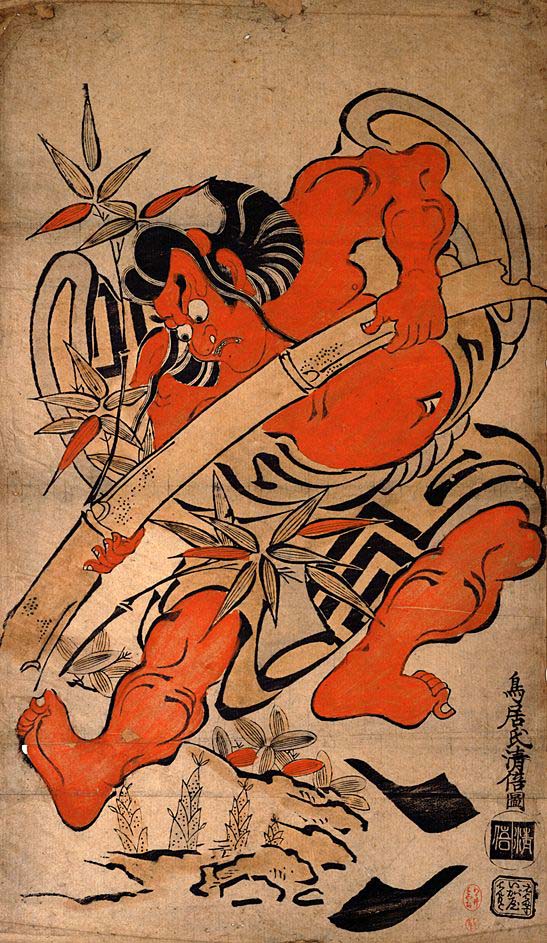
Ichikawa Danjûrô I playing the role of Soga Gorô Tokimune (Takenuki Gorô) in the drama "Tsuwamono Kongen Soga", which was staged at the Nakamuraza in the 5th lunar month of 1697 (print made by Torii Kiyomasu I) The Ichikawa Ebizô line of actors The Ichikawa Danjûrô line of actors |
|
|
| Contact | Main | Top | Updates | Actors | Plays | Playwrights | Programs | Links | FAQ | Glossary | Chronology | Illustrations | Prints | Characters | Derivatives | Theaters | Coming soon | News |