| OGINO SAWANOJÔ |
|
Stage names:
Other name:
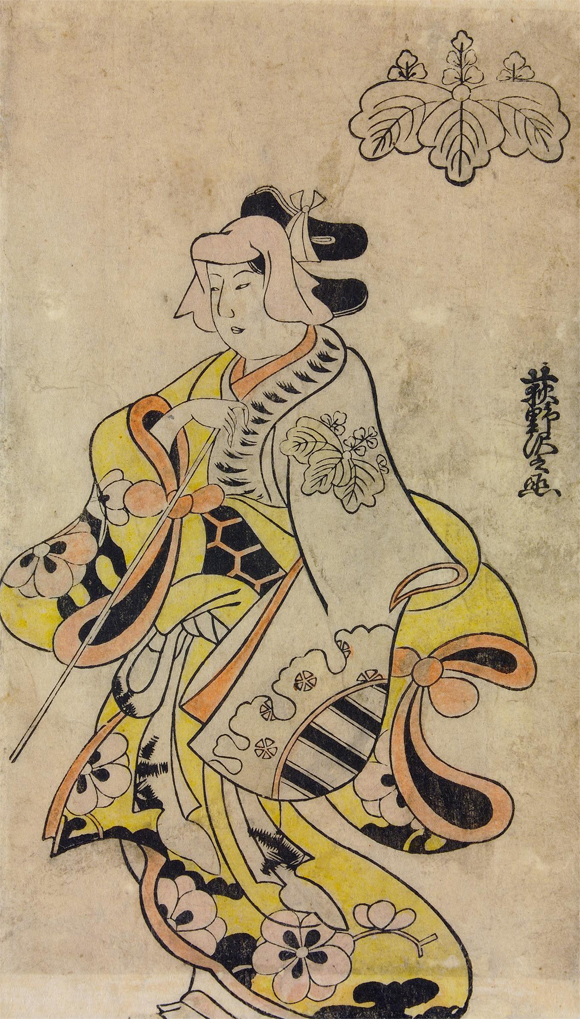
Real name: Inoue Hanzaemon Nicknames: Sashichi, Tôjûrô Poetry name: Shûkô Existence: 1656 ~ 1st day of the 8th lunar month of 1704 [1] Connections: Master: Ogino Chôdayû I Disciple: Ogino Samanojô II Career: 1656~1690: born in Kyôto. He started his career in Kyôto as a disciple of the actor Ogino Chôdayû I, performing under the name of Ogino Sawanojô. 1st lunar month of 1691: Samanojô played in Kyôto at Miyako Mandayû's theater the role of Masaki Rokurozaemon's spouse in the drama "Yome Kagami", which was produced by Yamashita Hanzaemon I. 1692: Samanojô settled in Edo. He had to change his first name, because it was very close to the first name of a Shogunate high-ranking dignitary. Ogino Samanojô took the name of Ogino Sawanojô. 1694: Sawanojô performed at the Ichimuraza. 11th lunar month of 1695: Sawanojô performed at the Ichimuraza in the kaomise drama "Kaomise Jûnidan"; his main stage partner was Ichikawa Danjûrô I. This was the beginning of a great duo, the first goruden konbi in Kabuki history. 4th lunar month of 1696: Ichikawa Danjûrô I and Sawanojô achieved a great success in the same theater by playing the roles of the wicked priest Narukami and Princess Taema in the drama "Narukami Shônin Sansesô Taema no Chûjô Hime" ("Narukami"). 11th lunar month of 1696: Sawanojô achieved a great success at the Nakamuraza by playing the leading role of Onna Narukami ('the female Narukami') in the drama "Neko no Koneko". 1st lunar month of 1697: premiere at the Nakamuraza of Mimasuya Hyôgo's drama "Sankai Nagoya", which included the first bombastic "Shibaraku" scene in Kabuki history [more details]. This drama opened with "Shibaraku", had a sayaate scene ("Fuwa") in the middle and ended with a spectacular scene with the Chinese Deity Shôki Daijin; Sawanojô played the role of the keisei Katsuragi. 3rd lunar month of 1697: Sawanojô and Ichikawa Danjûrô I played in the same theater the roles of Tamakura and Yagorô in the drama "Kantô Koroku". 5th lunar month of 1697: premiere at the Nakamuraza of Mimasuya Hyôgo's drama "Tsuwamono Kongen Soga", which celebrated the hatsubutai of Ichikawa Kuzô I, had the first "Fudô" scene in Kabuki history [2] and included a spectacular kusazuribiki scene; Sawanojô played the role of Ni-no-Miya [more details]. 6th lunar month of 1698: Sawanojô and Ichikawa Danjûrô I played in the same theater the roles of Asaka and Kamata Hyôe in Mimasuya Hyôgo's drama "Ryûjo Sanjûnisô"; the role of the villain Taira no Kiyomori was played by Yamanaka Heikurô I. 9th lunar month of 1698: Sawanojô and Ichikawa Danjûrô I played in the same theater the roles of Princess Taema and the wicked priest Narukami in Mimasuya Hyôgo's drama "Genpei Narukami Denki" (also called "Kumo no Taema Nagori no Tsuki"). This was Sawanojô's last performance, who (temporarily) retired and opened an incent and perfume shop in Edo in the district of Iida-chô. As a merchant, he took the name of Kôguya Tôjûrô ("Tôjûrô the perfumer"). His best-selling perfume was called Ogino Shûkô. He also started a new successful fashion with a woman hat called Sawanojô Bôshi ('Sawanojô's Hat'). 11th lunar month of 1699: Sawanojô was back on stage, at the Moritaza, where he played the role of Okuni, the legendary woman who created Kabuki, in Mimasuya Hyôgô's drama "Tôsei Okuni Kabuki". 5th lunar month of 1700: Sawanojô played at the Moritaza the role of Tora Gozen in the drama "Dainihon Tekkai Sennin". 1st lunar month of 1701: Sawanojô went back to Kamigata; he took back the name of Ogino Samanojô I and performed with Yoshizawa Ayame I and Mizuki Tatsunosuke I in the drama "Miyako no Waka Ebisu", which was staged in Kyôto at Ebisuya Kichirôbê's theater. 11th lunar month of 1701: Samanojô went to Ôsaka, took back the name of Ogino Sawanojô and performed in the kaomise program produced by Matsumoto Nazaemon III. 1703: last stay in Edo. 1st lunar month of 1704: Sawanojô appeared on stage for the last time, in Edo at the Moritaza, performing in the hatsu kyôgen drama "Arajishi Otokonosuke". He suddenly fell ill. 19th day of the 2nd lunar month of 1704 [3]: Ichikawa Danjûrô I, the main stage partner of Sawanojô, was stabbed by the actor Ikushima Hanroku in his dressing room and died a violent death. 1st day of the 8th lunar month of 1704 [1]: Sawanojô died in Edo. Comments: Ogino Sawanojô was an outstanding Genroku onnagata, who made a fame for himself in both Edo and Kamigata. He was one of the first actors in Kabuki history to breathe realism into his acting. "The senior among the Genroku onnagata was Ogino Sawanojô, who died in 1704. He played heroines to Danjûrô's heroes, and was long associated with the first Ichikawa. He wore an obi of unusual width, and it became the fashion among the ladies of the capital. Tiring of the stage, he gave it up and opened an incense shop, but the attraction of the theatre was too great, and he returned. Always closely associated with Danjûrô, he died the same year in which the founder of Japan's most famous line of actors was murdered in his dressing-room. "Amayo Sanbai Kigen", or Three Cups of Sake on a Rainy Night, a book of criticism, praises Ogino highly: "Even the gods and Buddha would be struck with the actions of this man. He is most realistic in pathetic scenes. As a lady of high rank, or a wife of the lower classes, he leaves nothing to be desired." (Zoë Kincaid in "Kabuki, the Popular Stage of Japan") |

|
[1] The 1st day of the 8th lunar month of the 1st year of the Hôei era was the 30th of August 1704 in the western calendar. [2] "Fudô", a drama belonging to the Kabuki Jûhachiban. Members of the audience responded to the presence of the God Fudô Myôô on stage with prayers and offerings! [3] The 19th day of the 2nd lunar month of the 17th year of the Genroku era was the 24th of March 1704 in the western calendar. |
 |
|
Ogino Sawanojô |
|
|
| Contact | Main | Top | Updates | Actors | Plays | Playwrights | Programs | Links | FAQ | Glossary | Chronology | Illustrations | Prints | Characters | Derivatives | Theaters | Coming soon | News |