| TSUWAMONO KONGEN SOGA |
| Play titles | Tsuwamono Kongen Soga  Kotobuki Kongen Soga |
| Authors | Mimasuya Hyôgo Nakamura Akashi Seizaburô |
| History |
Mimasuya Hyôgo's drama "Tsuwamono Kongen Soga" was premiered in the 5th lunar month of 1697 at the Nakamuraza [more details]. It celebrated the hatsubutai of Ichikawa Kuzô I and it included the first "Fudô" scene in Kabuki history. It was revived under the title "Kotobuki Kongen Soga", in January 1970 at the National Theatre [more details]. |
| Structure |
The original 1697 drama was in 4 acts (10 scenes). The 1984 revival was in 4 acts (4 scenes). |
| Key words |
Adauchi Adauchimono Aragoto Aragyô Asahina Yoshihide Ema Koshirô Fudô Myôô Fujisan Hakone-juku Hôjô Tokimasa Jidaimono Kabuki Jûhachiban Kajiwara Heizô Kagetoki Kajiwara Genta Kagesue Kamuro Kawazu Hakoômaru Kobayashi no Asahina Kudô Saemon Suketsune Kuruwa Kusazuribiki Mankô Gozen Matano Gorô Kagehisa Michiyuki Minamoto Yoritomo Ôiso-juku Rôtô Sake Soga Gorô Tokimune Soga Jûrô Sukenari Sogamono Sumô Takenuki Gorô Wada Yoshimori |
| Summary |
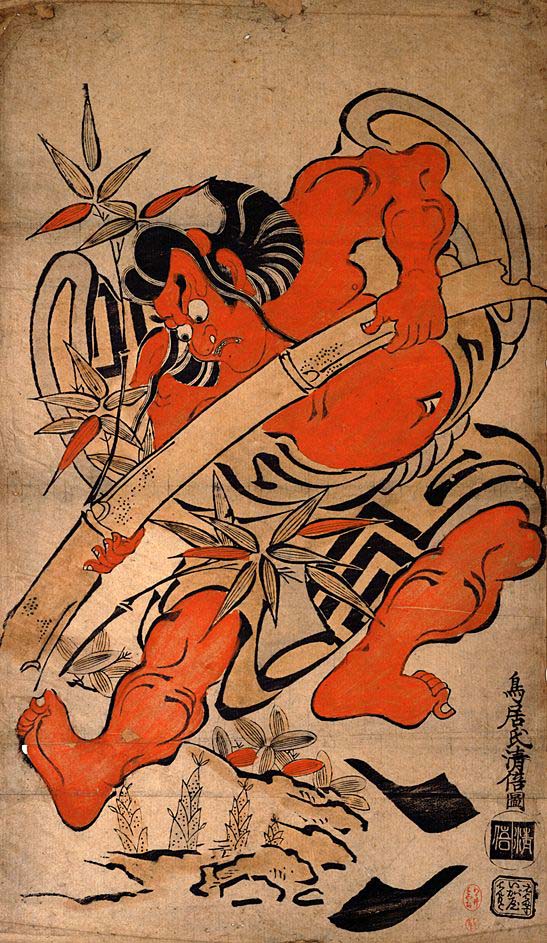
Act I, scene 1: The Residence of Hôjô Tokimasa A banquet is being held at the residence of Hôjô Tokimasa. Among the guests are the Shôgun, Minamoto no Yoritomo, and his retainers, including the Soga brothers' enemy, Kudô Suketsune. While the company is watching a sumô match, Kajiwara Heizô, one of Yoritomo's retainers, reveals that he has learned of a plot to kill the Shôgun. He produces a doll in the figure of Yoritomo with a large spike driven through it, claiming he found it on a river bank. Yoritomo, deciding that is must be the work of the Soga brothers (who are also his enemies), gives orders to have them executed. Two samurai are dispatched to carry out the order, but they are stopped and dragged back by the powerful warrior Asahina Yoshihide, who strongly objects to Yoritomo's rash decision. Eventually he manages to persuade the Shôgun to spare the brothers' lives. Act I, scene 2: The Myôjin Shrine Soga Jûrô is at the Myôjin Shrine practicing archery, vowing to avenge his father's death. As he shoots his arrows, however, he also prays that his love for the young samurai Ema no Koshirô, Hôjô's son, will be fulfilled. Just then a young woman, Lady Otome-no-Mae, appears and confesses that she also has become infatuated with Koshirô and asks Jûrô to be the go-between. He agrees, but only on his terms. Koshirô then arrives and Jûrô professes his love for him. Koshirô responds positively, so they make a pact of "brotherhood" before the shrine. Jûrô then explains about Otome-no-Mae and asks Koshirô to grant her his love as well. Koshirô is reluctant to do so, but when he finds out that she is a respectable lady he agrees, and he and Otome-no-Mae make a vow of marriage. Then Kajiwara's son, Genta, appears and he also prays at the shrine for his love for Koshirô to be requited. He sees Koshirô and proclaims his love. Koshirô, however, says he already has a love brother, Soga Jûrô. Genta becomes enraged and declares that he will tell the Shôgun that Koshirô has made a bond with his enemy. Fighting erupts and Koshirô and Jûrô defeat and drive away Genta and his men. Act II, scene 1: On the Road to Hakone The brothers Oniô and Dôzaburô, the faithful retainers of the Soga brothers, are travelling to Hakone to see Gorô. On the way they encounter a daimyô's procession and discover it to be that of Kudô Suketsune. Just then Oniô realizes that they have forgotten the kimono they were to bring to Gorô, and he goes back to get it, exerting Dôzaburô to be careful while he is away. Kudô, however, notices the young, good-looking Dôzaburô and has him brought forward. Dôzaburô, seeing his chance while Kudô is off his guard, attempts to assassinate him, but is easily subdued by Kudô. At this moment Oniô returns and, using the kimono to disguise himself, attempts to get his brother out of trouble. Eventually, however, they are recognized as the Soga brothers' retainers. Kudô then says that he is aware that the Soga brothers regard him as their enemy, but he swears that the man who killed their father was not he but Matano no Gorô. Oniô has a mind to strike Kudô, but since he does not wish to spoil the brother's revenge, he controls himself and says that he agrees there might be some mistake and that even Jûrô has his doubts. Dôzaburô, however, declares he will commit suicide and let his spirit aid the Soga brothers in vanquishing their enemy, whoever it may be. Kudô admires Dôzaburô's samurai spirit, but says he will not let such a fine samurai die before his eyes. He then repeats his claim that Matano is the Soga's real enemy. At this point Dôzaburô again attempts to kill Kudô, but he is stopped by his brother, who says he should be grateful for Kudô's mercy. Kudô informs them that he is travelling to Hakone as the Shôgun's envoy and tells the brothers to go back home. Act II, scene 2: The Hakone Shrine At Hakone the shrine intendant and the other priests are busy looking for Hakoômaru (Soga Gorô's boyhood name). Hôjô Tokimasa arrives and tells them that, in response to Hakoômaru's fervent wish, he has performed the coming-of-age ceremony for him and made him a man. He is now called Soga Gorô Tokimune. Gorô enters in his man's clothes and expresses his joy at having come of age and thus now being able to carry out his plan of revenge. At that moment Kudô's arrival is announced. Gorô begins to tremble in anticipation of killing his enemy. Tokimasa calms him down and Gorô goes off to hide behind a sliding paper panel. While Tokimasa and the intendant are greeting Suketsune, the panel begins to shake and rattle. Kudô asks what it is, and the intendant answers that it is a mouse. Gorô then brings in tea. Kudô says that he has heard that one of the Soga brothers is at the shrine. The intendant introduces Gorô to him and Tokimasa explains that he has performed the coming-of-age ceremony for him. In memory of the occasion Kudô presents Gorô with a small dagger. Gorô takes it and tries to kill Kudô with it, but Kudô grabs his arm. Tokimasa and the intendant intercede and Kudô lets go of Gorô. He complains, however, about the boy's behaviour and, saying the incident has upset him, prepares to leave. The intendant suggests he have a massage before he goes, and Gorô volunteers to do it. While administering the massage Gorô yearns to kill Kudô, but Tokimasa tells a story about a dove and a hawk in which he hints that Gorô should wait until he is united with his brother before seeking revenge. Unable to act, Gorô ends up clinging to Kudô. Kudô pushes him away and, complaining again about Gorô's behaviour and Tokimasa's as well, leaves for Kamakura. Gorô tries to run after him but is held back by Tokimasa and the intendant. Having thus been humiliated in the face of his enemy, Gorô cries himself to sleep, using the shrine's sacred image as his pillow. After a while Tokimasa and the intendant decide to wake him up and offer him some sake. They find his countenance changed, his face now a fierce red colour. Gorô explains that he fell asleep praying to the god rude and in his sleep saw smoke rising from a Buddhist altar. He believes this to be a sign that his prayers have been answered and that he has been granted the superhuman strength necessary to accomplish his mission of revenge. He then hurries off to the mountains. Act II, scene 3: In the Mountains The intendant brings Dôzaburô to where Gorô is doing his "wild training" (aragyô). They witness him breaking hoes, pulling up large bamboos by the roots (Takenuki Gorô), and smashing stone stupas. A small bonze appears and asks Dôzaburô for a food offering. When Gorô sees the bonze, he threatens to crush him to death, but the bonze disappears. Fearing the apparition was a demon, Gorô decides to go the Sagami River to purify himself. Act II, scene 4: The Sagami River At the river Gorô finds Asahina with his horse. He accuses him of polluting the water used for purifications. The two begin fighting. At that moment the little bonze appears again. He announces that Gorô and Asahina are of the same family and should thus not be fighting. He also confirms that in answer to his prayers Gorô has been granted superhuman power in order to accomplish his revenge. He then reveals that he himself is the god Fudô Myôô and shows them his true appearance. Gorô and Asahina rejoice and give thanks to the god. They then leave, Gorô for the Saga village and Asahina for Kamakura. Act III, scene 1: Oniô & Dôzaburô Home Oniô is busy making straw sandals to support the Soga brothers. Dôzaburô arrives and asks about Jûrô, but Oniô does not know where he is. Dôzaburô is despondent and lies down to sleep inside a paper mosquito net. Later Jûrô appears singing a song. Dôzaburô admonishes him, saying now is not the time to be singing. Jûrô, however, points out that it is the fifth day of the fifth month, Boys' Day, and everyone is celebrating the festival. He claims he is sad and Dôzaburô brings out some rice cakes to cheer him up. Dôzaburô then decides to repair the mosquito net, but there is no glue or paper in the house. Jûrô suggests using the rice cakes as glue and the letters he has received from his lover, Tora, to repair it. While they are working on the net Dôzaburô asks Jûrô to give up his visits to the Ôiso licensed quarter. Jûrô agrees to do so. He then says he would like a drink of sake. Since there is none in the house, Dôzaburô volunteers to go out and get some. While Jûrô is waiting for Dôzaburô to return, Tora enters with her kamuro. Jûrô is surprised and asks why she has come. Tora replies that it has been so long since they have met that she just had to come and see him. She mentions that they have now known each other for three years. Jûrô then complains that, even though it is a festive day, he is still wearing the same black kimono. Tora takes off her outer kimono and, shortening the sleeves, gives it to Jûrô to wear. Jûrô is delighted. He now looks presentable enough to pay a visit to his mother. Telling Tora to wait, he goes off to his mother's house. During Jûrô's absence Gorô arrives. Tora tells him why she is there and about her relationship with Jûrô, and then adds that he has gone to see his mother. Gorô then says he would like to tease his usually so serious brother. He asks Tora to hide and then dresses himself as Tora. When Jûrô returns he asks him who is dearer to him, Tora or Gorô. Jûrô answers that it is Tora, of course, and makes to embrace her, only to discover his brother. Gorô asks his brother whether a real Kawazu (the name of their father) would keep a woman. Tora hints that Gorô has a woman too, but Gorô denies it. Just then, however, Gorô's lover, Shôshô, arrives, and now it is Jûrô's turn to tease his brother. After this humorous scene the brothers decide to go to the Hôjô residence. Their mother, they know, will be there and they want to appeal to her to forgive Gorô for undergoing the coming-of-age ceremony instead of becoming a monk as she had wished. They send the women back to the licensed quarter and leave. Act III, scene 2: The Hôjô Residence At the Hôjô residence Boys' Day is being celebrated. The Soga's mother presents one of the Hôjô boys with a gift of a sword. Jûrô then enters with Dôzaburô, much to the delight of Tokimasa 's daughter, Man'yo who finds Dôzaburô very attractive. Jûrô announces that he too has brought a gift, a large warrior doll. He removes the cover to reveal Gorô posing in the form of the famous warrior Ishiyama Genta, subduing a tiger. Both the Soga's mother and Tokimasa lament that such warriors are not to be found anymore. But there is such a warrior, Jûrô argues. He asks if they have heard of Hakoômaru, otherwise known as Gorô Tokimune. His mother replies that she does not want to hear of any Hakoômaru. At this point Gorô, saddened by his mother's rejection, lets out a sigh. All are surprised, and Jûrô quickly explains that the statue can be made to move by pulling a string. He then demonstrates how, if he pulls the string, the statue will go to the mother, bow down, and weep. Gorô follows his instructions. Everyone expresses their amazement at the mechanical doll. They then all go inside, leaving Gorô alone. After a while Ema Koshirô enters followed by Jûrô. They hope to have a brief moment together and share a cup of sake. Man'yo also appears, however, with sake for Dôzaburô. The Hôjô brother and sister question each other's behaviour, but in the end they all drink and the couples embrace. Poor Gorô, however, is still alone. His mother then enters saying she wishes to leave. At this point Gorô gives up his act and pleads with his mother to pardon him. She replies that she will not forgive a child who is so selfish as to go against her wishes and abandoned the priesthood. Gorô argues that he did so in order to become a man and carry out his long-cherished ambition of avenging his father's death. He then declares that if she will not forgive him he will commit suicide. Jûrô reminds his brother that they swore to seek revenge together. Besides, the task is so formidable he cannot possibly accomplish it alone. The brothers argue, and Tokimasa urges the mother to pardon Gorô. Just then a Shogunate force arrives and demands that the Soga brothers be turned over. Jûrô and Koshirô put up resistance, but they are outnumbered. Gorô goes to their aid, but Jûrô refuses to let him fight, saying that since he has been disowned by their mother, he is not his brother. Seeing Gorô in danger, the mother finally gives in and pardon Gorô. The battle then stops. The opponents show their wooden swords and confess that the whole scene was staged for the purpose of persuading the mother to forgive Gorô. All present celebrate the happy outcome. Act IV, scene 1: The Travel-Dance Ni-no-Miya, the Soga's sister, travels to Ôiso to admonish Jûrô for carrying on a relationship with the courtesan Tora. She arrives at Ôiso. Act IV, scene 2: A House of Assignation in Ôiso Wada Yoshimori is holding a banquet with his ninety-three horsemen. There are women to entertain the men, but Tora is not present, so Yoshimori summons her. She comes but appears unhappy. Realizing why, Yoshimori sends for Jûrô, who appears now as a well-dressed samurai. Jûrô is reluctant to Join in but Yoshimori makes him drink. Asahina then arrives and is asked to dance. While he is dancing one of the sliding paper doors breaks open to reveal Gorô, who has also come. Asahina invites him up onto a table to dance with him. Gorô gets up on the table and casts a fierce look around the room. Asahina grabs hold of the hip plate of Gorô's armour and the two warriors engage in a tug of war contest. Despite Asahina's great strength, he is unable to move Gorô, and the tug of war ends when the hip plate breaks off from Gorô's armour. It is then announced that the Shôgun's hunting party is due to leave for the foot of Mt. Fuji, and Wada Yoshimori and his men return to Kamakura. The play ends with the words: "Indeed they are the very models of true samurai. Thereafter the world was governed peacefully." |
 |
|
Ichikawa Danjûrô I playing the role of Soga Gorô Tokimune (Takenuki Gorô) in the drama "Tsuwamono Kongen Soga", which was staged in the 5th lunar month of 1697 at the Nakamuraza (print made by Torii Kiyomasu I) |
|
|
| Contact | Main | Top | Updates | Actors | Plays | Playwrights | Programs | Links | FAQ | Glossary | Chronology | Illustrations | Prints | Characters | Derivatives | Theaters | Coming soon | News |