JULY 2007

2 shows in Tôkyô (Kabukiza, National Theater), 2 in Ôsaka (Shôchikuza) and 2 tours (Eastern Provinces, Central Provinces)!

Kabukiza (Tôkyô)
Dates 7 ~ 29 July 2007 (Shichigatsu Ôkabuki)
Program

Ninagawa Jûniya

Casting

Onoe Kikugorô, Nakamura Tokizô, Ichikawa Sadanji, Ichikawa Danshirô, Onoe Kikunosuke, Nakamura Kanjaku, Nakamura Kinnosuke, Ichikawa Kamejirô, Ichikawa Danzô, Kawarazaki Gonjûrô, Bandô Shûchô, Bandô Kamesaburô, Onoe Matsuya

Comments

"If music be the food of love, play on!". The trouble caused by love is the theme of Shakespeare’s play, a comedy with great depth. July at Kabukiza features an encore performance of a bold experiment. Ninagawa Yukio, known throughout the world for productions of Shakespeare and his blending of traditional and modern theatrical techniques will direct Kabuki actors in an adaptation of Shakespeare’s "Twelfth Night".

After being shipwrecked and being separated (presumably forever) from her twin brother Sebastian, Viola dresses as a young man, calls herself Cesario and takes service with Orsino, who is in love with the fabulously wealthy Olivia. In the guise of Cesario, Viola becomes Orsino’s messenger to Olivia, but she does not love him. Instead, she falls in love with Cesario and in turn, Viola falls in love with Orsino. But while these characters suffer for love, others lust after Olivia’s wealth. Her uncle Toby cannot stand to see the money leave the family and tries to get her married to the obnoxious Andrew. Meanwhile, Olivia’s steward Malvolio is also in love with her, but he is so stuck-up and out of date that the people around him plot to make him think that Olivia returns his love, only making him seem more ridiculous than ever.

In July’s production, all of Shakespeare’s characters will take on a new, Kabuki incarnation. Viola will become Princess Biwa (a biwa is a Japanese lute), and disguised as a man, she will take the name Shishimaru, sounding like a proper samurai, and all the other characters get new Japanese names as well.

Ninagawa Yukio is famous throughout the world for his direction of new plays and the classics, using modern theatrical techniques and traditional aesthetics with a bold visual touch. For example, his production of "Macbeth" brought the play into the world of Japan and transformed the stage into a giant Buddhist altar, with mysterious old women praying throughout the play, as though the story of Macbeth took place within the altar as a message from the land of the dead. His production of "King Lear" brought together a famous English actor as Lear and a popular Japanese actor as the fool and was performed in England, while his production of "Oedipus Rex" combined an actress from the Japanese modern theater with an actor from Kyôgen, the traditional comic style, and the production even went to Greece.

The new production of "Ninagawa Jûniya", which was in fact premiered in July 2005 at the Kabukiza, will star Onoe Kikunosuke as Biwa and her twin brother Shuzennosuke, while Onoe Kikugorô will play Maruo Bôdayû and the jester Sutesuke. Also featuring Ichikawa Sadanji, Ichikawa Danshirô and Nakamura Tokizô. Don’t miss this exciting new Kabuki experiment!

Source: Earphone Guide website

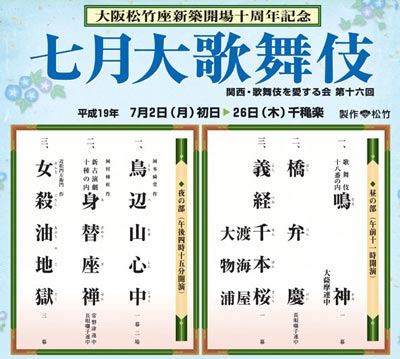
Shôchikuza (Ôsaka)
Dates 2 ~ 26 July 2007 (Shichigatsu Ôkabuki)
Matinée

Narukami

Hashi Benkei

Yoshitsune Sembon Zakura

  • Tokaiya
  • Daimotsu no Ura
  • Evening

    Toribeyama Shinjû

    Migawari Zazen

    Onna Goroshi Abura no Jigoku

    Casting

    Kataoka Nizaemon, Ichikawa Ebizô, Kataoka Takatarô, Kataoka Ainosuke, Kataoka Hidetarô, Bandô Takesaburô, Nakamura Karoku, Nakamura Kazutarô

    Comments

  • Narukami: one of the most popular and universally appealing plays in the Kabuki Jûhachiban collection of plays featuring the bombastic aragoto style of acting. The holy man Narukami (Ichikawa Ebizô) is angry at the Imperial Court and has taken refuge in the mountains where he has imprisoned inside a waterfall the dragon that brings rain, bringing a severe drought to the country. Princess Taema (Kataoka Takatarô) is sent by the Imperial Court to try to seduce Narukami, destroying his magical powers and release the rain. When he finds that he has been betrayed, anger transforms Narukami into a Thunder God.
  • Hashi Benkei:
    (Benkei on the Bridge)
    There are many legends about Benkei, the warrior-priest who was the faithful companion of the general Yoshitsune. This dance shows the first meeting of Benkei and Yoshitsune. Benkei goes nightly to the bridge at the Fifth Avenue of Kyôto, defeating men night after night and taking their swords. Finally he encounters a delicate young man that he thinks will be an easy opponent, but is defeated himself instead. This young man was Yoshitsune, under his childhood name of Ushiwakamaru. Benkei is so impressed that he becomes Yoshitsune’s retainer, right there and then. Starring Kataoka Ainosuke as Benkei and Nakamura Kazutarô as Ushiwakamaru.
  • Tokaiya/Daimotsu no Ura:
    (Tokaiya Inn and Daimotsu Bay)
    Yoshitsune (Ichikawa Ebizô) books passage on a boat to Kyûshû, but the captain is actually Taira no Tomomori (Kataoka Nizaemon), a general of the Heike clan that Yoshitsune helped to defeat. Tomomori was supposedly killed by Yoshitsune in the final battle of the war, but in this play, Tomomori is shown as surviving, living in disguise with the child emperor Antoku and his nursemaid (Kataoka Hidetarô). Tomomori uses the opportunity to try to get his revenge on Yoshitsune but is defeated again. Finally Tomomori holds a giant anchor and plunges into the sea.
  • Toribeyama Shinjû:
    (The Love Suicides at Toribeyama)
    This play by 20th century playwright Okamoto Kidô mixes old and new Kabuki styles. The samurai Hankurô (Kataoka Ainosuke) is in love with the courtesan Osome (Kataoka Takatarô). Visiting her one night in the pleasure quarters of Kyôto, he gets into a drunken quarrel and ends up killing a man in a fight. Knowing that execution awaits him, the two lovers decide to die together instead. Hankurô and Osome travel the road to death in new kimono that ironically were made for them to celebrate the New Year together.
  • Migawari Zazen: a dance play adopted from a classical kyôgen farce. A man (Kataoka Nizaemon) wants nothing more than to visit his lover Hanako, but he has one important problem, his homely and overbearing wife (Nakamura Karoku). He creates a scheme saying that he will be practicing Zen meditation all night and has his servant (Kataoka Ainosuke) take his place while he visits Hanako. He returns, giddy from a night of pleasure and tells his story to his servant in dance, unaware that his wife has discovered his deception and has taken his servant's place.
  • Abura no Jigoku: this play has become phenomenally popular in modern times for its hard-boiled sensibility and sensuous killing scene with the protagonists slipping and struggling through puddles of spilled oil, but was virtually ignored at the time it was written. It shows Yohei, the wastrel son of a well-to-do merchant, who constantly tries to borrow money from Okichi, the wife of a neighboring oil merchant. Pressed for funds, he tries to blackmail her, but ends up killing her in the long, dream-like scene that gives this plays its title, "the woman killer and the hell of oil". Starring Ichikawa Ebizô and Kataoka Takatarô in the roles of Yohei and Okichi.
  • Source: Earphone Guide website

    National Theater (Tôkyô)
    Dates 3 ~ 24 July 2007 (Shichigatsu Kabuki Kanshô Kyôshitsu)
    Program

    Kabuki no Mikata

    Shimpan Utazaimon (Nozaki-Mura)

    Casting

    Nakamura Fukusuke, Nakamura Tôzô, Nakamura Matsue

    Comments

    Educational program at the National Theater called Kabuki Kanshô Kyôshitu ("Kabuki appreciation class"). This is a very interesting formula for the beginners because there is lively presentation of Kabuki (or some aspects of the art like music, stage tricks or fighting scenes) on stage, followed by the drama "Nozaki-Mura":

    A farm girl Omitsu (Nakamura Fukusuke) is busy planning her marriage to Hisamatsu (Nakamura Matsue) who has just returned to the country after leaving his post in the city in disgrace. Suddenly Osome (???) appears. She is the daughter of the rich merchant Hisamatsu served and their love affair was the cause of his disgrace. Despite the best efforts of Hisamatsu's father Kyûsaku (Nakamura Tôzô), the course of true love cannot be changed. Omitsu decides to sacrifice her own love and to become a nun to save the young couple who would rather die than be separated. All four of the main actors are Living National Treasures and this act shows mature Kabuki acting at its finest.

    Kabuki Tour in the Central Provinces
    Dates 1 ~ 31 July 2007
    Program

    Kabuki no Mikata

    Heike Nyogo-ga-Shima (Shunkan)

    Omatsuri

    Casting

    Ichikawa Ukon, Ichikawa Danjirô, Ichikawa Monnosuke, Ichikawa Emisaburô, Ichikawa Emiya, Ichikawa En'ya, Ichikawa Shun'en

    Comments

  • Kabuki no Mikata: a speech about Kabuki made by Ichikawa Emisaburô and Ichikawa Shun'en
  • Shunkan: the priest Shunkan (Ichikawa Ukon) has been exiled to Devil's Island for plotting against the dictator Kiyomori. A pardon is given to his fellow conspirators, but Shunkan is only saved by an additional pardon given by Kiyomori's compassionate son. Even so, he gives up his place on the boat to freedom so his companion's new wife can accompany her husband back to the capital. The boat leaves and Shunkan is left watching is disappear in the distance, knowing he will be left on the island forever. Featuring Ichikawa En'ya as the evil emissary Senoo and Ichikawa Monnosuke as the merciful envoy Tanzaemon. With Ichikawa Emiya as the island girl Chidori and Ichikawa Emisaburô and Ichikawa Danjirô as Shôshô and Yasuyori, Shunkan's fellow exiles.
  • Omatsuri: Ichikawa Danjirô, Ichikawa Ukon and Ichikawa En'ya as gallant firemen and Ichikawa Emisaburô, Ichikawa Emiya and Ichikawa Shun'en as geisha at a festival telling a rueful tale of failure in love and showing the vigorous work songs of firefighters.
  • Source: Earphone Guide website

    Kabuki Tour in the Eastern Provinces
    Dates 30 June ~ 31 July 2007
    Program

    Tama Usagi

    Kanadehon Chûshingura
    (Gion Ichiriki Jaya)

    Tachi Nusubito

    Casting

    Nakamura Kichiemon, Nakamura Shibajaku, Ichikawa Somegorô, Nakamura Kashô, Ichikawa Komazô, Nakamura Kichinosuke

    Comments

  • Tama Usagi: ???
  • Gion Ichiriki Jaya: Yuranosuke (Nakamura Kichiemon) spends his days and nights in the pleasure quarters of Kyoto in an effort to make Moronô believe he is not planning a vendetta. His acting is so good that even men in his own group believe he has given his life up to pleasure. Moronô is not so easily convinced, though, and has sent spies, including a former retainer of En'ya Hangan, to find Yuranosuke's true intentions. Yuranosuke finds himself tested to the limits by the spy, and is even forced to eat meat on the anniversary of Hangan's death, a strong taboo. Okaru (Nakamura Shibajaku), now a courtesan, is also at the Ichiriki Teahouse. She catches a glimpse of a letter to Yuranosuke detailing plans for the vendetta, but he sees her and offers to buy out her contract, knowing he must kill her to keep the vendetta a secret. Okaru's brother Heieimon (Ichikawa Somegorô), a servant in the Hangan household, has also come to the teahouse and when he hears that Yuranosuke is to buy out her contract, he realizes his true intentions. Heieimon tries to convince Okaru to let him kill her as such an act may allow him to take part in the vendetta as well. Hearing that Kampei is now dead, Okaru agrees, but observing their loyal actions, Yuranosuke spares Okaru and allows Heieimon to join the vendetta.
  • Tachi Nusubito: ???
  • Source: Earphone Guide website

     
    Search this site powered by FreeFind
      Site map
    Contact | Main | Top | Updates | Actors | Plays | Programs | Links | FAQ | Glossary
    Chronology | Illustrations | Prints | Characters | Derivatives | Theaters | Coming soon | News