| Comments |
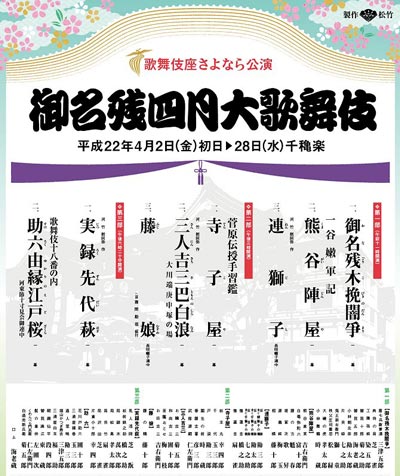
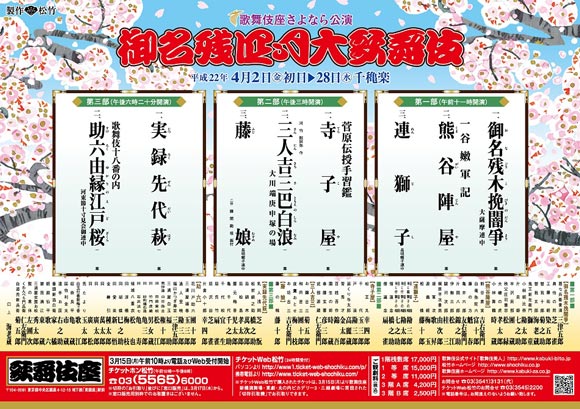
16th of the 16 Kabukiza Sayonara Kôen, the Kabukiza Farewell Performances ... the last programs before the destruction and the rebuilding of the Temple of Kabuki:
Kobiki no Danmari: a danmari is a fight in the dark where all the characters grope in the dark over some key object.
This particular danmari is filled with the larger-than-life characters
of Kabuki and features Living National Treasure Nakamura Shikan and the younger stars of Kabuki to say farewell to Kabukiza
in this final month of performances before it closes for rebuilding.
Kumagai Jin'ya: this play is a dramatization of the clash between the Genji general Kumagai Jirô Naozane
and the Heike warrior Taira no Atsumori at the battle of Ichi-no-Tani, one of the most famous passages of the epic
"Tales of the Heike". In the Kabuki version, on the cryptic orders of the Genji leader Yoshitsune,
Kumagai hides the enemy warrior Atsumori and has his own son take the warrior's place.
On the battlefield, Kumagai has to kill his own son in Atsumori's place.
Things become worse when his wife Sagami and Atsumori's mother Fuji-no-Kata arrive at his camp.
In the highlight of the play, he tells them the story of his mortal battle with Atsumori, keeping Atsumori's well-being and his own sacrifice a secret.
He then shows the head of Atsumori for inspection by his leader to see if he has interpreted his orders correctly.
This performance stars Nakamura Kichiemon as Kumagai,
with Sakata Tôjûrô as Kumagai's wife Sagami,
Nakamura Kaishun as Fuji-no-Kata,
Nakamura Baigyoku as Yoshitsune and
Nakamura Tomijûrô as Midaroku.
Renjishi: 2 entertainers dance a tale of the legendary shishi or lion-like spirits that live at the foot of a
holy Buddhist mountain. There is a comic interlude with 2 Buddhist pilgrims. Then, the shishi themselves appear and perform their dance with wild shaking of their long manes.
The dance shows a parent shishi forcing his cub to undergo harsh training in order to grow up strong.
This theme is often associated with the training a parent actor gives his son.
This performance is unusual because it features 2 cubs instead of one,
starring Nakamura Kanzaburô in the role of the parent shishi and his two sons,
Nakamura Kantarô and Nakamura Shichinosuke,
in the roles of the cubs.
Terakoya: Genzô and his wife Tonami run a small school and are
protecting Kan Shôjô's son and heir, saying that he is their son. However,
word has gotten out Kan Shôjô's son is there and Genzô has been ordered to
behead him. Moreover, Matsuômaru is to come to inspect the head. Their only
alternative is to kill one of the other students as a substitute, but all of
the students are farmer's children who could never pass for the son of a court
aristocrat. However, a new boy arrives that day and Genzô makes the terrible
decision to kill him in the place of his lord. As it turns out, Matsuômaru has
sent his own son to be sacrificed, because of his family's long loyalty to
Kan Shôjô. But he must face the most terrible situation for a father,
inspecting the head of his own son and lying when he says that it is the
genuine head of the son of Kan Shôjô. Finally Matsuômaru reveals his true
feelings to Genzô and he and his wife Chiyo mourn their dead son.
Starring Matsumoto Kôshirô as Matsuômaru, Kataoka Nizaemon as Genzô, Bandô Tamasaburô as Chiyo and Nakamura Kanzaburô as Tonami.
Sannin Kichisa:
(Three Thieves Named Kichisa)
The playwright Kawatake Mokuami excelled at portrayals of thieves and this short scene,
with its music and poetic lines, is one of his most famous.
A beautiful young woman helps out a woman who is lost on the road.
But she is actually Ojô Kichisa, a male thief who is disguised as a woman.
He steals an immense sum of money that the woman is carrying and this leads to
an encounter on this riverbank of three thieves, all with the name Kichisa.
The two others Kichisa are Oshô Kichisa, a bonze turned thief, and Obô Kichisa, an ex-samurai turned thief
Though they start out as rivals, they decide to become blood brothers
and form a gang. Featuring Onoe Kikugorô as Ojô Kichisa, Ichikawa Danjûrô as Oshô Kichisa and Nakamura Kichiemon as Obô Kichisa.
Fuji Musume: the spirit of wisteria blossoms dances of love in the form of a
beautiful young maiden. One of Kabuki's most famous and colorful dances, it will
feature the dancing skills of Living National Treasure Sakata Tôjûrô.
Jitsuroku Sendai Hagi:
(True Report of the Troubles in the Date Clan)
In the late 17th century, there was a dispute over leadership in the Date clan that led to the villainous head
retainer Harada Kai being interrogated in the mansion of the highest advisor to the Shôgun and killing his accuser
Date Aki there before being killed himself. This incident was reported in jitsuroku (true record) books that
laced reportage with lurid fiction. This was then dramatized in the popular play "Meiboku Sendai Hagi".
This is a rare performance of a dramatization of this jitsuroku version and shows the nurse Asaoka caught
between her duty to protect the young lord of the clan while the investigation is being conducted and her love
for her own son, who comes from the home clan far away to see her.
Starring Living National Treasure Nakamura Shikan, Matsumoto Kôshirô and Nakamura Hashinosuke in the roles of Asaoka, Katakura Kojûrô and Matsumae Tetsunosuke.
Featuring also Ichimura Manjirô, Kataoka Takatarô, Nakamura Senjaku and Nakamura Shibajaku in the roles of
the ladies-in-waiting Nishikigi, Matsushima, Kuretake and Sawada.
Sukeroku: the dandy Sukeroku is the most famous patron of the
Yoshiwara pleasure quarters.
But his reputation as the lover of Agemaki,
the highest ranking courtesan in the quarter is matched by that of his
tendency to pick fights. In fact, Sukeroku is the samurai Soga no Gorô
in disguise, and he uses the fights to find a lost heirloom sword.
His search takes place in the colorful atmosphere of the Yoshiwara
where processions of beautiful courtesans compete with the splendor of
cherry blossoms in full bloom. All the top stars in Kabuki appear in
a procession of beautiful, exciting and amusing roles.
Starring Ichikawa Danjûrô and Bandô Tamasaburô as Hanakawado Sukeroku and Miuraya Agemaki.
Featuring also Ichikawa Sadanji, Onoe Kikugorô, Bandô Mitsugorô, Nakamura Fukusuke, Nakamura Kanzaburô, Kataoka Nizaemon and Ichikawa Danshirô
in the roles of Ikyû, the shirozake seller Shinbê, Fukuyama Jukichi, the courtesan Miuraya Shiratama, the passer-by, Kanpera Monbei and Asagao Senpei.
Source: Earphone Guide website
|