AUGUST 2026

7 shows in Tôkyô (Kabukiza, Shinbashi Enbujô, Asakusa Kôkaidô, Asakusa Kôkaidô, Shinbashi Enbujô), 2 in Ôsaka (National Bunraku Theatre, Kintetsu Art Kan) & 1 in Nagasaki (Nagasaki Stadium City)!

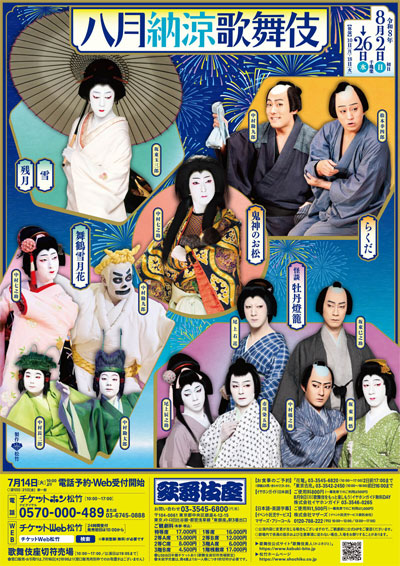
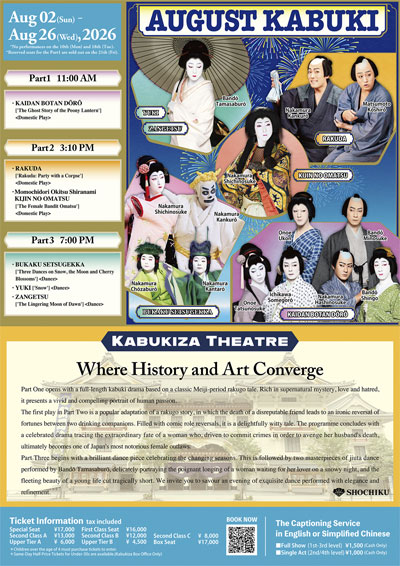
  • Living National Treasure Bandô Tamasaburô, Nakamura Kankurô, Nakamura Shichinosuke, Nakamura Senjaku, Matsumoto Kôshirô, Onoe Ukon, Bandô Minosuke, Bandô Yajûrô & Kataoka Ichizô perform at the Kabukiza!
  • All the others great Kabuki actors are on vacation ...
  • Kabukiza (Tôkyô)
    Dates 2 ~ 26 August 2026
    Hachigatsu Nôryô Kabuki
    August Cool-Breeze Kabuki
    1st program

    Kaidan Botan Dôrô

    2nd program

    Nemuru-ga-Rakuda Monogatari (Rakuda)

    Momo Chidori Okitsu Shiranami
    (Kijin no Omatsu)

    3rd program

    Bukaku Setsugekka

    Yuki

    Zangetsu

    Casting

    Living National Treasure Bandô Tamasaburô, Nakamura Kankurô, Nakamura Shichinosuke, Nakamura Senjaku, Matsumoto Kôshirô, Onoe Ukon, Bandô Minosuke, Bandô Yajûrô, Kataoka Ichizô, Kawarasaki Gonjûrô, Nakamura Yonekichi, Nakamura Kashô, Bandô Shingo, Ichikawa Somegorô, Nakamura Toranosuke, Onoe Tatsunosuke, Nakamura Hashinosuke, Nakamura Fukunosuke, Nakamura Utanosuke Nakamura Kantarô, Nakamura Chôzaburô, Sasano Takashi

    Comments

    The August Cool-Breeze Kabuki performances at the Kabukiza.

  • Botan Dôrô: one of the most famous ghost stories in Japan shows the ghost of a beautiful young girl who visits the man she loves nightly, her way lit by a lantern decorated with peonies. The clatter of her wooden clogs announces her appearance, “…karannn…koronnnn…” Originally a Chinese story, it became a Japanese classic when it was transformed into a long rakugo story by San'yûtei Enchô (1839~1900). Otsuyu (Onoe Tatsunosuke) the daughter of a samurai family falls in love with a young samurai named Shinzaburô (Ichikawa Somegorô), but she falls sick and dies when he stops visiting her. Her ghost begins to visit him nightly preceded by the ghost of her nursemaid carrying a lantern decorated with peonies and he welcomes these meetings, not realizing that she is dead. But a priest sees the signs of death and protects Shinzaburô with holy amulets and a powerful Buddhist statue. The ghosts then bribe Shinzaburô’s greedy servant Tomozô (Bandô Minosuke) and his wife Omine (Onoe Ukon) to take the amulets away. The result is that Shinzaburô is killed by the ghosts and Tomozô and Omine run away with the money. But the money doesn’t bring them happiness. This version of the story is not just a tale of ghosts, but shows human treachery and the revolving ironies of fate. Featuring also Matsumoto Kôshirô & Kawarasaki Gonjûrô.
  • Rakuda: this is a popular dramatization of a rakugo comic story. A petty gang boss named Rakuda (Kataoka Ichizô) has died after eating blowfish. Hanji (Matsumoto Kôshirô), one of his gang members, finds him and hopes to bury him, but has no money. When he tries to get the neighbors to contribute, everyone is overjoyed that such a nuisance is dead, but won't contribute a cent towards his burial. Finally Hanji pulls in a passing waste paper collector named Kyûroku (Nakamura Kankurô) and forces him to carry around Rakuda's body and threaten to make it dance if the neighbors won't pay up. They get a great sum of money and start drinking together. But as he drinks, the hapless Kyûroku becomes surprisingly aggressive.
  • Kijin no Omatsu: Natsume Shirojirô’s devoted wife, Omatsu (Nakamura Shichinosuke), hides a secret: she is the leader of a band of female outlaws determined to recover the treasured sword that was stolen from her husband’s lord—a loss that brought disgrace upon Shirojirô (Onoe Ukon) and reduced him to a masterless warrior. One day, Omatsu kills a travelling swordsman, only to discover to her horror that he was Shirojirô’s own brother Natsume Shirotarô (Nakamura Kashô). As tragedy deepens, Shirojirô, having been deceived into accepting a counterfeit of the treasured sword, prepares to take his own life in ritual suicide. Preventing his death, Omatsu sets out into the pitch-dark night in search of the genuine blade. Her quest leads to a climactic battle at a dilapidated temple, where she fights desperately to reclaim the treasured sword. Featuring also Nakamura Senjaku as Makimura Mondo.
  • Bukaku Setsugekka: a modern series of dances featuring Nakamura Shichinosuke as the spirit of the cherry blossoms ("Sakura"), Nakamura Kantarô and Nakamura Chôzaburô as autumn insects under the full moon ("Matsumushi") and Nakamura Kankurô as a snowman ("Yuki Daruma Goyomi").
  • Yuki: Living National Treasure Bandô Tamasaburô appears as an Ôsaka courtesan named Soseki, expressing her feelings of loneliness after having been jilted by her lover and who has decided to become a nun. This jiuta dance is performed in a restrained chamber style.
  • Zangetsu:
    (A Morning Moon)
    This work is said to have been composed in memory of the premature death of the daughter of Matsuya, a pupil of Minezaki Kotô, and the title of the piece is said to have been inspired by her posthumous Buddhist name. Living National Treasure Bandô Tamasaburô stars in an exquisite Jiutamai dance, which quietly portrays the imagery of a moon that appears and disappears, and the fleeting fragility of the young woman's life.
  • Sources: Earphone Guide Website or Shôchiku Kabuki Official Website

    Shinbashi Enbujô (Tôkyô)
    Dates 3 July ~ 23 August 2026
    Program

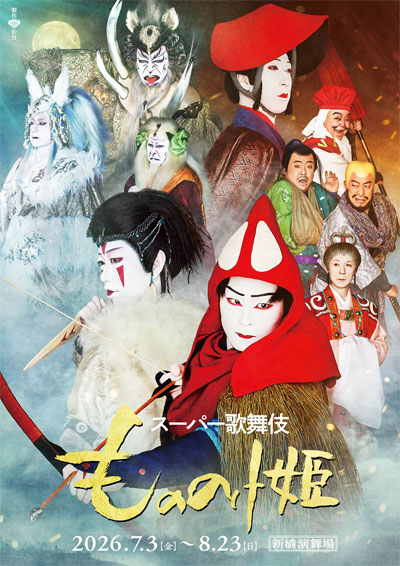
    Mononoke-hime [In Japanese]

    Casting

    Nakamura Kazutarô, Ichikawa Danko, Nakamura Tokizô, Ichikawa Chûsha, Ichikawa Monnosuke, Ichikawa En'ya, Ichikawa Emisaburô, Ichikawa Emiya, Ichikawa Juen, Ichikawa Seiko

    Comments

    Sûpâ Kabuki adaptation of Miyazaki Hayao's 1997 masterpiece "Princess Mononoke" with Ichikawa Danko and Nakamura Kazutarô in the roles of Ashitaka and San.

  • Mononoke-hime: This summer, Super Kabuki "Princess Mononoke" is performed at the Shinbashi Enbujô. Original story and screenplay written and directed by Miyazaki Hayao, the film "Princess Mononoke" is a masterpiece from Studio Ghibli that portrays an epic story of nature and humanity. This timeless classic is now be brought to life as a Super Kabuki production, captivating audiences with spectacular scale and dynamic staging. Sûpâ Kabuki ('Super Kabuki' in English) is a subgenre of modern Kabuki created by Ichikawa En'ô II. It is a new type of Kabuki characterized by epic stories told on a grand scale, incorporating contemporary staging styles that resonate deeply with modern audiences. This upcoming production vividly depicts the fierce conflict between humanity and nature, and the hope for coexistence, weaving together the intertwined destinies of Ashitaka (Ichikawa Danko) and San (Nakamura Kazutarô), the people of the Iron Town led by Eboshi Gozen (Nakamura Tokizô), and the gods inhabiting the forest, including the blind boar god Okkoto (Ichikawa Chûsha). Featuring also Ichikawa Monnosuke (Gonza), Ichikawa En'ya (Jiko), Ichikawa Emisaburô (the wolf goddess Moro), Ichikawa Emiya (the Oracle), Ichikawa Juen (an ape) and Ichikawa Seiko (Kôroku).
  • Sources: Earphone Guide Website or Shôchiku Kabuki Official Website

    Asakusa Kôkaidô (Tôkyô)
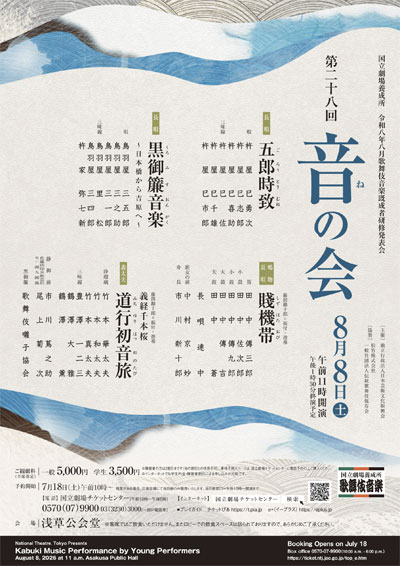
    Dates 8 August 2026
    Ne no Kai
    Program

    Gorô Tokimune

    Kuromisu Ongaku

    Yoshitsune Senbon Zakura
    (Michiyuki Hatsune no Tabi)

    Shizuhata Obi

    Comments

    28th edition of the summer program of the association Ne no Kai (literally 'the Sound Association'). The first 2 items in this program are only musical performances. The 2 ending items are dance-dramas staged with Kabuki actors.

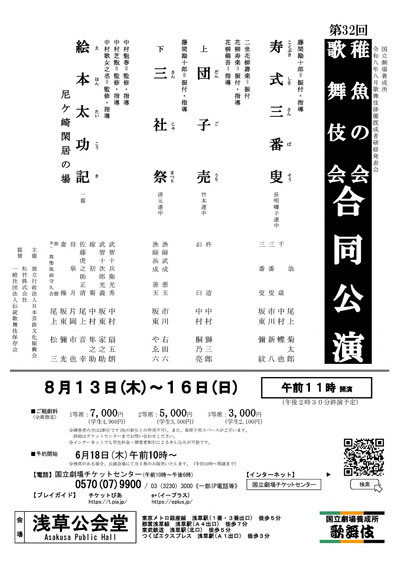
    Dates 13 ~ 16 August 2026
    Chigyokai/Kabukikai
    Program

    Kotobuki Shiki Sanbasô

    Dango Uri

    Sanja Matsuri

    Ehon Taikôki (Amagasaki Kankyo)

    Comments

    32nd edition of the common program for 2 associations, the Chigyokai (the Young Fishes Association) and the Kabukikai (the Kabuki Association), which stars stars' disciples in the leading roles of all the items in the program. Under the supervision of the actors Nakamura Kaishun, Nakamura Shikan and Nakamura Kamenojô and the dance masters Fujima Kanjûrô IV, Hanayagi Juraku III and Hanayagi Kingo.

    Kintetsu Art Kan (Ôsaka)
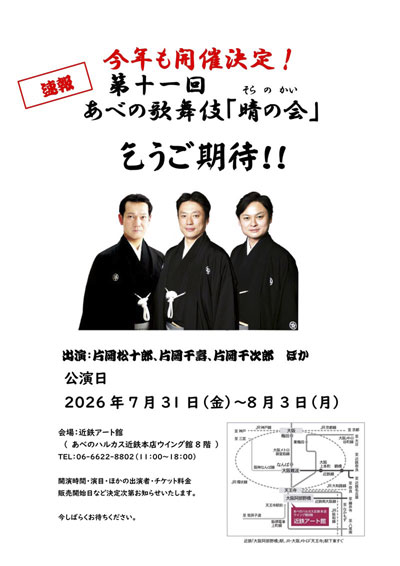
    Dates 31 July ~ 3 August 2026
    Sora no Kai
    Matinée

    Taki no Ase Odoru Kaomise

  • Yôkoso Kabuki he
    (Kabuki Wâkushoppu)
  • Buyô Sandai

  • Keisei
  • Awa Mochi
  • Hashi Benkei
  • Kamigata Shôsagoto

    Evening

    Taki no Ase Odoru Kaomise

  • Yôkoso Sora no Kai he
    (Kako Jû Kôen o furikaette)
  • Buyô Sandai

  • Keisei
  • Awa Mochi
  • Hashi Benkei
  • Kamigata Shôsagoto

    Casting

    Kataoka Matsujûrô, Kataoka Senjirô, Kataoka Senju, Nakamura Kansei, Kataoka Yûjirô, Kataoka Rikiya, Kataoka Yûjirô, Kataoka Sentarô, Nakamura Gandai

    Comments

    The 11th gala of the Sora no Kai (literally 'Sky Society'), in Ôsaka at the Kintetsu Art Kan, which stars mostly disciples of the Matsushimaya guild. These performances are entitled Abeno Kabuki (Abeno is the name of a famous district in Ôsaka). Two performances each day, one at 12:00 and one at 17:00. Under the supervision of Living National Treasure Kataoka Nizaemon and the dance master Yamamura Tomogorô III.

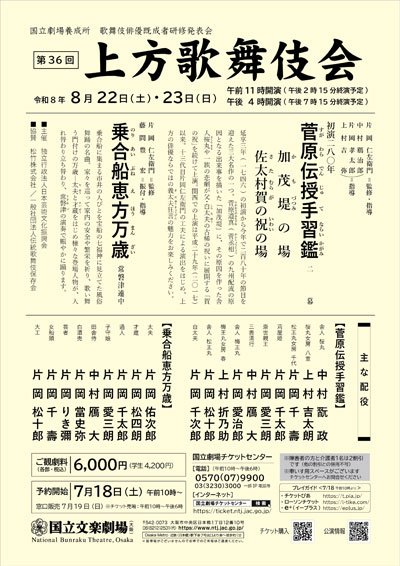
    National Bunraku Theatre (Ôsaka)
    Dates 22 ~ 23 August 2026
    Kamigata Kabukikai
    Program

    Sugawara Denju Tenarai Kagami

  • Kamo Zutsumi
  • Ga no Iwai
  • Noriaibune Ehô Manzai

    Comments

    36th edition of the Kamigata Kabukikai (the Kamigata Kabuki Association), a summer program in Ôsaka which stars Kamigata Kabuki stars' disciples in the leading roles. Under the supervision of Living National Treasure Kataoka Nizaemon, Nakamura Ganjirô, Kataoka Takatarô & Kamimura Kichiya.

    Nagasaki Stadium City (Nagasaki)
    Dates 7 ~ 9 August 2026
    Arîna Kabuki Buyô Tokubetsu Kôen
    Arena Kabuki Dance Special Special Performance
    Program

    Goaisatsu

    Ayatsuri Sanbasô

    Sagi Musume

    Renjishi

    Casting

    Kataoka Ainosuke, Nakamura Tanenosuke, Nakamura Kangyoku, Fuijma Michinori

    Comments

    1st edition of the Arîna Kabuki Buyô Tokubetsu Kôen (Arena Kabuki Dance Special Special Performance), a summer Buyô program in Nagaski at the Nagasaki Stadium City.

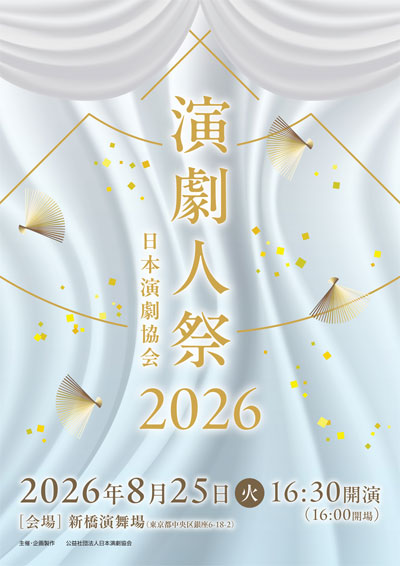
    Shinbashi Enbujô (Tôkyô)
    Dates 26 August 2026
    Engekijinsai
    Theater Festival
    Program

    Takasago
    A dance-drama performed by the masters Kanze Kiyokazu & Kanze Saburôta

    Tsuru Kame

    Casting

    Matsumoto Hakuô, Matsumoto Kôshirô, Ichikawa Somegorô

    Comments

    A special gala at the Shinbashi Enbujô with a dance-drama and a Kabuki dance-drama starring 3 generations of the Kôraiya guild.

  • Tsuru Kame: the crane (tsuru) is said to live for a thousand years, the tortoise (kame) is said to live for ten thousand years. Together, they are a traditional symbol of longevity. There is no particular plot to this play, but simply shows a visit by the empress to the Moon Pavilion where two courtiers dance as the spirits of the crane and tortoise. Starring Matsumoto Hakuô as the emperor, Matsumoto Kôshirô as the spirit of the crane and Ichikawa Somegorô as the spirit of the tortoise.
  • Sources: Earphone Guide Website, Shôchiku Kabuki Official Website or others sources

     
    Search this site powered by FreeFind
      Site map | Disclaimer
    Contact | Main | Top | Updates | Actors | Plays | Playwrights | Programs | Links | FAQ | Glossary | Chronology | Illustrations | Prints | Characters | Derivatives | Theaters | Coming soon | News