| SHIZUHATA OBI |
| Play titles | Shizuhata Obi Hanjo Monogurui  Harugasumi Shizuhata Obi |
| Common title | Shizuhata Obi |
| Author | Kineya Rokuzaemon X (music) |
| History |
"Shizuhata Obi", an adaptation of a popular mid-18th-century dance, was choreographed in 1828 as a short piece for the Sannô Festival. As such, it does not follow a fully developed narrative. Although it may be situated within the sumidagawamono category of dance-dramas, its emphasis lies less on plot than on the evocative image of a woman driven mad by grief, dancing beneath cherry trees in full bloom. The work culminates, without an explicit dramatic necessity, in an auspicious conclusion: a tribute to the deities who preside over and sustain the Sannô Festival. In this way, the piece blends emotional intensity with ritual devotion, characteristic of festival-oriented performances. In Kabuki, it was premiered in July 1892 in Tôkyô at the Torigoeza [more details]. |
| Key words |
Kyôjo Kyôjomono Kyôran Kyôranmono Nagauta Sannô Matsuri Senchô Shosagoto Sumidagawa Sumidagawamono |
| Summary |
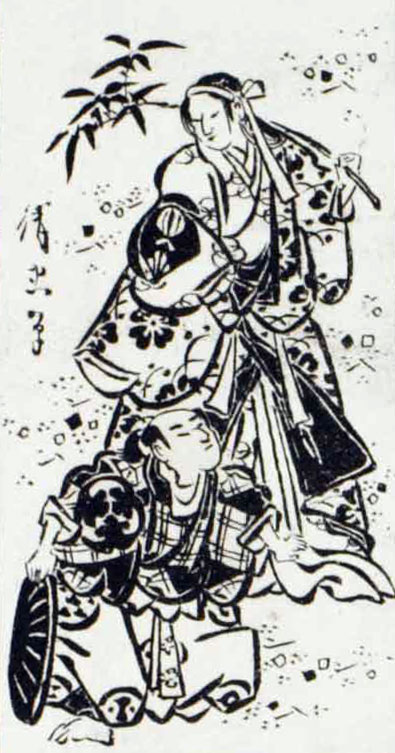
Tomaroku, a ferryman on the Sumida River hears rumours of a madwoman who wanders its banks, carrying a small net with which she gathers drifting cherry blossom petals. Seeking amusement, he resolves to mock her. When she appears, however, her sorrow soon becomes clear: she is Hanjo-no-Mae and she mourns the loss of her young son, abducted by a slave trader. Driven by grief and desperation, she has lost her sanity while searching for him. The boatman jeers at her madness, but she responds in poetic delirium, speaking of petals scattered by the wind and butterflies intoxicated by the fleeting beauty of spring. Intrigued, the boatman offers to reveal news of her son if she will demonstrate how she scoops the blossoms from the water, as though catching tiny fish. At last, moved by her anguish, he softens and shows compassion. Yet the woman, swept up in her grief, breaks into a frenzied dance, beating a small hand drum as her sorrow reaches its peak. In the end, both turn their thoughts to devotion, paying tribute to the Sannô Festival, as the scene blends frenzy, pathos, and ritual into a poignant conclusion. |
 |
|
An illustration from a tsuji banzuke for the staging of "Harugasumi Shizuhata Obi" in July 1916 at the Ichimuraza with Onoe Kikugorô VI (top) and Bandô Mitsugorô VII (bottom) in the roles of Hanjo-no-Mae and the senchô Tomaroku |
|
|
| Contact | Main | Top | Updates | Actors | Plays | Playwrights | Programs | Links | FAQ | Glossary | Chronology | Illustrations | Prints | Characters | Derivatives | Theaters | Coming soon | News |