| YOSHIZAWA AYAME I |
|
Stage names:
Others names:
Guild: Tachibanaya Line number: SHODAI (I) Poetry name: Shunsui Existence: 1673 ~ 15th day of the 7th lunar month of 1729 [1] Connections: Sons: Yoshizawa Ayame II, Yamashita Matatarô I, Nakamura Tomijûrô I, Yoshizawa Ayame III Grandsons: Yoshizawa Ayame V, Yamashita Matatarô II Great-grandson: Yoshizawa Iroha II Disciples: Yoshizawa Tamazuma, Yoshizawa Sengiku, Yoshizawa Takegorô, Yoshizawa Koshikibu, Yoshizawa Namie Family map: the Yoshizawa Clan Career: 1675 ~ 1690: born in Kyôto. His career started in the world of male prostitution. A man named Tachibana Gorozaemon spotted him and helped him to move to the theater world. He became a disciple of Mizushima Shirobê and learn the art of acting in the company of Arashi San'emon I. 1690 ~ 1693: first stay in Edo; he played at the Moritaza and the Nakamuraza under the name of Yoshizawa Ayame. 3rd lunar month of 1693: premiere in Kyôto at Miyako Mandayû's theater of Chikamatsu Monzaemon's drama "Butsumo Mayasan Kaichô", written for the star Sakata Tôjûrô I; Ayame played the role of Kofuji and he changed the first ideogram in his family name:
11th lunar month of 1695: second stay in Edo; Yoshizawa Ayame took the name of Yoshizawa Kikunojô and played at the Yamamuraza in the drama "Kaomise Jûnidan". Fall 1696: he went back to Kamigata and took back the name of Yoshizawa Ayame. 1st lunar month of 1698: Ayame played the role of Takane no Mae in the drama "Kantô Koroku Imayô Sugata", which was staged at Hayagumo Chôdayû's theater. Premiere at Hayagumo Chôdayû's theater of the drama "Keisei Asama-ga-Dake", which was produced by Yamashita Hanzaemon I; Ayame played the role of the courtesan Miura [casting]. Ayame's stage partner was the Edo actor Nakamura Shichisaburô I, the author of this play, which became a great success and a long run. The play was about the apparition of a courtesan's ghost to her unfaithful lover and became both a milestone in Kabuki history and a classic theme. Ayame's rank in the Kyôto hyôbanki, wakaonnagata section, was jô-jô-kichi (superior - superior - excellent) [visual]. 1st lunar month of 1700: Ayame played the role of the courtesan Sango in the drama "Keisei Zen no Tsuna", which was produced in Kyôto by Yamatoya Jinbê II; Ayame changed the first ideogram in his family name:
1st lunar month of 1703: Ayame settled in Ôsaka and achieved a great success by playing the role of the courtesan Ôiso no Tora in the drama "Soga Kuhon no Matsu", which was produced by the zamoto Matsumoto Nazaemon III. 11th lunar month of 1710: Ayame went to Kyôto and played the role of Ofuku in the drama "Inari Chôja Yotsugimaru", which was produced by Yamashita Karumo at Ebisuya Kichirôbê's theater. 3rd lunar month of 1711: Ayame's rank in the Kyôto hyôbanki, wakaonnagata section, was goku-jô-jô-kichi (extreme - superior - superior - excellent). 1st lunar month of 1712: Ayame became zamoto and produced the drama "Onna Wankyû" at Ebisuya Kichirôbê's theater. The roles of Wankyû and the courtesan Matsuyama were played by Yamashita Kyôemon I and Uemura Kichiya III. 11th lunar month of 1713: third stay in Edo; Ayame played two roles at the Nakamuraza in the drama "Onna Kusunoki Tenka Taiheiki". 1st lunar month of 1714: Ayame's rank in the Edo hyôbanki, wakaonnagata section, was goku-jô-jô-kichi (extreme - superior - superior - excellent). 11th lunar month of 1714: Ayame went to Kyôto and played the role of Otoyo in Sadoshima Saburôzaemon's kaomise drama "Yorozuyo Saiwai Gura", which was staged at Miyako Mandayû's theater. Fall 1716: First Kabuki adaptation of Chikamatsu Monzaemon's masterpiece "Kokusen'ya Gassen", which was produced by the zamoto Sakakiyama Shirotarô I in Kyôto at Miyako Mandayû's theater and starred the actors Sakakiyama Koshirô I (Watônai), Shibazaki Rinzaemon I (Kanki), Yamamoto Kamon (Kinshôjo), Murayama Heijûrô (Rôikkan), Ayame (Watônai's mother), Kikukawa Kiyotarô I (Watônai's wife Komutsu), Mihogi Gizaemon I (Ritôten) and Kikuta Zen'emon (Kairokuô). 11th lunar month of 1717: Ayame played in Kyôto the role of Gekinojô's nyôbô Otaga in the kaomise drama "Genjôraku Biwa no Ôumi", which was produced by Yamatoyama Jinzaemon I in Ebisuya Kichirôbê's theater. 11th lunar month of 1718: Ayame settled in Ôsaka and played in the drama "Suehiro Chôja Bandaigura", which was produced by Sawamura Chôjûrô I and celebrated the shûmei of Sugiyama Kanzaemon III. 11th lunar month of 1720: Ayame went back to Kyôto and played in the kaomise drama "Jûni Chôshi Megumi no Kodakara", which was produced by Sakakiyama Shirojûrô. 1st lunar month of 1721: Ayame achieved a great success in the same theater, playing a female role and a male role in the drama "Keisei Ôhara Sanemori". 11th lunar month of 1721: Yoshizawa Ayame became tachiyaku and took the name of Yoshizawa Gonshichi, playing the role of Sakuragi Ôinosuke in Yoshida Jûrobê's drama "Yamato Uta Denju No Tomigura", which was produced by Arashi Sanjûrô I. 1st lunar month of 1723: he switched back to wakaonnagata roles and took back the name of Yoshizawa Ayame I, playing in Kyôto at Daikokuya Takenojô's theater the role of the Tatewaki goke Okura in the new year drama "Keisei Hitomaruzuka" which was produced by Otowa Jirosaburô I. 11th lunar month of 1723: Ayame settled in Ôsaka and played at the Ônishi no Shibai the role of the female kojiki Kowata in the kaomise drama "Fukujukai Kogane no Minato", which was produced by Sakakiyama Shirotarô I. Spring 1728: Ayame appeared on stage for the last time, in Ôsaka at the Kado no Shibai; he played the role of Akashi no Tsubone in the drama "Ato Meron Keizu no Hakozaki", which was produced by Arashi Sanjûrô II. He retired from the Kabuki world. 15th day of the 7th lunar month of 1729 [1]: Ayame died. Comments: "The first onnagata in Kyôto during Genroku was Yoshizawa Ayame, who died in 1729. He was brought up by a widowed mother leading a precarious existence on Dôtonbori, the theatre street of Ôsaka. At first he was a page in the household of a daimyô, and later went on the stage. In the characters he played, he was not restricted to certain types of fair women as had been the case with his predecessors, but was most versatile, acting equally well heroines of the gay quarters, women of bad character, and ladies of high degree. The playwright Fukuoka Yagoshirô collected Ayame's ideas about the art of the onnagata, and made them into a book called "Ayame Gusa", or the "Sayings of Ayame". In this Ayame declared that an onnagata should have the heart of an onnagata even in the gakuya, or greenroom. When partaking of bentô (eatables served in a box) and sushi (cooked rice rolled into dainty morsels and stuffed with vegetables or fish after the manner of a sandwich), he should take care not to be seen eating. If his manners were masculine, and he ate and drank in the same manner as a tateyaku, his acting would not be successful. An onnagata, Ayame declared, should hide the fact of his being married, and if he were asked about his wife he should blush. Even if he had many children he must be like a child himself. Ayame also believed that the chief thing for an onnagata to do was to play the part of a good woman. This ought to be the duty of an onnagata, and rôles that were not proper, even though the play was popular, should be declined. He advocated that an onnagata should not lose the gentleness and mildness of a woman, but he recognised the unnaturalness of a male acting female rôles, and gave the advice that it was wise to develop the natural feelings of a woman in daily life, and not to use too much affectation on the stage. A really good onnagata was an actor who passed his daily life with the heart of a woman. When an onnagata on the stage thought that he had an important rôle as a woman, his actions would become unwomanlike." (Zoë Kincaid in "Kabuki, the Popular Stage of Japan") "Yoshizawa Ayame I was regarded as the greatest onnagata or female impersonator of his time and was an artist of ability, who developed the unique technique which was to be a model for the actors of the future. His ideas and secrets were written down in a book called "Ayamegusa", which was afterwards regarded as the Bible of the female impersonator" (A. C. Scott in "The Kabuki Theatre of Japan") "Ayame s'était prostitué très jeune après la mort prématurée de son père : on se rappelle que la carrière des onnagata commençait souvent, aux dix-septième et dix-huitième siècle dans les établissements spécialisés. De fait, c'est là qu'il eut l'occasion de rencontrer un protecteur fort versé dans les choses du théâtre, qui l'engagea à étudier la technique de l'onnagata en s'efforçant de donner de la femme l'illusion la plus complète possible : en ce sens, Ayame qui, bien que de vingt-cinq ans le cadet de Tôjûrô, eut l'occasion de jouer à ses côtés, fut conduit à appliquer à son domaine les mêmes principes réalistes qui avaient inspiré le jeu de son partenaire. Puisque le monde du Kabuki était désormais interdit aux femmes, il fallait, par un entraînement intensif, s'efforcer de les remplacer avec le maximum de vraisemblance, et Ayame élabora dans ce but une curieuse théorie du jeu de l'acteur, qui mêlait indissolublement la vie à l'art : si l'onnagata, disait-il, ne vit pas quotidiennement comme s'il était une femme, il ne pourra prétendre devenir un bon comédien. Et pendant plus de deux siècles, la scène devint ainsi le simple prolongement de l'existence d'onnagata qui, hors du théâtre même, s'habillaient en femme, se maquillaient, portaient perruque, allant même jusqu'à utiliser la partie des bains réservée à l'usage féminin" (Michel Wasserman in "Théâtre classique du Japon") [1] The 15th day of the 7th lunar month of the 14th year of the Kyôhô era was the 9th of August 1729 in the western calendar. |

 |
|
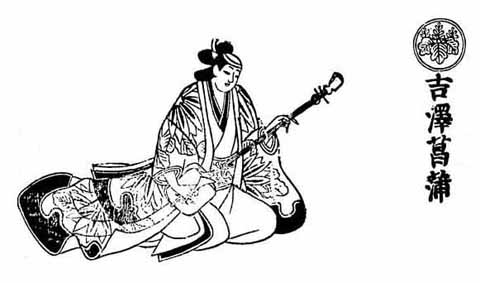
Yoshizawa Ayame I in an illustration from the book "Amayo no Sanbai Kigen" (1693) The Yoshizawa Ayame line of actors |
|
|
| Contact | Main | Top | Updates | Actors | Plays | Playwrights | Programs | Links | FAQ | Glossary | Chronology | Illustrations | Prints | Characters | Derivatives | Theaters | Coming soon | News |