| BANDÔ SHÛKA I |
|
Stage names:
Others names:
Guild: Yamatoya Line number: SHODAI (I) Poetry name: Shûka Existence: 1813 ~ 6th day of the 3rd lunar month of 1855 [1] Connections: Adoptive father: Bandô Mitsugorô III Son: Bandô Mitsugorô VI Adopted son: Bandô Minosuke IV Disciples: Bandô Kashiku, Bandô Tamazô, Bandô Matahachi (?) Career: 1813 ~ 1824: born in Edo. Second son of Tachibanaya Jisuke, an accounting manager at the Ichimuraza. He became a disciple of the star Bandô Mitsugorô III, who decided to adopt him and gave him the name of Bandô Tamanosuke I. 11th lunar month of 1824: he appeared on stage for the first time, taking the name of Bandô Tamasaburô I at the Ichimuraza. 6th lunar month of 1827: premiere at the Kawarasakiza of Tsuruya Nanboku IV's drama "Hitori Tabi Gojûsan Tsugi"; Tamasaburô played the roles of the courtesan Iroha and Shinanoya Ohan [casting]. 8th lunar month of 1829: tour in Nagoya with Bandô Hikosaburô IV. Tamasaburô achieved a great success by playing the roles of Okon and Ôgiya Yûgiri in the dramas "Ise Ondo Koi no Netaba" and "Kuruwa Bunshô" in the precinct of the Seijuin Temple. 1st lunar month of 1830: Tamasaburô and Bandô Hikosaburô IV settle in Ôsaka. They perform together at the Naka no Shibai. Tamasaburô played with success the role of Ohan in the drama "Katsuragawa Renri no Shigarami" (commonly called "Obiya"), which was produced by the zamoto Fujikawa Katsusaburô I. 27th day of the 12th lunar month of 1831 [2]: his adoptive father Bandô Mitsugorô III died. Fall 1832: Tamasaburô went back to Edo. 11th lunar month of 1832: Tamasaburô played at the Ichimuraza the roles of Hanazono and Kosakura in the kaomise drama "Bandô Musha Tsunagate Hajime". 2nd lunar month of 1837: premiere at the Moritaza of drama "Jitsu Kurabe Kuruwa Bunshô", the first Edo version of "Ninin Yûgiri" [more details]; Tamasaburô played the role of the first Yûgiri. 11th lunar month of 1839: Bandô Tamasaburô I took the name of Bandô Shûka I at the Ichimuraza, performing in the kaomise drama "Taiheiki Irifune Shinozuka". Shûka was in fact a haimyô which was used by Bandô Mitsugorô III. 6th lunar month of 1841: tour in Kôfu; Shûka played at the Kameyaza the roles of Kaoyo Gozen, Okaru and Tonase in the classic "Kanadehon Chûshingura". 1st lunar month of 1843: premiere at the Ichimuraza of the dance "Kashiragaki Ise Monogatari" (commonly called "Noriaibune"), which was staged within the new year sogamono drama "Kioi Uta Soga no Hanadashi"; Shûka was one of the seven dancers [more details]. 6th lunar month of 1845: Shûka played at the Ichimuraza the role of Oginoya Yaegiri in the drama "Komochi Yamanba"; the role of Sakata Kurando Tokiyuki was played by Mimasu Baisha. 8th lunar month of 1845: Shûka played at the Ichimuraza the roles of Osato ("Sushiya") and Shizuka Gozen in the classic "Yoshitsune Senbon Zakura". 1st lunar month of 1846: premiere at the Nakamuraza of Sakurada Jisuke III's Tokiwazu-based dance-drama "Kagura Uta Kumoi no Kyokumari", which was commonly called "Dontsuku"; Shûka performed in it [more details]. 8th lunar month of 1848: premiere at the Ichimuraza of Nishizawa Ippô's drama "Eiri Shôsetsu Asagao Monogatari"; Shûka played the role of Miyuki [casting]. 9th lunar month of 1850: premiere at the Nakamuraza of the drama "Minoriyoshi Kogane no Kikuzuki"; Shûka played the role of Hatsushiba [more details]. 2nd lunar month of 1851: premiere at the Ichimuraza of Sakurada Jisuke III's Kiyomoto-based dance "Akegarasu Hana no Nureginu", commonly called "Urazato Tokijirô"; Shûka played the role of Yamanaya Urazato [casting]. 5th lunar month of 1851: Shûka played at the Ichimuraza the role of Princess Taema in the drama "Narukami"; the role of the wicked priest Narukami was played by Ichikawa Danjûrô VIII. 11th lunar month of 1851: Shûka played at the Ichimuraza the role of Osono in the drama "Hana Momiji Kôra no Furugaki" (similar to the play "Hikosan Gongen Chikai no Sukedachi"); the role of Rokusuke was played by Sawamura Chôjûrô V. 1st lunar month of 1852: premiere at the Ichimuraza of Sakurada Jisuke III's drama "Satomi Hakkenden"; Shûka played the roles of Inuzuka Shino Moritaka and Princess Fuse [casting]. 3rd lunar month of 1852: Shûka played at the Ichimuraza the role of the shirabyôshi Hanako in the dance "Kyôganoko Musume Dôjôji", which is staged to commemorate the 23rd memorial service of his late adopted father Bandô Mitsugorô III. 9th lunar month of 1852: the play "Sesshû Gappô-ga-Tsuji" was staged for the first time in Edo, at the Ichimuraza; Shûka played the role of Tamate Gozen [casting]. 2nd lunar month of 1853: premiere at the Kawarasakiza of Kawatake Shinshichi II's drama "Shiranui Monogatari", which was based on Ryûkatei Tanekazu's long novel of the same title [more details]; Shûka played the roles of Aoyagi Harunosuke, the daijin Shiranui (in reality Princess Wakana), Namiroku's nyôbô Koiso, Suzushiro (in reality Princess Wakana) and the ryôshi Harukichi. 4th lunar month of 1853: Shûka played at the Kawarasakiza the role of Shizuka Gozen in the "Yoshinoyama" and "Shi-no-Kiri" scenes of the classic "Yoshitsune Senbon Zakura"; the roles of Tadanobu and Yoshitsune were played by Arashi Rikaku II and Bandô Takesaburô I. 5th lunar month of 1853: Shûka played at the Kawarasakiza the role of the female thief Hanaoka, who held 5 different names and disguises (Kaminari no Onaru, Gokuin Osen, Hotei no Oichi, Annozaka no Odaka and Karigane no Obun), in the drama "Karigane Gonin Onna" [3]. 3rd lunar month of 1854: premiere at the Kawarasakiza of Kawatake Shinshichi II's drama "Miyakodori Nagare no Shiranami"; Shûka played the role of the keisei Hanako, in reality the thief Tengu Kozô Kiritarô, in reality Yoshida Matsuwakamaru [casting]. 6th lunar month of 1854: premiere at the Kawarasakiza of Shinoda Sasuke's drama "Kumo no Uwasa Onna Narukami"; Shûka played the role of the ama Narukami [casting]. 11th lunar month of 1854: Shûka appeared on stage for the last time, in Edo at the Kawarasakiza, where he played the roles of Kaoyo Gozen and Okaru in the classic "Kanadehon Chûshingura". 6th day of the 3rd lunar month of 1855 [1]: Shûka died in Edo. Comments: Bandô Shûka I was an outstanding onnagata, who developped excellent diction and personal acting techniques. His forte were courageous and wild-spirited female roles. His fame in Edo between 1840 and 1854 was as high as his tachiyaku stage partner Ichikawa Danjûrô VIII. Bandô Shûka I's best roles: Okaru ("Kanadehon Chûshingura"), Yae ("Sugawara Denju Tenarai Kagami"), Agemaki ("Sukeroku"), Shizuka Gozen ("Yoshitsune Senbon Zakura"), the ama Narukami ("Onna Narukami") and Ohan ("Katsuragawa Renri no Shigarami"). Bandô Shûka I received posthumously the name of Bandô Mitsugorô V and his son, who was Bandô Mitsugorô V, became Bandô Mitsugorô VI. [1] The 6th day of the 3rd lunar month of the 2nd year of the Ansei era was the 31st of March 1855 in the western calendar. [2] The 27th day of the 12th lunar month of the 2nd year of the Tenpô era was the 29th of January 1832 in the western calendar. [3] This parodic play was in fact the female version of the famous "Karigane Gonin Otoko", an Ôsaka sewamono whose heroes were 5 thieves called Kaminari Shôkurô, Gokuin Sen'emon, Hotei Ichiemon, An no Heibê and Karigane Bunshichi. |

 |
|
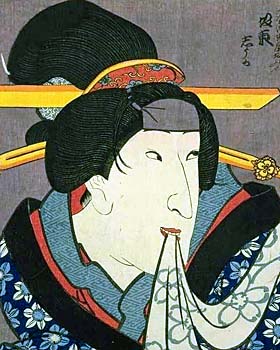
Bandô Shûka I in a print made by Utagawa Toyokuni III Print made by Utagawa Kuniyoshi Print made by Utagawa Toyokuni in 1849 Print made by Utagawa Toyokuni in 1850 Print made by Utagawa Toyokuni in 1852 Print made by Utagawa Toyokuni in 1852 Print made by Utagawa Toyokuni in 1853 Print made by Utagawa Toyokuni in 1854 Print made by Utagawa Toyokuni in 1860 The Bandô Tamanosuke line of actors The Bandô Tamasaburô line of actors The Bandô Shûka line of actors The Bandô Mitsugorô line of actors |
|
|
| Contact | Main | Top | Updates | Actors | Plays | Playwrights | Programs | Links | FAQ | Glossary | Chronology | Illustrations | Prints | Characters | Derivatives | Theaters | Coming soon | News |