Play title Kanadehon Chûshingura  In Japanese
Authors Takeda Izumo II
Miyoshi Shôraku
Namiki Senryû I
History

The play "Kanadehon Chûshingura" was originally written for the puppet theater (Bunraku) and staged for the first time in August 1748 in Ôsaka at the Takemotoza. It was adapted to Kabuki the same year and staged for the first time in December 1748 in Ôsaka at the Naka no Shibai [casting]. The "Sandanme" act (third act) was performed with the actors Ichimura Mihoemon, Yamamoto Koheiji and Ichinoyama Hikoshirô II in the roles of Moronô, Momoi Wakasanosuke and Hen'ya Hangan.

Structure

The "Sandanme" act, the third act of "Kanadehon Chûshingura", is made up of three scenes commonly called "Shinmotsu" (literally "the Gifts"), "Matsu-no-Ma Ninjô" (literally "Sword-drawing in the Pine-Tree Room") and "Ura Mon" (literally "the Back Gate"). Scene 1 and 2 are always performed for a tôshi kyôgen production of this drama and are never staged independently of the others acts. The "Ura Mon" scene, which is about the couple Kampei/Okaru, is usually omitted (except for some tôshi kyôgen performances in the Kamigata style) and replaced by the michiyuki "Ochiudo".

Key words Gidayû Kyôgen
Adauchi
Jidaimono
Summary

Act 3, Scene 1: "Shinmotsu"

This relatively short scene is a comedy with a sinister undercurrent. It takes place outside the rear gate of the Ashikaga mansion and introduces the obnoxious character of Sagisaka Bannai, one of Moronô's senior retainers. Bannai is infact one of Kabuki's greatest comic roles called dôkeyaku. In this scene, Bannai stands next to a palanquinin in which we are to suppose is Moronô himself, though that character never actually appears. A samurai comes to report that lord Wakasanosuke's senior retainer, Kakogawa Honzô, is on his way here, and at this Bannai immediately assumes that he's come to continue the fight of the other day on behalf of his master. Bannai warns his lackeys that they mustn't let Honzô escape and that upon his signal they are to attack him. His signal will be a cough. This leads to a very funny episode in which these stupid lackeys ask for a rehearsal and repatedly get their orders wrong. At last however, Honzô is allowed to approach but far from wanting a fight, he has come bearing gifts which he hopes will appeal to Moronô's avaricious nature. Of his own accord, Honzô has decided to bribe the senior lord into making peace with Wakasanosuke so that any fatal confrontation will be avoided. But at first Bannai ignores him and it is only after dropping a heavy packet of coins into Bannai's sleeve that his attitude completely changes. Bannai suddenly welcomes Honzô warmly which throws his group of lackeys into confusion, and when he does unintentionally cough, he only manages to stop these men from attacking Honzô in the nick of time. Moronô signals to Bannai to accept the gifts after which Honzô is invited to join their party inside the mansion. In the final lines of the chanter, "Honzô, sure that money would win the day, has bought the life of his master". The faithful retainer has calculated well.

Act 3, Scene 2: "Matsu-no-Ma Ninjô"

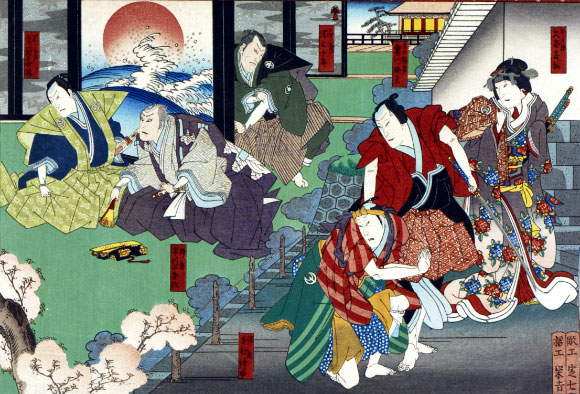
We come to one of the play's truly great scenes. It's set within Tadayoshi's mansion in an ante-room sumptuously decorated with a pine tree motifon the gold sliding doors and for this reason it is often called simply the "pine room scene". It's some moments after the events we saw last and Moronô, Bannai and Honzô have now made their way to this room. As they enter they're surprised to see Wakasanosuke waiting for them, still furious at Moronô and prepared for a fight. He does not see Honzô and nor does he know what Honzô has done to assuage Moronô's anger. To Wakasanosuke's astonishment, Moronô is humble and apologetic, and his ingratiating words force Wakasanosuke to give up any idea of revenge. In complete contrast to his previous behaviour Moronô now praises the young lord for his early arrival and his diligence in performing hisdut ies. He seems overly anxious to appease Wakasanosuke's violent mood and thereare so me very amusing moments when Moronô even offers to have Bannai massage hisback when Wakasanosuke claims to feel out of sorts. Wakasanosuke can do nothing but swallow his fury and withdraw, screaming one final insult at Moronô as he leaves.

After realizing that he and Bannai are alone Moronô's real feelings naturally reveal themselves. He never meant a word of what he said and despises Wakasanosuke as much as ever, but having taken Honzô's gifts he had to pretend otherwise. This has left Moronô in a filthy mood and when Enya Hangan appears soon after, Moronô scolds him for being late. As yet Moronô holds no particular grudge against Hangan and the entire tragedy of "Chûshingura" might have been averted if only the following incident hadn't occured. A letter arrives from Hangan's wife, Kaoyo, addressed to Moronô. The latter thinks it is a favourable reply to his previous advances and his mood somewhat recovers until he actually reads the note. It is an ancient poem from the "Shin Kokinshû" collection with which Kaoyo means to reject Moronô. When he realizes this he is both furious and embarassed for he feels sure that Kaoyo must have told Hangan as well. When asked if he's seen the poem Hangan replies that he has not, but this is not enough to prevent the onslaught of insults which now come from Moronô. The core of what follows is bitter sarcasm which Moronô takes to its furthest extreme andwhich pushes the normally placid and sensible Hangan beyond endurance. Moronô extols the beauty of both Kaoyo's handwriting and her person, saying that it's no wonder Hangan himself was late in coming to the mansion today... he was probably at home enjoying himself and getting drunk with his wife. But Moronô's sadistic streak really shows itself when he starts to belittle Hangan by comparing him to a fish which is suddenly let free from its tiny well into a broad river. He is just like that fish for he has come from his tiny mansion into this magnificent big one. Though at first merely confused as to why Moronô should suddenly be insulting him, gradually Hangan feels pushed more and more into defending his name. By the end, he has no choice but to unsheath his sword and slash at Moronô, despite the fact that such action is forbidden and punishable by death. His honour as a warrior demands that Moronô die for his gross insults, even at the expense of his own life. However, tragically, Honzô rushes out just then to hold Hangan back and prevents him from killing Moronô, and the senior lord escapes with only a minor cut to his forehead.

Courtesy of Paul M. Griffith

Nakamura Fukusuke I and Ichikawa Danzô VI playing the roles of En'ya Hangan and Kô no Moronô in the "Matsu-no-Ma Ninjô" scene of the drama "Kanadehon Chûshingura", which was staged in October 1857 at the Moritaza (print made by Utagawa Toyokuni III)

 
Search this site powered by FreeFind
  Site map
Contact | Main | Top | Updates | Actors | Plays | Playwrights | Programs | Links | FAQ | Glossary | Chronology | Illustrations | Prints | Characters | Derivatives | Theaters | Coming soon | News