| ONNA MODORI KAGO |
| Play titles | Sugata no Hana Torii-ga-Irozashi  Ume Kaoru Haru no Hanakago |
| Common title | Onna Modori Kago |
| Authors | Sakurada Jisuke I (lyrics) Kishizawa Koshikibu III (music) |
| History |
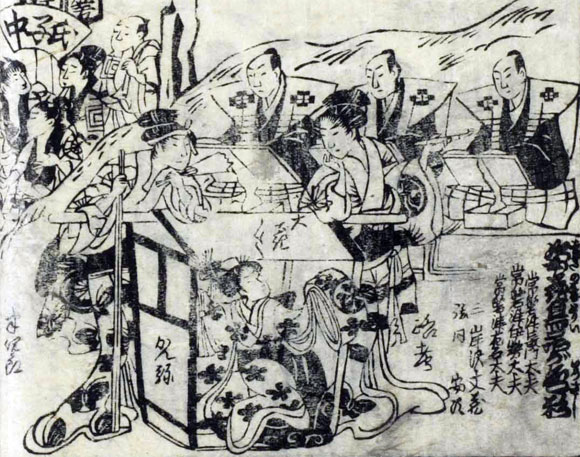
In Kabuki, several dance-dramas or plays parody other familiar and highly popular numbers. They retain many features of the original works but substitute female characters in place of the original male roles. Examples include "Onna Narukami", a female version of "Narukami"; and "Onna Shibaraku", a female adaptation of the spectacular "Shibaraku". "Onna Modori Kago" provides another example. It is the female version of "Modori Kago", in which the palanquin bearers from the dance "Modori Kago" appear as female bearers. Unlike the original "Modori Kago", which contrasted regional identities (Edo vs. Ôsaka), the emphasis here was on color, femininity, and spectacle, rather than competition or bravado. "Onna Modori Kago" was premiered under the title "Sugata no Hana Torii-ga-Irozashi" in the 5th lunar month of 1805 in Edo at the Nakamuraza [more details]. In January 1928, a revised version with Tokiwazu and Nagauta musical ensembles was premiered at the Kabukiza under the title "Ume Kaoru Haru no Hanakago" [1] [more details]. |
| Key words |
Kago Kagokaki Kakikae Kyôgen Kamuro Kuruwa Nagauta Ômon Shin-Yoshiwara Shosagoto Tokiwazu Yakko Yoshiwara |
| Summary |
The dance opens at the ômon (Great Gate) of Yoshiwara [2]. Azumaya Oyoshi [3] and Naniwaya Osaku [3], two female palanquin bearers enter carrying a four-hand palanquin. Their very presence creates immediate comic contrast, as palanquin bearing was typically a male occupation. Their movements combine the physicality of labor with graceful femininity, establishing the tone of lighthearted sophistication. The palanquin stops, and Shimada Jûzaburô, the customer, steps out [4]. Through flirtatious gestures, teasing glances, and rhythmic footwork, Oyoshi engages him in a brief, humorous exchange. The dancers open the palanquin again, this time revealing a comic yakko and the scene transitions into a celebratory kuruwa-style dance. The performers boast about the pleasures, elegance, and excitement of Yoshiwara life, mimicking scenes of drinking parties, flirtation, and rivalry over men. The piece concludes with an energetic ensemble dance. The mood remains cheerful and decorative, evoking a fleeting vision of Edo-period pleasure-quarter life. |
| Notes |
[1] A number with the same title was staged in April 1926 in Asakusa at the Shôchikuza. Same dance-drama? So far, no answer to this question. [2] In fact Shin-Yoshiwara. [3] Different names depending on the production. In "Ume Kaoru Haru no Hanakago", Azumaya Oyoshi and Naniwaya Osaku were in reality Katagiri Sukesaku's daughter Murosaki and Fukushima Ichimatsu's sister Hayasaki. In recent productions, the names were also related to the name of the performing actor. For example:
[4] Shorter versions of "Onna Modori Kago" does not include the part with Shimada Jûzaburô. |
 |
|
The actors Iwai Hanshirô V, Morita Kan'ya IX and Segawa Rokô III playing the roles of a female kagokaki, a kamuro and a kagokaki in the dance-drama "Sugata no Hana Torii-ga-Irozashi", which was staged in the 5th lunar month of 1805 at the Nakamuraza |
|
|
| Contact | Main | Top | Updates | Actors | Plays | Playwrights | Programs | Links | FAQ | Glossary | Chronology | Illustrations | Prints | Characters | Derivatives | Theaters | Coming soon | News |