| KINKAKUJI |
| Play title | Gion Sairei Shinkôki  Keisei Niwatoriyama The Gion Festival Chronicle of Faith* |
| Authors | Asada Icchô Nakamura Akei Toyotake Ôritsu |
| History |
The 5 acts puppet theater drama "Gion Sairei Shinkôki" was performed for the first time at the Toyotakeza in the 12th lunar month of 1757. It was adapted for Kabuki for the first time in the 1st lunar month of 1758 in Kyôto, produced simultaneously at the Minamigawa no Shibai [casting] and at the Kitagawa no Shibai [casting]. It used its real title at the former theater but it was entitled "Keisei Niwatoriyama" at the latter theater. "Gion Sairei Shinkôki" was staged for the first time in Edo in the 5th lunar month of 1758, at the Moritaza [casting]. |
| Structure |
The "Kinkakuji" scene, the only one still performed, is the 4th act of the original puppet theater drama. |
| Key words | Akahime Goban Gidayû Kyôgen Jitsuaku Kinkakuji Konoshita Tôkichi Matsunaga Hisahide Ôseri Sanhime Sabakiyaku Seri Taikôki |
| Summary |
The play was set in Kinkakuji, the Golden Pavilion in Kyôto, which is still a huge tourist attraction to this day. A magnificent set represented the inside of the pavilion, with its gold walls sporting figures of tigers and decorated with trees, plants, and colored swirls of cloud, contrasting with black lacquered trims and balcony railings. The occupant of the pavilion was the evil Daizen, who had recently killed the shogun and captured the Shôgun's mother, keeping her captive on the upper floor of Kinkakuji. Although it is wartime, Daizen lives in luxury, indulging in his favorite pastime--playing the board game go. He is said to be the most skilled player in the realm, but he wishes things were going as well on the front lines as they are in his go games, but unfortunately he lacks a good strategist. A man named Tôkichi appears, wanting to switch sides and work for Daizen as a strategist. Daizen is suspicious, but wants his skill, and so decides to test him by challenging him to a game of go. After a battle of wits, Daizen is shocked to discover he has been beaten. He next tests Tôkichi's strategic ability by throwing down a well the bowl used to hold the go pieces, and tells him to retrieve it without getting his hands wet. To achieve this, Tôkichi diverts water from the nearby waterfall through a pipe and into the well, so that the bowl floats to the surface. He presents it to Daizen on the upturned go board and promises to present Daizen with his enemy's head in the same way, a sentiment which well pleases Daizen. In the meantime, Daizen has been trying to force Princess Yuki to paint a dragon on the ceiling of the pavilion, and to give in to his favors. She has persistently refused, giving several reasons--he is the man who killed the shogun to whom she and her husband owed their loyalty; she doesn't have the secret scroll of a tiger painted by her grandfather from which to copy; she loves her husband and cannot betray him. Daizen responds that if it is her love for her husband that is stopping her, then he will have him hung in a well and then torture her in his bed. She tries to kill him with his sword, but fails and as punishment, he orders her husband's death and has her tied to the cherry tree in the garden. Her husband is led in past her, and then alone in desperation as the cherry blossom falls plentifully around her on the ground, she draws a picture of some mice with her toes. They come to life and gnaw away the ropes binding her, but before she can escape, Daizen's brother spots her, but is felled with a dagger thrown by an unseen assailant. The rescuer is none other than Tôkichi, now in his true identity as Hisayoshi, one of Nobunaga's great warriors, who had planned all along to rescue the Shôgun's mother and defeat Daizen. The play ends with the warriors posed to meet one final time for battle. Text courtesy of Jean Wilson (November 1997) (*) the title "The Gion Festival Chronicle of Faith" comes from the 1st volume of "Kabuki Plays On Stage". |
| Comments |
"In the latter half of "Kinkakuji", Hisayoshi climbs up the cherry tree and rescues Keijuin who is confined on the second floor of Kinkakuji temple. At this time, the change of scene is done by up-and-down motion of the entire Kinkakuji temple stage set. For this, a part of the floor of the stage is cut out, and the seri (stage lift) mechanism is used to move this part of the stage upward and downward. The large seri used to move the stage set for an entire building upward and downward as in this scene, is called ôseri." (from Invitation to Kabuki) |
 |
||
|
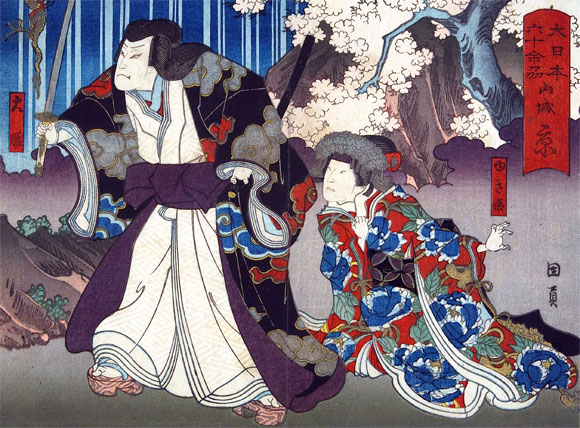
The actors Arashi Kichisaburô III (left) and Bandô Hikosaburô V (right) playing the roles of Matsunaga Daizen and Princess Yuki in the "Kinkakuji" act of the drama "Gion Sairei Shinkôki" in a mitate-e print made in 1861 by Utagawa Kunikazu |
||
|
|
| Contact | Main | Top | Updates | Actors | Plays | Playwrights | Programs | Links | FAQ | Glossary | Chronology | Illustrations | Prints | Characters | Derivatives | Theaters | Coming soon | News |