| ARASHI KANSHIRÔ I |
|
Stage names:
Line number: SHODAI (I) Existence: ??? ~ 22nd day of the 8th lunar month of 1739 [1] Connection: Father: Arashi Kan'emon I Father-in-law: Arashi San'emon II Son: Arashi Kanshirô II Disciples: Arashi Ugenta, Arashi Kanzaburô (Arashi Kichisaburô I's master) Son-in-laws: Nakamura Tokujûrô, Sakurayama Shirosaburô I, Sawamura Chôjûrô III Career: Before 1700: son of Arashi Kan'emon I, he started his career at an early age, performing in Ôsaka under the name of Arashi Kanshirô I. 1st lunar month of 1700: Kanshirô performed in Ôsaka in the new year drama "Kamakura Shôgatsu Tsukai", which was produced by Arashi San'emon II. Fall 1701: Kanshirô went to Edo. 11th lunar month of 1701: Arashi Kanshirô I took the name of Arashi Kan'emon II at the Moritaza, performing in the kaomise drama "Taiheikoku Yuzuriha no Kagami". Fall 1706: he went back to Ôsaka. 11th lunar month of 1706: Arashi Kan'emon II took back the name of Arashi Kanshirô I, performing in Ôsaka in the kaomise drama "Kantô Koroku", which was produced by Shinozuka Jirozaemon I; his others stage partners were Otowa Jirosaburô I, Hyakunin'isshu Genzaburô, Bandô Kikumatsu I, Hanai Azuma and Onogawa Orie. 11th lunar month of 1713: Kanshirô played in Ôsaka at Shioya Kuroemon's theater the role of Madenojô in the kaomise drama "Yoyo Meoto Tsuru no Mago". 11th lunar month of 1717: Kanshirô played at the Naka no Shibai the role of Nagahisa Kuniemon in the kaomise drama "Inari Yashiki Daikoku Bashira", which was produced by Sawamura Chôjûrô I. 12th lunar month of 1717: Kanshirô played in the same theater the role of Hada Jinsuke in the kiri kyôgen "Ôsaka Shinjû Hajimari" [2]. 11th lunar month of 1720: Kanshirô played in Ôsaka at the Higashi no Shibai the roles of Yawatayama Gondayû [illustration] and a daikan in Kyôya Yagoshirô's kaomise drama "Kogane no Ikioi" and in the kiri kyôgen "Nanshoku Kamo Samurai Jûshichikinenki", which were produced by Arashi San'emon III. 11th lunar month of 1722: Kanshirô produced in Ôsaka at the Higashi no Shibai the kaomise drama "Tenchi Tennô Sokutai Guruma", in which he played the role of Kanawa Rokurô. 1st lunar month of 1723: Kanshirô produced in the same theater the new year ni-no-kawari drama "Keisei Tomoe Daiko", in which he played the role of Date no Koyata. 11th lunar month of 1723: Kanshirô became jitsuaku and played at the Naka no Shibai the role of Tada Kurando in the kaomise drama "Chûshin Futaba no Matsu", which was produced by Matsushima Hyôtarô. 1st lunar month of 1724: Kanshirô's rank in the Ôsaka hyôbanki, jitsuaku section, was jô-jô (superior - superior) [visual]. 11th lunar month of 1724: Kanshirô played at the Ônishi no Shibai the role of Iwagaki Jûrobê in the kaomise drama "Senbon Matsu Hi-no-De no Maizuru", which was produced by Sakakiyama Shirotarô I and Sawamura Kiyojûrô. 1st lunar month of 1725: Kanshirô's rank in the Ôsaka hyôbanki, jitsuaku section, was jô-jô-(shiro)kichi (superior - superior - (white) excellent) [visual]. 11th lunar month of 1725: Kanshirô played at the Ônishi no Shibai the role of Takatsuji Daigaku in the kaomise drama "Gokoku Jôju Naniwa no Yakata", which was produced by Sakakiyama Shirotarô I. 11th lunar month of 1726: Kanshirô played at the Kado no Shibai in the kaomise drama "Bunbu Aioi no Matsu", which was produced by Fujii Hanamatsu and celebrated the shûmei of Fujikawa Hanzaburô II. 1st lunar month of 1727: Kanshirô's rank in the Ôsaka hyôbanki, jitsuaku section, was jô-jô-(hanshiro)kichi (superior - superior - (half-white) excellent) [visual]. 11th lunar month of 1727: Kanshirô played at the Kado no Shibai the role of Fuwa Banzaemon in the kaomise drama "Onna Kabuki Chiyo no Hajime". 1st lunar month of 1728: Kanshirô's rank in the Ôsaka hyôbanki, jitsuaku section, was jô-jô-kichi (superior - superior - excellent) [visual]. Fall 1729: Kanshirô went to Kyôto. 11th lunar month of 1729: Kanshirô became tachiyaku and played the role of Suminoe Manzaemon in the kaomise drama "Fukuju Yakata Wagô no Futabashira", which was produced at Kameya Kumenojô's theater by Sakakiyama Shirotarô I. 1st lunar month of 1730: Kanshirô's rank in the Kyôto hyôbanki, tachiyaku section, was jô-jô-(hanshiro)kichi (superior - superior - (half-white) excellent) [visual]. 11th lunar month of 1730: Kanshirô played in Kyôto the role of Nakatomi Tanzaemon in Sawamura Bunji's kaomise drama "Inari Yakata Manpô no Kura", which was produced by Arashi Koroku I at Hayagumo Chôdayû's theater. Fall 1731: Kanshirô went back to Ôsaka. 11th lunar month of 1731: Kanshirô became jitsuaku and played the role of Minatoyama Daigaku in the kaomise drama "Aioi Kikenjô", which was produced by his son Arashi Kokuseki. 1st lunar month of 1732: Kanshirô's rank in the Ôsaka hyôbanki, jitsuaku section, was jô-jô-(hanshiro)kichi (superior - superior - (half-white) excellent) [visual]. Fall 1732: Kanshirô went to Kyôto. 11th lunar month of 1732: Kanshirô became tachiyaku and played the role of Naniwazu Kanzaemon in the kaomise drama "Hayazaki Kogane no Hanabusa". 1st lunar month of 1733: Kanshirô's rank in the Kyôto hyôbanki, tachiyaku section, was jô-jô-kichi (superior - superior - excellent) [visual]. 11th lunar month of 1733: Kanshirô played at Kameya Kumenojô's theater (Kyôto) the role of Tsumori Gensuke in the kaomise drama "Chôseiden Kogane no Shikigawara", which was produced by Sakakiyama Shirotarô I. 1st lunar month of 1734: Kanshirô's rank in the Kyôto hyôbanki, tachiyaku section, was a little bit lower, down to jô-jô-(hanshiro)kichi (superior - superior - almost excellent). Fall 1734: Kanshirô went back to Ôsaka. 11th lunar month of 1734: Kanshirô became jitsuaku and played the role of Mochizuki Kôemon in the kaomise drama "Honchô Bugaku no Hajimari", which was produced by Iwai Hanshirô III at the Naka no Shibai. 1st lunar month of 1735: Kanshirô's rank in the Ôsaka hyôbanki, jitsuaku section, was jô-jô-kichi (superior - superior - excellent) [visual]. 11th lunar month of 1735: Kanshirô played the role of the rônin Nagagara Tamiemon in the kaomise drama "Toyo no Asahi Eitaigura", which was produced by Iwai Hanshirô III at the Naka no Shibai and celebrated the arrival in Ôsaka of the Edo actor Bandô Hikosaburô I and the shûmei of Arashi Kiyosaburô III. 11th lunar month of 1736: Kanshirô played the role of the senior retainer Ishimaru Hideemon in the kaomise drama "Yamato Fumi Mannen no Ayatsuri", which was produced by Iwai Hanshirô III at the Kado no Shibai. 11th lunar month of 1737: Kanshirô played at the Naka no Shibai in the kaomise drama "Fukakusa-no-In Sannô no Maki". 1st lunar month of 1738: Kanshirô appeared on stage for the last time, playing in the same theater the role of Kanjûrô in the new year drama "Gonin Onna Itazuragami". 22nd day of the 8th lunar month of 1739 [1]: Kanshirô died in Ôsaka. Comments: Arashi Kanshirô I was an important jitsuaku and tachiyaku actor, who made most of his career in Kamigata from the end of the Genroku era to the Genbun era. He was excelling in budôgoto and also in aragoto, a rare feature in Kamigata, in jidaimono dramas. He was endowed with a big powerful voice and it was said at the end of his career that nobody would be talented enough to replace him as a jitsuaku! [1] The 22nd day of the 8th lunar month of the 4th year of the Genbun era was the 24th of September 1739 in the western calendar. [2] This drama was a shinjûmono based on the story of Chôemon and his lover Ichinojô. The 17th day of the 5th lunar month of the 3rd year of the Tenna era (the 11th of June 1683 in the western calendar), the courtesan Yamatoya Ichinojô and her lover Goze no Chôemon committed suicide together in Ôsaka. This event caused quite a stir and three Ôsaka theaters decided to capitalize on the situation by simultaneously producing the same month the first shinjûmono of Kabuki history. |

 |
|
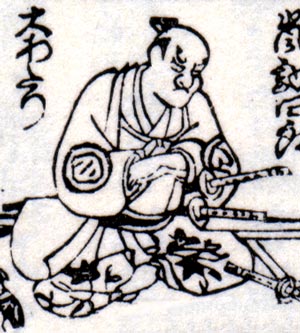
Arashi Kanshirô I playing the role of Minatoyama Daigaku in the kaomise drama "Aioi Kikenjô", which was staged in the 11th lunar month of 1731 at the Kado no Shibai The Arashi Kanshirô line of actors |
|
|
| Contact | Main | Top | Updates | Actors | Plays | Playwrights | Programs | Links | FAQ | Glossary | Chronology | Illustrations | Prints | Characters | Derivatives | Theaters | Coming soon | News |