| SUZU-GA-MORI |
| Play title | Ukiyozuka Hiyoku no Inazuma  Gozonji Suzu-ga-Mori |
| Author | Tsuruya Nanboku IV |
| History |
The play "Ukiyozuka Hiyoku no Inazuma" was premiered in the 3rd lunar month of 1823 at the Ichimuraza [casting]. |
| Structure |
"Ukiyozuka Hiyoku no Inazuma" was divided in two parts, 9 acts and 19 scenes. The "Suzu-ga-Mori" scene of this drama was the 6th scene of the first part. It quickly became a successful independent drama. |
| Key words |
Banzui-chôbeimono Hikyaku Hirai Gonpachi Kakôshû Kumosuke Sewamono Shirai Gonpachi Suzu-ga-Mori Tachimawari |
| Summary |
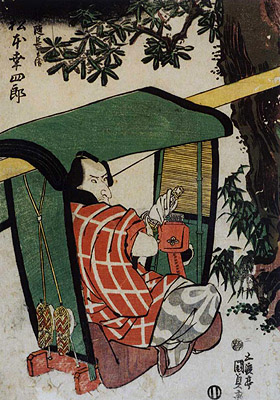
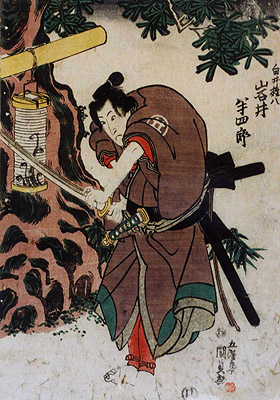
The scene represents the execution ground of Suzu-ga-Mori, a gloomy place near Edo. A running messenger is assaulted by several rascals disguised as palanquin-bearers (kumosuke). They rob him of his clothes. The messenger, almost naked and fearing for his life, decides to offer them the letter box, which he is carrying and is intended for the Edo Authorities. It contains a warrant for the capture of a man called Shirai Gonpachi, the murderer of his uncle. It is written that he ran away from the scene of the crime, heading for Edo and wearing the distinctive mon of the Shirai clan on his kimono. The gang of Suzu-ga-Mori is interested to catch this murderer and get the big reward from the Edo police. One rascal says that he has seen the mon on the kimono of a young man about to take a palanquin from Ômori to Edo, which means that he should arrive here shortly. They hide themselves in the bushes around the massive commemorative stone of the execution ground. A palanquin appears and comes down the hanamichi. It stops near the stone. The passenger, a young man with the Shirai mon, gets out and starts to quarrel with the two bearers about the outrageous transportation fee. The bearers attach him but are suddenly counter-attacked by the Suzu-ga-Mori gang. One rascal can spot the mon on Shirai Gonpachi's kimono but the young fugitive is saved by the moon, which is suddenly hidden by a big cloud, plunging the scene into a pitch-black darkness. A bloody and comical tachimawari takes place, with Gonpachi killing or cutting arms, feet and faces with his samurai sword. Another palanquin arrive on stage during the fight. Its passenger is the famous Edo otokodate Banzui Chôbê. He can watch the great fight by the light of the palanquin lantern and is impressed by the bravery of the young man. The gang is finally defeated and the survivors run away. Shirai Gonpachi comes near the palanquin to check the blade of his sword at the light of the lantern. His eyes meet Chôbê's ones, who is inside the palanquin. Gonpachi is about to retreat, when Chôbê starts to speak to him, telling him how he admires his great swordsmanship. Chôbê hands to Gonpachi the messenger letter, which he has found on the ground during the fight. Gonpachi reads it and realizes it is a warrant to catch him. Chôbê grabs the letter, reads it and understands who the young man is. Chôbê burns the letter and drops the flaming paper, telling Gonpachi that everything is forgotten. Chôbê can help him anytime during his stay in Edo. They promise to meet again and they finally part.
|
 |
 |
|
The actors Matsumoto Kôshirô V and Iwai Hanshirô V playing the roles of Banzui Chôbê and Shirai Gonpachi in the "Suzu-ga-Mori" scene of the drama "Kakene Nashi Edokko Ryôri", which was staged in the 3rd lunar month of 1828 at the Nakamuraza (print made by Utagawa Kunisada I) |
|
|
|
| Contact | Main | Top | Updates | Actors | Plays | Playwrights | Programs | Links | FAQ | Glossary | Chronology | Illustrations | Prints | Characters | Derivatives | Theaters | Coming soon | News |