| SHIOKUMI |
| Dance titles | Shiokumi  Shichimai Tsuzuki Hana no Sugatae |
| Authors | Sakurada Jisuke II (lyrics) Kineya Shôjirô II (music) Fujima Kanjûrô I (choreography) |
| History |
The actor Bandô Mitsugorô III performed in the 3rd lunar month of 1811 at the Ichimuraza a 7-role hengemono, which was entitled "Shichimai Tsuzuki Hana no Sugatae". One of these seven roles was a salt-making girl. This role became an independent dance, staged under the title "Shiokumi". |
| Key words |
Ariwara Yukihira Nagauta Eboshi Matsukaze-murasamemono Shiokumi Shosagoto |
| Summary |
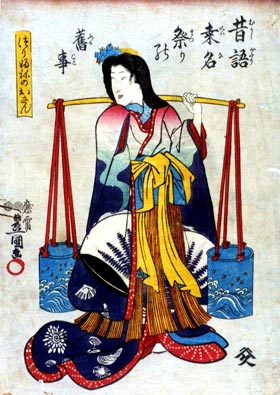
The dance is about the shiokumi Matsukaze, a "salt-scooper" who carries seawater for the purpose of making salt. She appears on stage very richly dressed, wearing opulently embroidered garments, a beautiful cloak and a courtier's gold hat (eboshi), which ought to belong to her lover, Ariwara no Yukihira. She carries a pair of pails, painted with waves, on a yoke across her back. The poet Ariwara no Yukihira was exiled to the seashore of Suma, where he had a love affair with two shiokumi sisters, Matsukaze and Murasame. Ariwara no Yukihira was forgiven by the Imperial court and finally left Suma for the Imperial Capital Kyôto. Matsukaze dances to the memory of the poet and expresses her longing for him. In the end, her dancing recalls the sweet memories she had with him. |
 |
|
The actor Bandô Shûka I performing a shiokumi role in a dance, which was staged in the 7th lunar month of 1847 at the Ichimuraza (print made by Utagawa Toyokuni III) |
|
|
| Contact | Main | Top | Updates | Actors | Plays | Playwrights | Programs | Links | FAQ | Glossary | Chronology | Illustrations | Prints | Characters | Derivatives | Theaters | Coming soon | News |