![]() |
| Play title | Yoshitsune Sembon Zakura |
| Authors | Takeda Izumo II Miyoshi Shôraku Namiki Senryû I |
| History |
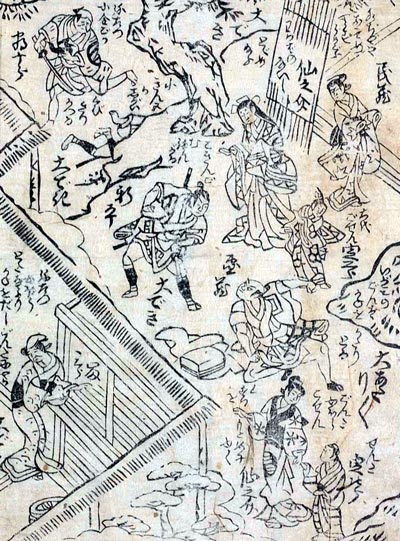
The play "Yoshitsune Sembon Zakura" was originally written for the puppet theater (Bunraku) and staged for the first time in November 1747 in Ôsaka at the Takemotoza. It was adapted to Kabuki the following year and staged for the first time in January 1748 in Ise with Kataoka Nizaemon IV (Tokaiya Gimpei, Yokawa no Zenji Kakuhan) and Yamamoto Koheiji (Tadanobu). It was performed for the first time in a city licensed theater in May 1748, in Edo at the Nakamuraza [casting]. The "Ko-no-Mi" and "Kokingo Uchijini" scenes were performed with Sawamura Chôjûrô III, Ichikawa Yaozô I, Arashi Tamagashiwa, Sawamura Utagiku and Nakamura Nakazô I in the roles of Gonta, Kokingo, Wakaba no Naishi, Gonta's wife Kosen and Gonta's son Zenta. The first performance in Ôsaka was done in August 1748, at the Naka no Shibai [casting], and the "Ko-no-Mi" and "Kokingo Uchijini" scenes were performed by Nakamura Utaemon I (Gonta), Ichimura Sanohachi (Wakaba no Naishi, Kosen) and Yamatoya Jimbei IV (Kokingo). |
| Structure | The "Ko-no-Mi" and "Kokingo Uchijini" scenes, which are nowadays regularly performed, are the first and second scenes of act III. |
| Key words | Gempei-kassenmono Gidayû Kyôgen Giri/Ninjô Tachimawari Heike |
| Summary |
Wakaba, the wife of Koremori, a young fugitive Heike lord, and her son are travelling in search of him with their servant Kokingo. While they are resting at a roadside tea stall, Gonta enters and tries to strike up a conversation. Shortly he leaves, purposely walking off with Kokingo's pack and leaving his own identical one in its place as if by mistake. Before long Kokingo notices the switch and is about to go off in pursuit, when Gonta comes rushing back effusive in his apologies at his mistake. He swears he hasn't touched a thing and asks Kokingo to confirm that everything is intact. A relieved Kokingo does so, but Gonta now notices that his own pack has been opened. He frantically searches but claims that the 20 ryô which he had hidden between layers of clothing are missing, and in an increasingly loud and menacing voice he accuses Kokingo of being a stinking thief and demands his money back. Kokingo is outraged at this slur on his character but is restrained from drawing his sword by Wakaba, and close to tears throws 20 ryô of his own money at Gonta, and leaves. A smug Gonta is just congratulating himself on a having done a nice bit of work when his wife, Kosen the tea stall owner, and son emerge to confront him. She upbraids him for his crooked ways and points out that he's known as "Gonta the Swindler" by everyone in the area, and that their son is bullied because of Gonta's bad reputation. It seems to be like water off a duck's back to Gonta, but finally we see him warm his son's cold hands and carry him home on his back. This an important moment in the play, for without it we would never fully realize the tragedy of Gonta's fate in the next act. As Act 4 closes, we see Kokingo attacked and killed after a long fight. In the dark the respectable proprietor of a sushi shop comes along. In fact he is ruffian Gonta's father, Yazaemon. As the curtain falls, we see Yazaemon take a sword and bring it down on the neck of the dead Kokingo. Text courtesy of Jean Wilson (July 1998) |
![]() |
![]() |
|
The actors Ichikawa Danjûrô VII and Ichimura Uzaemon XII playing the roles of Gonta and Kokingo in the "Ko-no-Mi" scene of the drama "Yoshitsune Sembon Zakura", which was staged in July 1828 at the Ichimuraza (print made by Utagawa Kunisada I) |
|
|
|
|
Contact | Main | Top | Updates | Actors | Plays | Playwrights | Programs | Links | FAQ | Glossary Chronology | Illustrations | Prints | Characters | Derivatives | Theaters | Coming soon | News |