| OKAZAKI |
| Play title | Igagoe Dôchû Sugoroku  Igagoe Norikake Gappa |
||||||||||||
| Authors | Chikamatsu Hanji, Chikamatsu Kasaku ("Igagoe Dôchû Sugoroku") Nagawa Kamesuke I ("Igagoe Norikake Gappa") |
||||||||||||
| History |
The play "Igagoe Dôchû Sugoroku" was originally written for the puppet theater (Bunraku) and staged for the first time in the 4th lunar month of 1783 in Ôsaka at the Takemotoza. The authors drew their inspiration from Nagawa Kamesuke I's successful drama "Igagoe Norikake Gappa", which was directly written for Kabuki and was staged for the first time in the 12th lunar month of 1776 in Ôsaka at the Naka no Shibai [casting]. "Igagoe Dôchû Sugoroku" was adapted for Kabuki the same year and staged for the first time in the 9th lunar month of 1783 in Ôsaka at the Naka no Shibai [casting]. This play is based on the famous Igagoe vendetta, which took place in 1634. When it was dramatized, the names and details, and even the era were changed because of censorship by the ruling Tokugawa Shogunate:
|
||||||||||||
| Structure |
"Igagoe Dôchû Sugoroku" is made up of 10 acts. "Okazaki" gathers act VIII ("Fujikawa Shinseki" / "At the new barrier on the Fuji River") and act IX ("Okazaki Yamada Kôbê Sumika" / "at Yamada Kôbê's Home in Okazaki"). |
||||||||||||
| Key words |
Adauchi Gidayû Kyôgen Giri/Ninjô Igagoemono Jidaimono Katakiuchi Okazaki-juku Sandai Adauchi Tôkaidô |
||||||||||||
| Summary |
Act VII: Fujikawa Shinseki Pursuing Sawai Matagorô, in this play, the killer of his father, Wada Shizuma comes to a barrier at Fujikawa, but does not have a certificate to let him through. Osode, a teahouse maiden falls in love with Shizuma and helps him by taking the travel documents from Sukehei, a footman. She distracts the footman by showing him the telescope used to watch travelers approaching the barrier and he is absorbed watching a husband and wife who are dumpling sellers. Matagorô and his uncle Rinzaemon pass through the barrier and ask a horse driver to kill Shizuma and Karaki Masaemon if they are found. After the barrier is closed for the night, Masaemon arrives and sneaks past by going through a bamboo grove. Sukehei tries to follow in the same way since Shizuma took his travel papers, but is captured instead. Act VIII: Okazaki Yamada Kôbê Sumika Osode takes Shizuma to her house. Shizuma presents a letter addressed to her father Yamada Kôbê from the stolen travel documents and the letter asks him to protect Matagorô, who has been betrothed to marry Osode. She has never met Matagorô, so Shizuma immediately poses as him and they go to their marriage bed. Karaki Masaemon has been attacked and is rescued by Kôbê. In fact, Kôbê was once Masaemon's fencing teacher and recognizes him immediately. But at that time, Masaemon was still using his childhood name and so Kôbê does not realize that Masaemon is now the enemy of his family and even requests his help in protecting Matagorô. Masaemon's wife Otani appears outside with her newborn baby. When he left to help with the vendetta, Masaemon divorced Otani to shield her from punishment. But she has followed him, hoping to unite her baby with his father at least once. Masaemon comforts her outside in the snow, but insists that she leave immediately since he must keep his true identity a secret. The baby falls into Kôbê's hands, and learning that it is Masaemon's son, vows to keep the child as a hostage to try to draw out their enemy. But Masaemon grabs the baby and stabs it, saying that it is cowardly to take hostages. Finally Kôbê introduces Masaemon to "Matagorô" and Masaemon is surprised to see that it is actually Shizuma. Suddenly Kôbê reveals that he knows their true identities and realized that his old student was actually Masaemon by the hidden tears in his eyes when he killed his own son. Now Kôbê throws his loyalty to Shizuma and Masaemon and tells them where Matagorô is. Source: Earphone Guide website |
||||||||||||
| Trivia |
"Okazaki" used to be a popular item before WW2. Since the end of WW2, it was been so far revived only four times, in February 1952 at the Shinbashi Enbujô and in September 1970, December 2014 and March 2017 at the National Theatre. Act VII is nicknamed "Tômegane" (the telescope) because of the telescope used by Matagorô's henchman Sukehei to spy Shizuma and Osode in a comical scene. Act VIII is nicknamed "Tabako Kiri" (tobacco shredding): when his wife Otani and his son Shôtarô arrives at Kôbê 's home, exhausted and chilled to the bone, Masaemon does not look at them, shows absolutely no emotion and prefer to smoke instead of helping them. |
 |
 |
 |
|
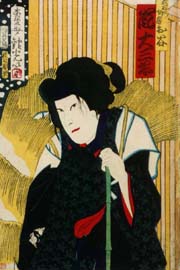
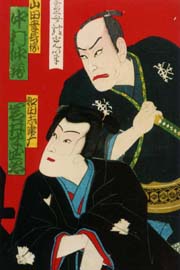
The actors Arashi Daizaburô IV, Nakamura Sôjûrô, Iwai Hanshirô VIII and Nakamura Nakazô III playing the roles of Otani, Karaki Masaemon, Wada Shizuma and Yamada Kôbê in the drama "Kaze Kaoru Iga no Akebono", which was staged in june 1874 at the Nakamuraza (print made by Shôsai Ginkô) |
||
|
|
| Contact | Main | Top | Updates | Actors | Plays | Playwrights | Programs | Links | FAQ | Glossary | Chronology | Illustrations | Prints | Characters | Derivatives | Theaters | Coming soon | News |