| ÔAKINAI HIRU-GA-KOJIMA |
| Play titles | Ôakinai Hiru-ga-Kojima  Kurokami Sanada Obi Neya no Kumiuchi |
| Authors | Sakurada Jisuke I Masuyama Kinpachi I [1] |
| History |
The kaomise drama "Ôakinai Hiru-ga-Kojima" was premiered at the Nakamuraza in the 11th lunar month of 1784 [more details]. It celebrated the shûmei of Sanogawa Ichimatsu III, Sanjô Kantarô IV and Nakajima Mihozô III and the return in Edo of Ôtani Hiroemon III. The opening day was the 1st day of the 11th lunar month of the 4th year of the Tenmei era, which was the 12th of December 1784 in the western calendar. |
| Structure |
"Ôakinai Hiru-ga-Kojima" was divided into a 3-act ichibanme and a nibanme. It included the Nagauta-based meriyasu "Kurokami", performed by Kineya Sakichi I and Koide Ichijûrô I, and the Tomimoto-based shosagoto "Sanada Obi Neya no Kumiuchi", performed by Tomimoto Buzendayû II. The 1969 revival at the National Theatre was in 3 acts (6 scenes). |
| Key words |
Ema Koshirô Genji Genpei Kassen Genpei-kassenmono Go Goban Goshirakawa Tennô Heike Hikinuki Hiru-ga-Kojima Hôjô Masako Hôjô Tokimasa Hôjô Yoshitoki Itô Nyûdô Itô Sukechika Izu Izu Nikki Jidaimono Junkabuki Kamata Masakiyo Kamisuki Kaomise Kawazu Hakoômaru Kawazu Ichimanmaru Kawazu Sukeyasu Kudô Suketsune Kurokami Mankô Gozen Meriyasu Nagauta Nyûdô Minamoto Yoritomo Minamoto Yoshitomo Mongaku Ôzatsuma Shirabyôshi Soga Sukenobu Sogamono Taira Kiyomori Tenmei Kabuki Tomimoto |
| Summary |
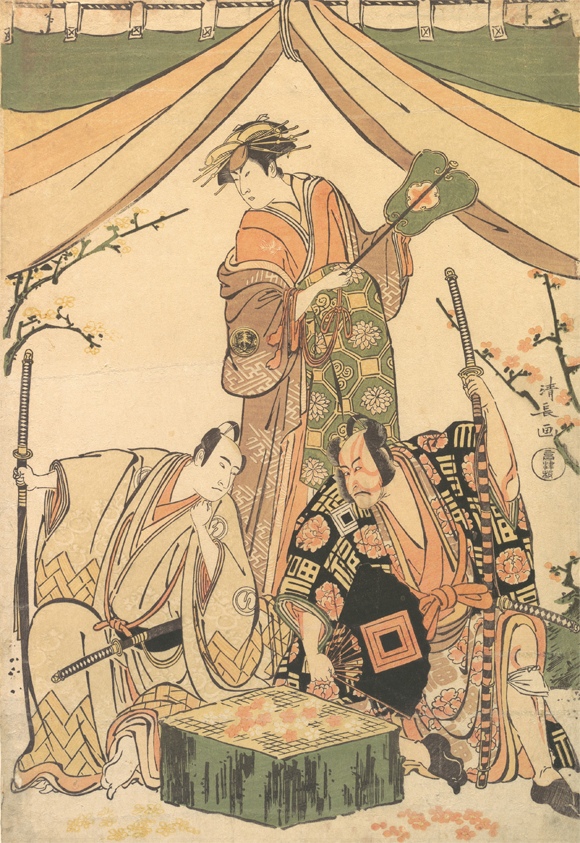
Act I: at the Izu Gongen Shrine Rumours swirl through the countryside that Minamoto Yoritomo, the young Genji clan leader exiled to Izu as a child, is gathering troops to lead his clan in a fresh battle against the powerful Heike clan, currently led by the tyrant Taira Kiyomori in the capital of Kyôto. Warriors loyal to the Genji clan are eager to assess the situation, while those aligned with the Heike eye their opponents with suspicion, searching for signs of which way the tide will turn. In Izu, where Yoritomo has grown into a man, the nyûdô Itô Sukechika, lord of the region, has gained favour with the Heike and is intent on crushing Yoritomo to secure his own path to power. Sukechika is a notorious scoundrel who has seized land belonging to his uncle's family, making him despised by his cousin Kudô Suketsune. Even Sukechika's own son, Kawazu Sukeyasu, grows uneasy with his father's immoral ways, secretly sympathizing with Yoritomo, whom Sukechika seeks to destroy. Further complicating the situation is Sukechika's daughter, Princess Tatsu, who is secretly Yoritomo's mistress. As tensions rise, powerful warriors are aligning themselves with either the Genji or the Heike, and the situation in Izu is bound to reach a breaking point sooner or later. At Izu Gongen Shrine, several northern warriors sympathetic to the Genji cause gather to offer prayers and seek divine guidance about the conflict between the two rival clans. As they enter the shrine for the ritual, a thief sneaks in and attempts to steal a written prayer vow from the altar. However, Sukeyasu's young son, Hakoômaru, spots the thief and subdues him after a brief struggle. Meanwhile, at the shrine, Matano Gorô Kagehisa and Kawazu Saburô Sukeyasu engage in a game of go, with the shirabyôshi Kazaori acting as the officiating judge. Sukeyasu plays with the white stones, symbolizing the Genji's white banner, while Kagehisa uses the black stones, representing the Heike's red banner. The game progresses [2] and ends with a victory for Sukeyasu, who plays the white stones. Kagehisa grumbles about Kazaori's apparent favouritism toward Sukeyasu. After the game, he attempts to charm her, but Kazaori reveals her preference for Sukeyasu. A brief struggle ensues, and during the commotion, a paper-wrapped memorial plaque falls from Kazaori's bosom. As Sukeyasu stoops to pick it up, his own prayer-vow slips from his chest and falls to the ground. Kagehisa picks up the prayer-vow, while a drawing of Yoritomo falls from Sukeyasu's bosom, which Kazaori then retrieves. Sukeyasu shoves Kagehisa aside and runs off with Kazaori, leaving Kagehisa behind, confused by the prayer-vow. As he reads it, Kagehisa realizes it reveals Sukeyasu's concern for his father's evil ways, along with a vow to offer his life as atonement for Sukechika's deeds. Meanwhile, Sukeyasu questions Kazaori about the memorial plaque, which bears the name of Kamata Masakiyo, a warrior who fought under Minamoto Yoshitomo, Yoritomo's fallen father. Kazaori, as it turns out, is Masakiyo's daughter. Kagehisa, now suspicious of Sukeyasu's loyalty to Yoritomo, tries to probe him for information. Sukeyasu, however, cautiously deflects the questions while also trying to gauge Kagehisa's true allegiance. Act II: at Soga Sukenobu's Mansion At the same time, the Heike, concerned about the growing support for Minamoto Yoritomo among northern warriors, holds a special ceremony at Soga Tarô Sukenobu's mansion, hoping to win them over to their side instead. Meanwhile, the peasant Goheiji arrives at the mansion, demanding to know the whereabouts of his son, Chôroku, who was last seen speaking with Sukenobu and entering the building. A servant, Mishima Bukuryô, promises to look into it. In truth, Sukenobu has persuaded Chôroku to assist the Yoritomo cause by impersonating him-since Chôroku bears a striking resemblance to Yoritomo-and to sacrifice himself for the cause. Sukechika's son, Sukeyasu, is expected to attend the ceremony, but he is away on a trip. Instead, he has arranged for his wife, Mankô, to go in his place. When Mankô arrives at Sukenobu's mansion, she meets him for the first time. She suspects that, like her husband, Sukenobu secretly supports Yoritomo and is plotting against the Heike, so she aims to probe his loyalties. Their meeting is cordial, but one of Mankô's maids soon remarks that it's strange: the night before, while playing a game with Mankô's son, Ichimanmaru, they had noticed that Mankô's name and Sukenobu's always seemed to be linked. This hints at a possible connection between the two, which causes some embarrassment. Mankô, married to Sukeyasu, and Sukenobu, a widower, use this incident to subtly probe each other's stance on Yoritomo. Mankô tries to coax Sukenobu into admitting his allegiance to Yoritomo, but Sukenobu refuses to reveal his true feelings and warns Mankô to watch her words. Stepping out to the well to purify herself before making her public pledge of loyalty to the Heike, Mankô senses something amiss. She is certain that Sukenobu has hidden Yoritomo in a nearby cave. Throwing a sedge hat toward the entrance, she watches as Chôroku, disguised as Yoritomo, emerges. Mankô, having known Yoritomo in the past, mistakenly believes the young man to be Yoritomo himself. She urges him to raise the Genji banner, knowing that many northern warriors await his call to arms. However, Chôroku insists that he intends to take the tonsure and has no interest in leading a rebellion. At that moment, Owari Saburô Tokikane, a spy, leaps out with his sword drawn, declaring he will kill Yoritomo and earn a reward from the Heike. Mankô, however, manages to subdue him and orders her servant Samon to tie up the intruder. Meanwhile, inside the mansion, a meeting of warriors is underway. Sukechika and other Heike loyalists are present, plotting to kill Yoritomo and pledge their loyalty to the Heike. Sukenobu enters and offers his pledge of allegiance. Sukechika, however, presses him to admit he supports Yoritomo by presenting a pledge written by Sukenobu that suggests sympathy for the Genji cause. Sukenobu denies knowledge of the pledge and insists he is loyal to the Heike. Elsewhere, Sukeyasu has been wounded in a confrontation with his cousin Kudô Suketsune, who is seeking revenge for Sukechika's usurpation of his estate. Injured, Sukeyasu drags himself to Sukenobu's mansion and meets with his father, urging him to return the stolen land to its rightful owner. Before he dies, Sukeyasu asks Sukenobu to look after his wife Mankô and their two young sons, Ichimanmaru and Hakoômaru. His death fulfils the earlier omen of a union between Sukenobu and Mankô, and the two boys vow revenge on Suketsune, a vendetta that will culminate in their famous quest for justice many years later. After Mankô and her children leave, the ceremony to pledge loyalty to the Heike begins, with each warrior making their vow before the altar. Sukechika initially refuses to take part, claiming his loyalty is already well known, but when the matter of his daughter, Princess Tatsu, being Yoritomo's secret mistress comes to light, he is forced to undergo the ritual, alongside Goheiji. The spirits of the two are possessed during the ceremony and, under the influence, reveal their true intentions. Sukechika admits he plans to feign loyalty to the Heike while secretly plotting to seize control of the land, while Goheiji confesses his role as a pawn, promised a high position and wealth for his cooperation. When the trance ends, both Sukechika and Goheiji are unaware of the truths they have revealed and try to bluff their way through. But Sukenobu, now armed with this knowledge, gains the upper hand, leaving Sukechika on the defensive. Sukechika motions to his men, and they move toward the cave where the fake Yoritomo is hidden. Sukenobu attempts to intervene, but others stop him. Chôroku, disguised as Yoritomo, is pulled out. Sukenobu feigns surprise and quickly strikes off Chôroku's head, shocking everyone. When Goheiji cries out, recognizing the head as his son's, Sukenobu kills him as well. Sukenobu declares that he will present the severed head of Yoritomo to the Heike as proof of his loyalty and departs, leaving Sukechika behind, both confused and frustrated by the turn of events. Act III: at Masaki Kôzaemon's Home Masaki Kôzaemon is, in fact, the exiled Genji leader Minamoto Yoritomo, living in Shimoda disguised as a calligraphy teacher. His wife, Ofuji, is actually Princess Tatsu, the daughter of Itô Sukechika. Kozaemon's behaviour is such that Ofuji, often jealous, pouts as he flirts freely with the young women who come to take his lessons. On this particular day, Ofuji turns away two women who come to ask to be his disciples. One is Kiyotaki, in truth Kazaori, the daughter of a former Genji warrior. The other is Omasu, actually Masako, daughter of Hôjô Tokimasa, a powerful lord in the Izu region who secretly supports Yoritomo and wishes to back him against the Heike. Ofuji dismisses the two women rudely, stating that she cannot accept such pretty girls as her husband's students. However, the women meet Kozaemon as he returns home, and he asks them to wait outside while he makes arrangements to secretly bring them inside. Once inside, he conducts his lessons with the girls, making flirtatious advances that anger Ofuji to the point of demanding a divorce. She threatens to return to her father, but this is a recurring ritual, and she is easily persuaded to abandon the idea. Outside, a beggar-priest known as Jigokudani no Seizaemon lingers nearby. In truth, Seizaemon is in reality the priest Mongaku, who harbours secret sympathy for Yoritomo's cause. He has come to observe Yoritomo's true intentions for the future. He forces his way into the house and demands shelter for the night, as the weather is cold and snowy. Kozaemon suspects that Seizaemon is no ordinary beggar and invites him in. Seizaemon produces a skull, claiming it is that of Yoshitomo, Yoritomo's father. As he thrusts the skull toward Kozaemon, an ominous rumble is heard, and a strange flame burns. The three exchange alarmed glances. Kozaemon attempts to take the skull, but Seizaemon quickly hides it again. It was Seizaemon's way of trying to test Yoritomo's true intent, but Kozaemon says nothing. Meanwhile, the Heike retainer Nirayama Jirô Takesada sneaks into the mansion with the help of landlord Yajibê, hoping to discover Kozaemon's true identity. Kozaemon's servant, Rokusuke, unwittingly admits the enemy into the house, as he had been guided there by Yajibê. Later, remembering that he was supposed to bring the two women waiting outside into the house, Rokusuke returns with a lantern. Kiyotaki and Omasu, freezing from the cold, gratefully enter and warm themselves by the fire. The women ask Rokusuke to arrange a meeting with Kozaemon. Aware of Ofuji's jealousy, Rokusuke hesitates but finally suggests they wait in complete darkness while he informs Kozaemon to come to them. By accident, Seizaemon enters the dark room and bumps into Omasu. She mistakes him for Kozaemon, expressing her delight at meeting him again, which startles Seizaemon. Omasu reveals that her father, Hôjô Tokimasa, and her brother Hôjô Yoshitoki, along with other powerful warriors, wish to support Yoritomo against the Heike, and she hands over a treasure as a symbol of their pledge. Seizaemon takes the treasure and tucks it into his bosom. However, Omasu becomes suspicious when Kozaemon remains silent and begins feeling Seizaemon's clothing. When she reaches his shaved head, she is struck with alarm, realizing that this is not Yoritomo. At that moment, Kozaemon enters with a light, and Omasu informs him of her mistake in giving the treasure to Seizaemon. Kozaemon sends the women to another room while Seizaemon hands the treasure over to him. Seizaemon, still trying to force Kozaemon to reveal his identity, takes out the skull of Yoshitomo and strikes Kozaemon with it. However, Kozaemon remains silent about his true identity and his plans. At this point, Ofuji, now aware of Omasu's true identity as Masako, daughter of Hôjô Tokimasa, decides to give up Yoritomo for Masako's sake. She believes that Masako's family can better support him in his future efforts. Omasu, now revealed as Masako, is seen in an upstairs room with Kozaemon, in truth Yoritomo, with whom she has fallen in love three years earlier. Her desire is finally fulfilled, and she becomes Yoritomo's bride that night. In contrast, Ofuji, or Princess Tatsu, sits downstairs in despair, gazing at the reflection of the two in the mirror. Although she has resolved to give up Yoritomo for his own good, she is filled with doubt, combing her black hair (kamisuki) and questioning if she has made the right choice [4]. As the window upstairs closes, leaving Princess Tatsu alone, her inner turmoil grows. At first, she feels grateful for the trust Yoritomo placed in her by entrusting her with the treasure, symbolizing the pledge to Masako's father, Tokimasa. But as her doubts deepen, she heads upstairs, only to be stopped by Nirayama Jirô Takesada, the spy who has earlier infiltrated the house. Takesada, loyal to Masako and her father, is determined to ensure that nothing prevents Masako from claiming Yoritomo's love. Seeing Princess Tatsu's distress, he attempts to take the treasure from her. In desperation, Princess Tatsu tries to throw the treasure into the garden pond but finds that it will not leave her hand. The priest Seizaemon, sensing her agony, enters and begins an incantation. The treasure drops from her hand, and she is freed from its hold. Awakened from her trance, she picks up the treasure, finding that it no longer has power over her. Now released from her inner torment, Princess Tatsu heeds Seizaemon's advice and sets out to deliver the treasure to Masako's father, Tokimasa. Kozaemon, having observed these events, now calls upon Seizaemon to reveal his true identity. Seizaemon refuses and attempts to leave. Kozaemon tries to stop him by force, but Seizaemon is protected by an otherworldly power. In a flash of magic, Seizaemon reveals his true identity [3] as Mongaku, a priest sent by retired Emperor Goshirakawa to summon Yoritomo and rally an army to attack the Heike. For the first time, Kozaemon also reveals his identity as Yoritomo, vowing to strike against the Heike clan. When Rokusuke attempts to leave and inform the enemy of Yoritomo's plans, he is killed by Yoritomo. Meanwhile, the house is surrounded by a large force. Mongaku and Yoritomo look out to see that, thanks to Princess Tatsu's message, all the powerful generals of the region have rallied under Yoritomo's white Genji banner. Tokimasa, Masako, Kiyotaki, and others gather to pledge their loyalty to Yoritomo's cause. |
| Notes |
[1] Others sakusha were Nakamura Raisuke, Han Mataichi, Iwata Umesaburô & Tamaki Fudeji. [2] With an Ôzatsuma musical accompaniment. [3] Using the hikinuki technique. [4] This is a kamisuki scene with the meriyasu "Kurokami" performed in this part of the 3rd act. |
 |
|
Nakamura Rikô I (top/center), Sawamura Sôjûrô III (bottom/left) and Ichikawa Danjûrô V (bottom/right)
playing the roles of the shirabyôshi Kazaori, Kawazu Saburô Sukeyasu and Matano Gorô
in the kaomise drama "Ôakinai Hiru-ga-Kojima",
which was staged in the 11th lunar month of 1784 at the Nakamuraza |
|
|
| Contact | Main | Top | Updates | Actors | Plays | Playwrights | Programs | Links | FAQ | Glossary | Chronology | Illustrations | Prints | Characters | Derivatives | Theaters | Coming soon | News |