| NINOKUCHI-MURA |
| Play titles | Meido no Hikyaku Koi Bikyaku Yamato Ôrai Koi no Hikyaku Yamato Ôrai Koi no Tayori Yamato Ôrai Keisei Koi no Hikyaku Umegawa Chûbê Ninokuchi-mura Ninokuchi Village |
| Authors | Chikamatsu Monzaemon ("Meido no Hikyaku") Namiki Shôzô I ("Koi no Tayori Yamato Ôrai") Suga Sensuke, Wakatake Fuemi ("Keisei Koi no Hikyaku") |
| History |
The play "Meido no Hikyaku" was originally written for the puppet theater (Bunraku) by Chikamatsu Monzaemon and staged for the first time in Ôsaka at the Takemotoza in the 3rd lunar month of 1711. It was based on a real event that happened in Ôsaka the 5th of the 12th lunar month of 1710: a messenger named Chûbê was executed because he used some official money, which was entrusted to him, for the love of a courtesan named Umegawa. Chikamatsu Monzaemon was not the first author to work on this thema: the first drama was "Keisei Kuhonji Jôdo", which was staged in the 1st lunar month of 1711 in Kyôto at Miyako Mandayû's theater and starred Hanaoka Bunzaemon and Yamamoto Kamon in the roles of Chûbê and Umegawa. There was also a similar drama staged in Ôsaka in Spring 1711, starring Otowa Jirosaburô I and Sodeshima Genji in the roles of Chûbê and Umegawa (title unknown). Chikamatsu's rival Ki-no-Kaion wrote also his own version, entitled "Keisei Sandogasa", which was staged in the 10th lunar month of 1713 at the Toyotakeza. A Kabuki drama similar to "Meido no Hikyaku" was written by Namiki Shôzô I and staged under the title "Koi no Tayori Yamato Ôrai" (an other possible reading is "Koi no Hikyaku Yamato Ôrai") in the 7th lunar month of 1757 in Ôsaka at the Ônishi no Shibai (casting unknown). Another drama, which had a deep impact on the current contents of "Koi Bikyaku Yamato Ôrai", was written for the puppets by Suga Sensuke and Wakatake Fuemi, which was staged under the title "Keisei Koi no Hikyaku" in the 12th lunar month of 1773 at the Toyotakeza. It was adapted for Kabuki in the 2nd lunar month of 1796 at the Kado no Shibai [casting]. |
| Structure |
"Ninokuchi-mura" is the second act of "Koi Bikyaku Yamato Ôrai". |
| Key words | Sewamono Shinjûmono |
| Summary |
Introduction about the previous act ("Fûin Giri") The full-length play is the story of Chûbê, the adopted son of a family firm of official money couriers. He has long been in love with the courtesan Umegawa and has arranged to ransom her. But Chûbê has a rival, his friend Hachiemon. One day when Chûbê happens to visit the pleasure quarters, Hachiemon declares that he will ransom Umegawa himself. The proprietor of the brothel is sympathetic to Chûbê, but if he cannot come up with the money to ransom Umegawa, she will have to go to Hachiemon. Finally pressed by his love for Umegawa and his pride, Chûbê breaks the seals on some bundles of gold coins with which he has been entrusted, knowing that he has committed a crime punishable by death. Even though the other people congratulate the couple, Chûbê and Umegawa leave in desperation since the law will soon catch up with him. The village of Ninokuchi They escape to his home village Ninokuchi-mura, traveling through the snow, keeping each other warm. Chûbê longs to see his father Magoemon, but formally they are strangers since officially they are not related after Chûbê was adopted by the money courier's family. More to the point, arresting officers have already reached the village and if Magoemon sees or speaks with Chûbê, he will be forced to turn him over to the authorities. Chûbê and Umegawa take refuge in a cottage and see Magoemon walk by, but duty prevents them from meeting. Suddenly Magoemon slips on the ice and Umegawa rushes out to help him. He soon realizes who she is, but they pretend to take care of each other, Umegawa pretending that he is a man very much like her father in law and Magoemon careful to say that he appreciates her kindness, but cannot accept her as his daughter in law. Umegawa finds a way around Magoemon's scruples by offering to blindfold him so that he can have a final parting from his son. Magoemon quickly accepts and, as father and son tearfully clasp hands, she pulls the blindfold off and Magoemon embraces his son, his natural feeling as a father overcoming his sense of duty. But just at this moment, the arresting officers are heard and Magoemon urges them to escape, calling after them as they disappear across the snowy landscape. |
 |
 |
 |
|
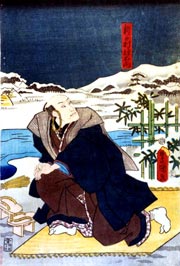
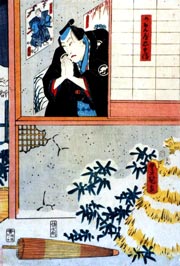
The actors Iwai Kumesaburô III, Bandô Hikosaburô IV and Kataoka Gadô II playing the roles of Umegawa, Magoemon and Chûbê in the drama "Ninokuchi-mura" scene of the drama "Koi Bikyaku Yamato Ôrai", which was staged in the 8th lunar month of 1854 at the Nakamuraza (print made by Utagawa Toyokuni III) |
||
|
|
| Contact | Main | Top | Updates | Actors | Plays | Playwrights | Programs | Links | FAQ | Glossary | Chronology | Illustrations | Prints | Characters | Derivatives | Theaters | Coming soon | News |