| MORITSUNA JIN'YA |
| Play title | Ômi Genji Senjin Yakata  The Castle of the Genji Advance Guard at Ômi [1] |
||||||||||||||||||
| Common title | Moritsuna Jin'ya |
||||||||||||||||||
| Authors | Chikamatsu Hanji Miyoshi Shôraku Matsuda Saiji Takeda Shinshô Chikamatsu Tônan |
||||||||||||||||||
| History |
The play "Ômi Genji Senjin Yakata" was originally written for the puppet theater (Bunraku) and staged for the first time in the 12th lunar month of 1769 in Ôsaka at the Takemotoza. It was adapted for Kabuki the following year and staged for the first time in the 5th lunar month of 1770 in Ôsaka at the Naka no Shibai [casting]. The play is based on the fight between the Toyotomi and the Tokugawa clans and the Siege of Ôsaka. The drama was set during an older period and names were changed to disguise the protagonists' identity and avoid the Shogunate censorship:
|
||||||||||||||||||
| Structure |
The original play was in 9 acts. Only one act survived, the 8th one, entitled "Moritsuna Yakata" and commonly called "Moritsuna Jin'ya". |
||||||||||||||||||
| Key words |
Biwako Genji Gidayû Kyôgen Gotô Matabê Gotô Mototsugu Hôjô Tokimasa Jidaimono Kakôshû Kimura Shigenari Kubi Jikken Kubioke Migawarimono Minamoto Yoriie Ômi Ôsaka-jô Ôsaka no Eki Ôsaka no Jin Sakamoto-jô Sanada Nobuyuki Sanada Yukimura Sanbaba Sasaki Moritsuna Sasaki Takatsuna Seppuku Tokugawa Ieyasu Toyotomi Hideyori |
||||||||||||||||||
| Summary |
Two brothers, Sasaki Moritsuna and Sasaki Takatsuna, descendants of the Genji clan, live near the lake of Ômi. They are on different sides, one for the Shôgun, the other a rebel. Moritsuna holds his brother's son, Koshirô, as a hostage and tells his venerable mother Mimyô [2] to instruct the lad to commit seppuku that Takatsuna may be influenced to take an honourable course of action. The boy is disinclined to listen to his grandmother, the more so as he sees his mother Kagaribi approaching the gate. His grandmother tries in vain to carry out the execution, but her love for her grandchild renders her powerless to act. Messengers arrive and relate in descriptive posture dances how the battle went and that Takatsuna has been killed. A representative of the Shôgun comes with Takatsuna's head in order that Moritsuna may identify it. He is Tokimasa, a dignified old warrior in gold armour, his white hair bound with a silver band, and comes through the audience followed by his retainers in armour, one carrying the head-box, another a chest of armour. The head-box is placed in the centre of the stage and the ceremonial of examination proceeds. Moritsuna slowly seats himself in front of the box. With eyes that do not see, he carefully takes off the long upper portion and lifts up the shallow lower portion of the box on which rests the head, placing it on top of the cover which makes a stand for it, the face looking out toward the audience. Koshirô, peering forth to see the head, disturbs the august assembly by leaping down from an upper room and committing seppuku, Moritsuna taking no notice of the tragic deed further than to upbraid him for his impolite behaviour in the presence of the exalted guest. He continues his silent examination of the head. The audience is so hushed that the stray notes of the samisen sound like drops of water echoing through a vacant house. It seems an endless time before he lowers his eyes, and the longer he evades looking the more the actor hypnotises the audience. At last Moritsuna's brotherly affection overcomes his strong self-control, and conflicting emotions are seen upon his face. Slowly his gaze travels down. It is the moment the audience have been awaiting. There is a slight start when his eyes rest full upon the face, an imperceptible surprise, and then a smile of relief. It is not the head of Takatsuna. His brother is still alive. But even while smiling he makes up his mind to resort to subterfuge to deceive Tokimasa, and to hide the truth from this worthy person. Moritsuna takes the head in his arms, addresses a lament to it, places it before the dignitary and declares it to be the true head of his brother. Tokimasa retires and Moritsuna gives vent to sorrow that Koshirô should have sacrificed himself. The boy, realising that the head was not that of his father, and hoping to lead Tokimasa into the belief that it was, takes his own life. There is not a dry eye in the audience when the dying boy says farewell to all the members of the family, and breathing his last as a spy, hidden within the chest of armour, is discovered and killed. (Zoë Kincaid in "Kabuki, the Popular Stage of Japan") |
||||||||||||||||||
| Notes |
[1] The title "The Castle of the Genji Advance Guard at Ômi" comes from the 1st volume of "Kabuki Plays On Stage". [2] Mimyô was named Bimyô in "The Kabuki Handbook". Idem in the Ritsumeikan Univ. Roles Database. Mimyô or Bimyô, which reading is the correct one? |
 |
 |
 |
|
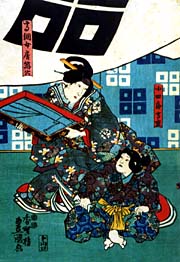
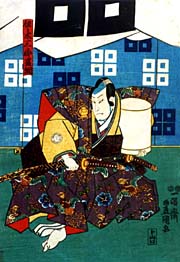
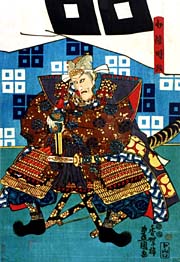
The actors Onoe Baikô IV, Sawamura Genpei II, Sawamura Chôjûrô V and Ichikawa Ebizô V playing the roles of Kagaribi, Koshirô, Sasaki Moritsuna and Hôjô Tokimasa in the drama "Ômi Genji Senjin Yakata", which was staged in the 3rd lunar month of 1851 at the Kawarasakiza (print made by Utagawa Toyokuni III) |
||
|
|
| Contact | Main | Top | Updates | Actors | Plays | Playwrights | Programs | Links | FAQ | Glossary | Chronology | Illustrations | Prints | Characters | Derivatives | Theaters | Coming soon | News |