| KEYA-MURA |
| Play title | Hikosan Gongen Chikai no Sukedachi  Taikô Shinkenki |
| Authors | Umeno Shitakaze, Chikamatsu Yasuzô ("Hikosan Gongen Chikai no Sukedachi") Namiki Gohê ("Taikô Shinkenki") |
| History |
The play "Hikosan Gongen Chikai no Sukedachi" was originally written for the puppet theater (Bunraku) and staged for the first time in the 10th lunar month of 1786 in Ôsaka at the Higashi no Shibai. It was not immediately adapted for Kabuki and Namiki Gohei I wrote a similar play, which was entitled "Taikô Shinkenki" and produced by Bandô Iwagorô in the 3rd lunar month of 1787 at the Naka no Shibai [casting]. This drama was staged for the first time in Kyôto the same year in August [casting]. "Hikosan Gongen Chikai no Sukedachi" was finally adapted for Kabuki for the first time the following year, in the 5th lunar month of 1788 in Ise at the Furuichi no Shibai [casting]. It was produced in a major theater for the first time in the 7th lunar month of 1790, in Ôsaka at the Nakaza (casting unknown). It was staged for the first time in Edo in the 9th lunar month of 1796, simultaneously at the Kiriza [casting] and the Miyakoza [casting]. |
| Structure |
"Keya-mura", or "Keya-mura Rokusuke Sumika" ("at Rokusuke's home in the village of Keya"), is the 9th act of the 11-act drama "Hikosan Gongen Chikai no Sukedachi". It is the most popular and most staged part of this drama. |
| Key words | Gidayû Kyôgen Sewamono Onna Budô Adauchi |
| Summary |
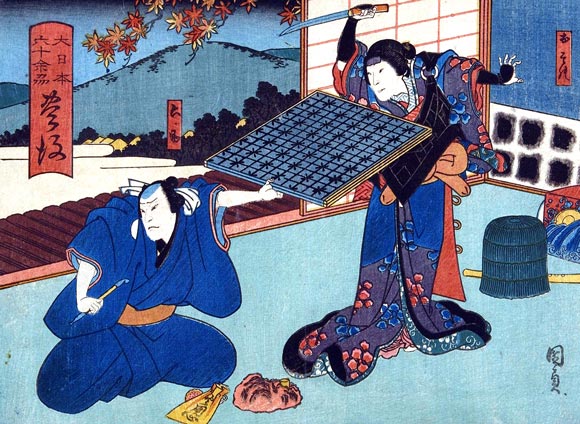
Kyôgoku no Takumi is a fighting student that is not satisfied with simply having driven his rival Rokusuke away into obscurity, but kills his master Yoshioka Ichimisai and his master's daughter Okiku as well. Ichimisai's wife and daughter Osono suffer great hardship searching for their father's killer, but he has changed his name and gone into hiding. They also search for Okiku's young son Yasomatsu, who disappeared at the time that she was killed. Rokusuke lives a quiet life in the countryside as a farmer, concealing his fighting skills. He is happy to help a young man become a fighting master, unaware that this is Takumi in disguise. As it happens, he found Yasomatsu at the scene of the tragedy, but has no idea that this is the grandson of his fighting teacher. He hangs the boy's kimono outside his house hoping that the boy's family will see it. At this point, a woman disguised as a traveling priest comes by, sees the kimono and immediately attacks Rokusuke as her father's murderer. He handily wards off her attack and when he tells her his name, she suddenly becomes very feminine and claims to be his wife. It is Osono, who was betrothed to Rokusuke long ago. For the first time, Rokusuke learns of the tragedy that has overcome his master's family and reveals that he knows where his master's killer is. The play ends as Rokusuke takes the young boy to avenge his grandfather's death. Source: Earphone Guide website |
| Comments |
It is often said that the character of Rokusuke is based on Miyamoto Musashi. The role of Osono is considered a challenge for an onnagata female role specialist for its blend of fierce warrior skills and soft femininity. Source: Earphone Guide website |
 |
|
|
The actors Mimasu Daigorô IV and Onoe Kikujirô II playing the roles of Rokusuke and Osono in the drama "Hikosan Gongen Chikai no Sukedachi" in a print made in 1861 by Utagawa Kunikazu According to the chronicles, the two actors did really perform the roles ... but not together! |
|
|
|
| Contact | Main | Top | Updates | Actors | Plays | Playwrights | Programs | Links | FAQ | Glossary | Chronology | Illustrations | Prints | Characters | Derivatives | Theaters | Coming soon | News |