![]() |
| Play title | Yoshitsune Sembon Zakura |
| Authors | Takeda Izumo II Miyoshi Shôraku Namiki Senryû I |
| History |
The play "Yoshitsune Sembon Zakura" was originally written for the puppet theater (Bunraku) and staged for the first time in November 1747 in Ôsaka at the Takemotoza. It was adapted to Kabuki the following year and staged for the first time in January 1748 in Ise with Kataoka Nizaemon IV (Tokaiya Gimpei, Yokawa no Zenji Kakuhan) and Yamamoto Koheiji (Tadanobu). It was performed for the first time in a city licensed theater in May 1748, in Edo at the Nakamuraza [casting]. |
| Structure |
The "Tokaiya", "Funayagura" and "Daimotsu no Ura" scenes are the second, third and fourth scenes of the second act of "Yoshitsune Sembon Zakura". They are either staged independently of the rest of the play or as part of a tôshi kyôgen production of "Yoshitsune Sembon Zakura". |
| Key words | Jidaimono Gempei-kassenmono Gidayû Kyôgen Giri/Ninjô Genji Heike |
| Summary |
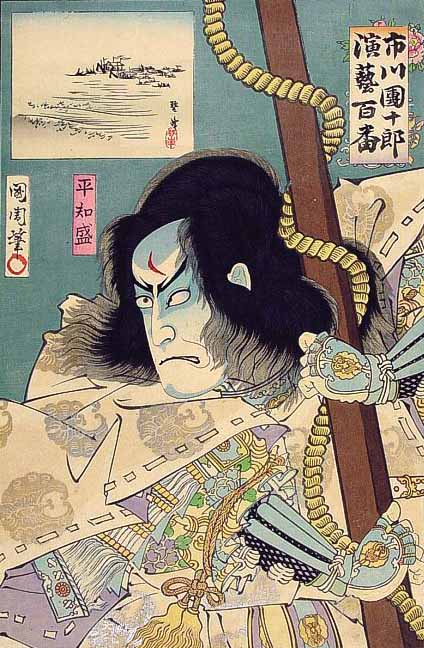
Tokaiya Yoshitsune and his followers have arrived at Daimotsu Bay outside Ôsaka. There they await a boat to Kyûshû, where they have decided to take refuge. The weather is rough, and they are forced to wait at the Tokaiya Inn run by the shipping agent Ginpei, who lives there with his wife Oryû and little daughter Oyasu. Oryû is preparing a meal. Benkei, now disguised as a traveling priest, goes to leave the inn. When he steps over the sleeping body of the child Oyasu, he finds that his legs are unable to move. This, we will understand later, is because the child is of imperial lineage, and thus Benkei's action is one of great disrespect. A retainer of Yoritomo named Sagami arrives and demands a ship to take him to Kyûshû, where Yoshitsune is rumored to be planning to escape. When Oryû tells him that the next available boat has already been spoken for, he says that he will force the other would-be passengers to heed his demands. At this tense moment, the master of the house, Ginpei, returns. Sagami suspects that the other passengers may be the very men he is seeking, and bares his sword as he goes to confront them. He is disarmed by Ginpei and runs off. At this, Yoshitsune emerges to thank Ginpei for his help. Ginpei says that the storm seems about to break, and urges Yoshitsune and his party to take flight before other pursuers appear. Yoshitsune and his men board a barge for the ship that will take them to Kyûshû. Suddenly, Ginpei reappears in armor and bearing a halberd. He reveals that he is actually none other than the Heike warrior Taira no Tomomori, and that Oyasu is in reality the boy Emperor Antoku. Furthermore, the woman posing as his wife Oryû is actually Suke-no-Tsubone, wet nurse to the child Emperor. Tomomori has posed as the commoner Ginpei as he awaited his chance to get revenge on Yoshitsune. The quarrel just now with Sagami was deliberately devised in order to gain Yoshitsune's trust. Now Tomomori looks forward to getting revenge on Yoshitsune for having defeated him in battle. Tomomori tells Suke-no-Tsubone that, if in fact he is not successful in his mission, all the lights on his boat will be extinguished. Should she see that signal, she is to take the child Emperor and commit suicide with him by jumping into the sea. Funayagura Suke-no-Tsubone dresses herself and the child Emperor in their court robes, and they anxiously await news of the battle. Finally, Sagami returns with the news that things have gone badly for Tomomori. The Heike forces have been unable to avenge themselves on the Genji, and instead have been routed by Yoshitsune and his men. When Suke-no-Tsubone opens the doors and looks out on the sea, she finds that indeed the lights have gone out. Another messenger arrives, and after giving the news that their allies have been utterly defeated, he commits suicide. Suke-no-Tsubone explains to the child Emperor that they are now going to take a journey to a paradise beneath the waves, where they will be freed from the sorrows of this world. Just as they are about to jump into the sea, however, Yoshitsune arrives and stops them. Daimotsu no Ura Suddenly the gravely wounded Tomomori reappears. He challenges Yoshitsune to fight him to the death, but Yoshitsune refuses, instead praising Tomomori for his bravery and loyalty in protecting the Emperor. Yoshitsune vows that he will take care of the Emperor in Tomomori's stead. Benkei attempts to persuade Tomomori to free himself from earthly passions and become a Buddhist priest, but Tomomori says that whether dead or alive, he can never be freed from his resentment against the Genji clan. The Emperor, child though he is, recognizes Yoshitsune's good will and asks Tomomori to forgive him. Suke-no-Tsubone also begs Yoshitsune to keep his promise to protect the Emperor, and then takes her life. Tomomori has not been unmoved by their pleas. He says that all this misfortune has been the result of the evil karma sowed by his own father, Kiyomori. Begging Yoshitsune to believe that it was not Tomomori himself, but his resentful ghost, that attempted to avenge itself on him, Tomomori ties himself to an anchor, and jumps into the sea. Source: Valerie L. Durham |
![]() |
|
The actor Ichikawa Danjûrô IX playing the role of Taira no Tomomori in the drama "Yoshitsune Sembon Zakura" in a print made by Toyohara Kunichika in August 1898 |
|
|
| Contact | Main | Top | Updates | Actors | Plays | Playwrights | Programs | Links | FAQ | Glossary | Chronology | Illustrations | Prints | Characters | Derivatives | Theaters | Coming soon | News |