| NAGAMACHI ONNA NO HARAKIRI |
| Play title | Nagamachi Onna no Harakiri  |
||||||||||||||||||
| Author | Chikamatsu Monzaemon | ||||||||||||||||||
| History |
The play "Nagamachi Onna no Harakiri" was originally written for the puppet theater (Bunraku) and staged for the first time in Ôsaka at the Takemotoza in the 7th lunar month of 1712. It was based on two real events which happened in Ôsaka, the shinjû of Ohana and Hanshichi and the harakiri of a woman in Nagamachi. No record of any Kabuki adaptation before the beginning of the 20th century. "Nagamachi Onna no Harakiri" was revived for the first time in July 1907 in Tôkyô at the Misakiza, with the Kabuki actresses Matsumoto Kinshi, Ichikawa Sakiji and Ichikawa Senshô in the roles of Hanshichi's aunt, Hanshichi and Jingorô. In ôshibai, it was revived in October 1922 at the Imperial Theater [more details]. During the second half of the 1900s, it was staged only twice and only the third act:
|
||||||||||||||||||
| Structure |
"Nagamachi Onna no Harakiri" was in 3 acts (4 scenes). |
||||||||||||||||||
| Key words |
Ageya Harakiri Ishigaki-chô Katanaya Kuruwa Kyarazaikuya Michiyuki Nagamachi Sewamono Shimodachiuri Shinjû Shinjûmono Tedai Yodogawa |
||||||||||||||||||
| Summary |
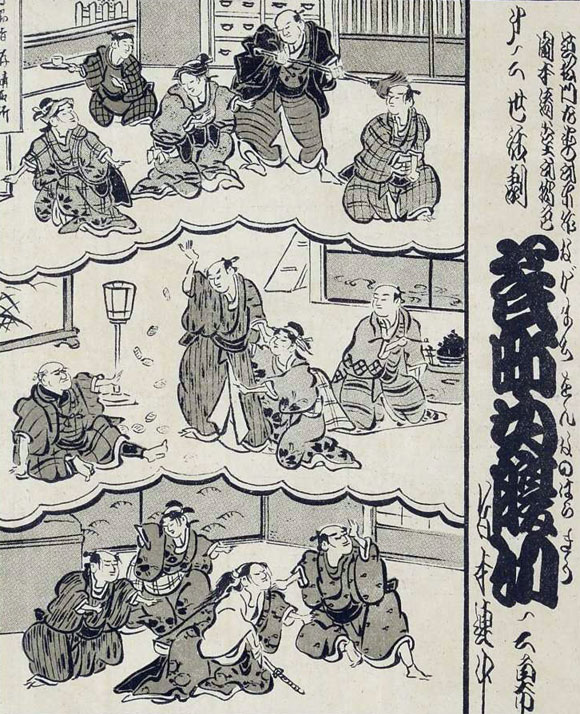
Act I, scene 1: Kyô Shimodachiuri Katanaya Hanshichi, a live-in employee of Iwami, a swordsmith in Shimodachiuri in Kyôto, lies in bed at his employer's house, pretending to be ill. His sweetheart Ohana, a courtesan from the ageya Izutsuya in Ishigaki-chô, visits him disguised as his aunt. Taking her claim at face value, Iwami allows her to enter and see Hanshichi. Soon after, Hanshichi's real aunt [1] arrives at the shop. Realizing he has been deceived, Iwami bursts into the room and beats Hanshichi with a broom. Hanshichi's aunt intervenes and protects him, insisting that Ohana is indeed her half-sister-and thus another aunt to Hanshichi-despite being fifteen years younger than she is. When Iwami leaves on business, Hanshichi's aunt reveals a sword she has brought. Hanshichi recognizes it as a treasured blade once belonging to his family. Hanshichi's aunt explains that, according to a fortune-teller, the sword carries a curse that will afflict the family for three generations. His grandfather used it to take his own life after a quarrel, his father later fell into ruin and died tragically, and his mother soon followed. After raising Hanshichi herself, Hanshichi's aunt sold the sword cheaply in hopes of ending its misfortune. Yet the sword has mysteriously returned. Its current owner, a samurai, has asked Hanshichi's uncle [2] to find a skilled swordsmith to restore it. Following this request, she brings it to Iwami's shop. Leaving the ominous blade in Hanshichi's care, she departs for her home in Ôsaka. Act II, scene 1: Ishigaki-chô Izutsuya A Buddhist priest from the Kômanji temple visits the ageya Izutsuya where Ohana works and goes upstairs with her and several other courtesans to enjoy himself. Hanshichi appears outside the teahouse. Though eager to see Ohana, he cannot approach her, burdened by debts he owes her employer after visiting her frequently on credit. He hides as Ohana's stepfather, Kuhê, arrives to meet Izutsuya Tarozaemon, the proprietor. Kuhê proposes extending Ohana's term of service, which is soon to end, in exchange for a payment of twenty ryô. Calling Ohana forward, Kuhê orders her to sever ties with Hanshichi, but she fiercely refuses, determined to marry him once her service ends. As their argument escalates into a physical struggle, Hanshichi emerges from hiding and pulls Kuhê away. Kuhê insults him and demands a large sum if he wishes to redeem Ohana. Hanshichi produces twenty ryô and throws them at him, but Kuhê rejects the amount. The two hurl the coins back and forth before grappling with one another. Declaring that such disorder disrupts his business, Tarozaemon orders his servants to throw Hanshichi out. Kuhê gathers the scattered coins and leaves. Meanwhile, the priest departs for another teahouse, accompanied by Ohana and the others. On the way, Ohana spots Hanshichi by the roadside and slips away to meet him. He urges her to flee with him to Ôsaka. When she questions his sudden wealth, he confesses that he has secretly sold the entrusted sword for thirty-two ryô and replaced it with an inferior one costing only eight. Act II, scene 2: Ohana Hanshichi Michiyuki Hanshichi and Ohana travel on foot along the Yodo River, making their way toward Ôsaka. Act III, scene 1: Ôsaka Nagamachi Kyaraya The pair arrive at the woodworking shop run by Hanshichi's uncle [2], the kyarazaikuya Jingorô, in Nagamachi, Ôsaka. In his absence, Hanshichi's aunt tells Hanshichi that she received the repaired sword from him two days earlier and that Jingorô has already returned it to its owner. She adds that a sudden summons came shortly before, and her husband has gone to answer it. Hanshichi turns pale, fully aware of the reason for the call. Hoping to spare Ohana from the consequences of his actions, he urges her to return to her family, but she refuses, choosing to remain by his side. As Hanshichi prepares to confess his deception, Jingorô returns. Hanshichi's aunt quickly hides the young couple inside a large chest before opening the door. Jingorô declares that he must take responsibility for the exchanged sword and resolve the matter with his life. Hanshichi's aunt, however, insists that the fault lies with her, for entrusting the cursed blade to her nephew despite the warning attached to it. Taking up the sword that her husband has brought back, she sacrifices herself. Stunned, Hanshichi and Ohana emerge from hiding. With calm resolve, Hanshichi's aunt urges them to flee. |
||||||||||||||||||
| Notes |
[1] Hanshichi's aunt initially had no name. In recent times, she was named Otatsu in Bunraku but Okô in Kabuki after WWII. |
 |
|
"Nagamachi Onna no Harakiri" in October 1922 at the Imperial Theater, with the actors Onoe Baikô VI, Sawamura Sôjûrô VII, Matsumoto Kôshirô VII and Sawamura Sônosuke I in the roles of Hanshichi's aunt, Hanshichi, Jingorô and Ohana |
|
|
| Contact | Main | Top | Updates | Actors | Plays | Playwrights | Programs | Links | FAQ | Glossary | Chronology | Illustrations | Prints | Characters | Derivatives | Theaters | Coming soon | News |