| HIMANEGI NO KIYOMORI |
| Play titles | Itsukushima Maneku Hiôgi  Gohiiki Onga no Shimadai |
| Common title | Himanegi no Kiyomori |
| Authors | Segawa Jokô II, Tajima Konosuke I & Hon'ya Sôshichi (1808) Katsu Hyôzô I & Sakurada Jisuke II (1809) Matsuoka Ryô (2013/2019) |
| History |
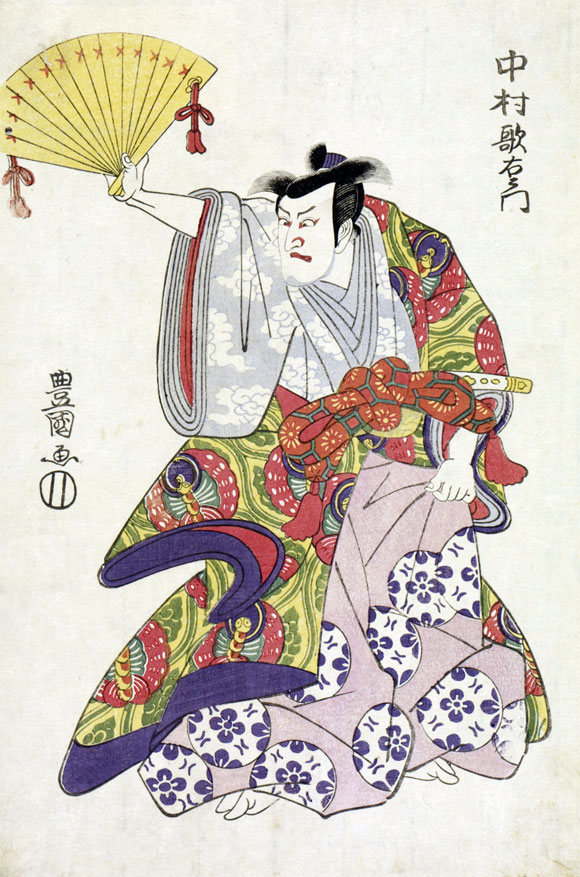
The "Himanegi no Kiyomori" scene was premiered in the 11th lunar month of 1808, in Edo at the Nakamuraza, in the kaomise drama "Gohiiki Onga no Shimadai". The role of Taira no Kiyomori was played by the star Nakamura Utaemon III. It was integrated at the beginning of the drama "Misao no Hana Toba no Koizuka", which was written by Katsu Hyôzô I and Sakurada Jisuke II, and was premiered in the 11th lunar month of 1809 at the Ichimuraza [casting]. It was a kaomise drama, which celebrated the shûmei of Onoe Shôroku I and Onoe Matsusuke II (who played the role of Taira no Kiyomori). It was revived in November 1936, in Tôkyô at the Kabukiza, under the title "Itsukushima Maneku Hiôgi", in a special program celebrating the 100th anniversary of the passing away of the star Nakamura Utaemon III. The role of Taira no Kiyomori was played by Nakamura Utaemon V. After WWII, it was revived twice, in December 2013 at the Minamiza and in July 2019 at the Shôchikuza. In both productions, the role of Taira no Kiyomori was played by Kataoka Gatô V. |
| Key words |
Ecchû Zenji Genji Heian Jidai Heiji no Ran Heike Himanegi no Kiyomori Hiôgi Itsukushima Jinja Jidaimono Kanjo Koto Minamoto Yoshitomo Nanba Rokurô Nanba Tsunetô Sanmi no Chûjô Koremori Sanmi no Chûjô Shigehira Shirabyôshi Taira Kiyomori Taira Koremori Taira Moritoshi Taira Munemori Taira Shigehira Taira Shigemori |
| Summary |
Taira no Kiyomori, the formidable warlord who establishes Japan's first warrior-dominated government, stands at the height of his power, a supremacy symbolized by his recent reconstruction of the Itsukushima Shrine. As the play opens, his retainers gather in the shrine's hall of worship, awaiting his arrival for the celebration marking the transfer of the deities to their newly completed sanctuary. The ruler of Japan Taira no Kiyomori enters and takes the seat of honour behind a bamboo screen. At his side are his sons, Taira no Munemori, a leading court official, and Taira no Shigehira, one of the Taira Clan's foremost military commanders. They are joined by his grandson, Taira Shigemori's son, the commander Taira no Koremori, the loyal vassals Ecchû Zenji Moritoshi and Senoo Saburô Kanetsune [1], and several ladies-in-waiting (kanjo). As the festivities commence, Kiyomori admires the breathtaking beauty of the island on which the shrine stands. One after another, he and the members of his retinue celebrate the prosperity of the Taira Clan and the successful completion of the new sanctuary. The entertainment then begins as two young shirabyôshi, Hotoke Gozen and Giô, are summoned to perform a ceremonial dance in honour of the shrine's deities. Accompanied by the gentle rhythms of the koto, they captivate the audience with a graceful and alluring performance. Their dance enchants everyone present, especially Kiyomori, who invites the performers to approach so that he may reward them. As they advance, Hotoke Gozen suddenly lunges forward, brandishing a dagger and crying, "This is for my father!" as she strikes at Kiyomori. The warlord reacts instantly, using his fan (hiôgi) to deflect the blow and disarm her. The others rush in, overpowering her and binding her hands. Outraged by the audacious attempt on his lord's life, Senoo draws his sword and prepares to cut her down, but Munemori intervenes, insisting that so sacred an occasion must not be stained with bloodshed. When Kiyomori demands to know her identity, Hotoke Gozen reveals that she is Princess Kujû [2], daughter of Minamoto no Yoshitomo, the warlord whom Kiyomori defeats during the Heiji Rebellion and who later dies at the hands of one of his own retainers while fleeing from the Heike. Senoo once again raises his sword to execute Princess Kujû, but Kiyomori stops him. He tells those assembled that he and Yoshitomo have been close friends since childhood, and that overcoming such a cherished companion has brought him profound sorrow. Declaring that mercy will better honour Yoshitomo's memory, he orders her release. Though reluctant, Senoo and the retainer Nanba Tsunetô obey, untying Princess Kujû, who departs after expressing her gratitude for Kiyomori's clemency. Shortly afterward, Munemori, gazing toward the nearby shore, remarks on the presence of a group of carpenters still at work. Moritoshi explains that while the shrine's main hall is complete, further labour is required to finish the Hall of Sutras. Yet night is already approaching, and the dedication ceremony is scheduled to take place that very evening. Concerned, Shigehira warns that the Heike could become an object of ridicule if the ceremony must be delayed because of unfinished construction. Hearing this, Kiyomori turns his gaze toward the sun as it sinks into the western sea and calmly suggests that they simply call it back. Even his sons dismiss the notion as impossible, but Kiyomori recalls the Chinese legend of Emperor Yao and the ten suns, in which nine are brought down by arrows. Raising his fan, he begins to pray and beckon to the fading orb. To the amazement of all present, the descending sun reverses its course and slowly climbs back into the sky. While the assembled spectators stare in stunned disbelief, Kiyomori laughs with satisfaction and declares, "Now, this is a beautiful sight." |
| Notes |
[1] Was he the brother of Senoo Tarô Kaneyasu? [2] Princess Kujû was sometimes described in tales or plays as a daughter of Minamoto no Yoshitomo, but this relationship is not firmly established by the main historical sources. |
 |
|
The actor Nakamura Utaemon III playing the role of Taira no Kiyomori in the "Himanegi no Kiyomori" scene of the kaomise drama "Gohiiki Onga no Shimadai", which was staged in the 11th lunar month of 1808 at the Nakamuraza (print made by Utagawa Toyokuni I) |
|
|
| Contact | Main | Top | Updates | Actors | Plays | Playwrights | Programs | Links | FAQ | Glossary | Chronology | Illustrations | Prints | Characters | Derivatives | Theaters | Coming soon | News |