| KAMIYUI TÔJI |
| Play titles | Sandai Banashi Kôza no Shinsaku  Ninjô Banashi Kamiyui Tôji Chô Chidori Suma no Kumiuchi Ume-mo Yaeiroka no Fukagawa |
| Common title | Kamiyui Tôji |
| Author | Kawatake Shinshichi II [1] |
| History |
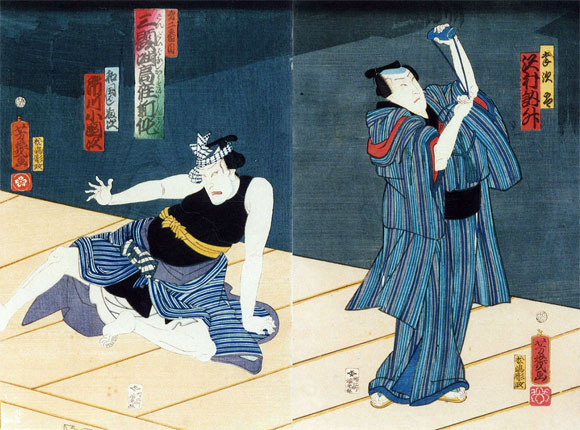
Kawatake Shinshichi II's drama "Sandai Banashi Kôza no Shinsaku" was premiered in the 2nd lunar month of 1863 in Edo at the Ichimuraza [more details]. The opening day was the 2nd day of the 2nd lunar month of 1863 [2]. It was the nibanme drama of the Kabuki program "Chô Chidori Suma no Kumiuchi", which also included the Kiyomoto/Jôruri-based dance-drama "Ume-mo Yaeiroka no Fukagawa" [4]. "Kamiyui Tôji" was based on a sandai banashi created by Kawatake Shinshichi II. He belonged to a group that used to hold a monthly gathering in a restaurant to introduce new stories. At the time the story of "Kamiyui Tôji" was presented, sandai banashi was said to be at the height of its popularity. The narrative drew on three themes: Kokusen'ya Gassen, chichi-morai ("begging milk for a baby"), and kamiyui ("hairdresser"). The play "Kamiyui Tôji" achieved great popularity upon its premiere, partly because "Kokusen'ya Gassen"-one of the masterpieces of Chikamatsu Monzaemon-was performed at the neighboring Nakamuraza. As the summary shows, two of the three themes are immediately apparent: Tôji is a kamiyui, and a chichi-morai scene appears in the third act of "Kamiyui Tôji". The reference to "Kokusen'ya Gassen" is more subtle. The hairdresser bears the nickname Wakokubashi no Tôji ("Tôji of the Wakoku Bridge"), with Wa and Tô corresponding to the first two ideograms of Watônai, the hero of "Kokusen'ya Gassen". In addition, Tôji's confrontation with Kanzakiya Kihê in the third act echoes the clash between Watônai and Kanki in "Kokusen'ya Gassen", as Kanzakiya Kihê is commonly known as ... Kanki. The last but not the least: Watônai's wife was named Komutsu, whereas Tôji"s wife was named Omutsu. After WWII, it was revived only once, in January 1974 at the National Theatre, under the new title "Ninjô Banashi Kamiyui Tôji" [more details]. |
| Structure |
The 1974 revival was in 3 acts (5 scenes). |
| Key words |
Ame-uri Bessô Chichi-morai Chichi-moraimono Danmari Dôguya Fukagawa Honjo Hyappongui Jochû Kameido Kamiyui Kanekashi Kinchaku-kiri Komeya Mukô Ryôgoku Okappiki Omamori Saga-chô Sakaya Sake Sandai Banashi Sewamono Shitazori Soba Sobaya Sumidagawa Torii Wakadanna Zashiki |
| Summary |
Act I, scene 1: Mukô Ryôgoku Hyappongui It is a spring evening. On the east side of the Sumida River in Mukô Ryôgoku near Hyappongui, pieces of shabby furniture lie abandoned on the road. Beside them, the hairdresser Tôji lies helplessly drunk, while his apprentice Kaneyakko is at a loss. A watchman passes by, and Kaneyakko asks him to keep watch over the furniture while he goes to find help. Omutsu, Tôji's wife, appears carrying her baby on her back and leading their seven-year-old son, Kunimatsu, by the hand. Kunimatsu is surprised to see his father lying there. The watchman instructs Omutsu to watch the furniture and continues his rounds. At her call, Tôji awakens and discovers that Kaneyakko is gone. He tells Omutsu to find him, and she obeys. Though he inwardly appreciates her beauty and tenderness, he does not express it. A moneylender (kanekashi), Okan, followed by the komeya Sanroku and, finally, the sakaya Gonkurô arrives. They have heard that Tôji quarrelled with his landlord and was evicted, and they intend to claim his furniture as security for debts. Tôji, enraged, throws all the furniture into the river, explaining that he might as well destroy it as hand it over to them. Omutsu returns and reports that Kaneyakko is nowhere to be found. She lays the drowsy Kunimatsu on the roadside, since they have no home to return to. When she sees the furniture has been thrown into the river, she deeply regrets losing her cherished amulet (omamori) from the dresser. She reproaches Tôji for claiming to be indebted to the Hiranoya family and to repay their kindness, yet turning into a different man when drunk, and she urges him to give up drinking. Tôji, angered by her words, declares that he divorces her. Tôjin Ichibê, a candy seller (ame-uri) and Omutsu's adoptive father, arrives. Omutsu informs him of her divorce, and he chuckles and urges her to come with him. He adopted her at age five, hoping she would support him in the future. When Tôji proposed to her at seventeen, threatening double suicide if refused, Ichibê reluctantly consented. Though still attached to Tôji, Omutsu reluctantly follows Ichibê with her children, while Tôji collapses again. Hiranoya Kôjirô, the young master (wakadanna) of the Hiranoya household, appears. He has frequented the pleasure quarters and fallen in love with the courtesan Daikokuya Senzan. Though short of money, he is determined to redeem her, raising fifty ryô by pawning a friend's incense case. As he hurries, pickpocket Torakichi steals his purse. Shocked, Kôjirô struggles and stumbles over Tôji. In the darkness, the three, including the newly returned Kaneyakko, collide [3]. Kôjirô seizes Torakichi's amulet case, while Torakichi escapes with Kôjirô's purse. Act II, scene 2: Fukagawa Saga-chô It is an early winter evening, six months later. Along the street stand a soba stall and a tea booth. Kôjirô meets the dôguya Ichisuke, a broker who helped him pawn the incense case. Ichisuke informs him that the case will be sold at the end of the month, and Kôjirô must quickly raise one hundred ryô to redeem both the incense case and Senzan. Tôji, hidden behind a reed blind, overhears them. He emerges and apologizes for his long silence. Seeing Kôjirô's worn and haggard appearance, Tôji feels a deep ache and vows to help him. He recalls that his mother once served the Hiranoya household as Kôjirô's nurse. Tôji lived with his mother, while his brother Torakichi was sent to foster parents. After her death, Tôji fell into ruin through drinking, while Torakichi went astray from the age of fourteen. Kôjirô explains the pickpocket incident and shows the amulet case. Tôji is astonished to see it belongs to his brother Torakichi. Determined to atone for his brother's crime, he promises to raise one hundred ryô by the end of the month. Kôjirô thanks him and leaves. Tôji, however, is at a loss as to how he can earn the money. Ichibê appears with Kunimatsu and the baby. Tôji hides behind the reed blind again. Ichibê eats soba without giving any to Kunimatsu and treats him cruelly. Unable to remain hidden, Tôji emerges. Kunimatsu clings to him. Ichibê tells Tôji that Omutsu has gone into service, leaving the children, and that he is waiting for them to starve. He ignores Tôji's appeal, instructing him to collect the bodies when they die. Containing his anger, Tôji firmly declares that he will take responsibility for the children. Tôji buys a bowl of soba for Kunimatsu. While they eat, he asks about Omutsu. Kunimatsu responds with precocious wit, teasing him. When he sees Tôji counting coins and asking the vendor to delay payment, the boy apologizes. Moved to tears, Tôji leaves with the children. As the sobaya Nihachi clears his stall, he discovers Torakichi pretending to sleep behind the reed blind. Having overheard everything, Torakichi is shocked at the harm he has caused Kôjirô and Tôji. Deeply remorseful, he resolves to raise money at any cost to make amends. Act III, scene 1: Kanzakiya Bessô Monsoto The front gate of a villa in Kameido is covered in snow. Two weeks have passed. Tôji trudges along the road holding his baby and an umbrella, with Kunimatsu following. When his clog strap breaks, he takes shelter under the gate to fix it. Oine, a maid, appears to discard milk and notices the father and sons. Tôji explains his situation and asks for milk for the baby. Moved with pity, Oine reflects that it is unfair for him to wander in the snow with a motherless child while her mistress has milk to spare. She gives milk to the baby, who drinks eagerly. Oine explains that the villa was purchased by the proprietor of Kanzakiya for his mistress, Omutsu, a gentle and refined lady from Wakoku Bridge in Honjo. Kunimatsu exclaims that she is his mother, but Tôji silences him. He thanks Oine and prepares to leave, while she hurries back inside. The sight of Omutsu's luxurious life worsens Tôji's misery, as he must raise one hundred ryô that day. When Kunimatsu cries for his mother, Omutsu appears at an upstairs window, rejoicing to see Tôji. He tells her that his arrival is a coincidence and reproaches her for becoming another man's mistress, explaining that he had been sure she would return. They realize that both have been caught in Ichibê's scheme. Omutsu recounts how Ichibê told her that Tôji had attempted suicide after their separation and that she should become a wealthy man's mistress temporarily to raise money to open a shop for him. She has been waiting for news of him. Tôji explains that he could not bear Ichibê's cruelty toward the children and resolved to care for them himself. Seeing her children moves Omutsu to tears. When Tôji explains his urgent need for one hundred ryô to save his young master, he asks her to borrow the money from her patron, despite the shame of asking his separated wife. Omutsu promises to try, giving milk to the baby, while Kunimatsu, jealous, seeks her attention as well. Omutsu tells Tôji to wait at the gate of the Kameido Tenjin Shrine for her reply. Kunimatsu refuses to leave. When Tôji starts to go, Oine offers to look after the children. Grateful, Tôji departs into the snow. Act III, scene 2: Kameido Tenjin Torii Mae An okappiki named Gorô chases and arrests Torakichi, who has stolen one hundred ryô from a storehouse. He pleads to be released temporarily to meet someone he has long wanted to see but escapes when an opportunity arises. After the crowd disperses, Tôji reflects that he might act the same in desperation. Kaneyakko arrives carrying a barrel of sake and urges him to drink, but Tôji refuses. Oine brings a letter from Omutsu explaining that her patron cannot provide the money. Resolute, Tôji decides to negotiate directly with the proprietor of Kanzakiya, fearing that his young master may commit suicide if the money is not obtained. Act III, scene 3: Kanzakiya Bessô Zashiki Kanzakiya Kihê (commonly called Kanki), the proprietor, drinks sake while attended by Oine. He confirms that she delivered the letter to Tôji and gave one hundred ryô to Omutsu as instructed. At that moment, Tôji bursts in. Tôji demands one hundred ryô as compensation for keeping Omutsu as a mistress. Kanki refuses, explaining that he has her father's consent and resents Tôji's aggressive manner. As they begin to fight, Omutsu rushes in to intervene. Omutsu draws a dagger, telling Tôji that she could not secure the money she promised and intends to sacrifice herself. She expresses gratitude to Kanki for treating her with respect and asks him to give the money to Tôji for her sake. Kanki reveals the truth: the money is intended to redeem a girl whom Kôjirô is to marry. He had left the funds with Omutsu for her discretion, but she has refused to spend it. He then discloses that Omutsu is his long-lost sister, kidnapped at age five and identified through an amulet. He waited until Tôji reformed to reveal the truth. Tôji and Omutsu, surprised and overjoyed, express their gratitude. Omutsu takes Kanki's hands, recognizing him as her brother. Kanki gives one hundred ryô to Tôji, instructing him to deliver it to his master and promising to help them establish a shop and live happily together. Tôji rushes along the snow-covered road to deliver the money, while his reunited family watches him depart. |
| Notes |
[1] The others sakusha were Takeshiba Kinsaku I, Umezawa Sôroku, Takeshiba Hyôzô I, Takeshiba Shinzô, Mura Kôji, Takeshiba Tôji, Takeshiba Jûzô, Takeshiba Toyozô, Takeshiba Hyakuzô, Takeshiba Hanshichi & Takeshiba Sakichi. [2] The 2nd day of the 2nd lunar month of the 3rd year of the Bunkyû era was the 20th of March 1863 in the western calendar. [3] This is the danmari scene which concluded the first act of "Sandai Banashi Kôza no Shinsaku". |
 |
|
The actors Ichikawa Kodanji IV (left) and Sawamura Tosshô II (right) playing the roles of the kamiyui Tôji and Hiranoya Kôjirô in the drama "Sandai Banashi Kôza no Shinsaku", which was staged in the 2nd lunar month of 1863 at the Ichimuraza (print made by Ochiai Yoshiiku) |
|
|
| Contact | Main | Top | Updates | Actors | Plays | Playwrights | Programs | Links | FAQ | Glossary | Chronology | Illustrations | Prints | Characters | Derivatives | Theaters | Coming soon | News |