| ONNA KURUMABIKI |
| Play titles | Goshoguruma Hikuya Sodezuma  Onna Kurumabiki |
||||||||||||||||||||||||||||||||||||
| Authors | Sakurada Jisuke III (lyrics) Kiyomoto Senzô (music) |
||||||||||||||||||||||||||||||||||||
| History |
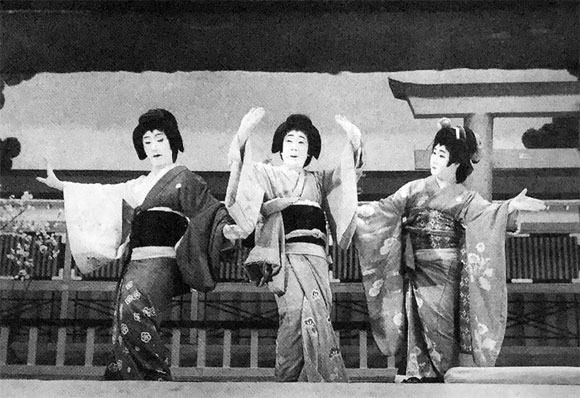
In Kabuki, several dance-dramas or plays parody other familiar and highly popular numbers. They retain many features of the original works but substitute female characters in place of the original male roles. Examples include "Onna Modori Kago", in which the palanquin bearers from the dance "Modori Kago" appear as female bearers; "Onna Narukami", a female version of "Narukami"; and "Onna Shibaraku", a female adaptation of the spectacular "Shibaraku". "Onna Kurumabiki" provides another example. It is the female version of "Kurumabiki", the opening scene of the third act from the popular 1746 Kabuki drama "Sugawara Denju Tenarai Kagami". "Onna Kurumabiki" is believed to have been created during the 1850s as a niwaka" number in Yoshiwara, performed by geisha and their patrons. Although known popularly as "Onna Kurumabiki", its full title is "Goshoguruma Hikeya Sodezuma". In modern times, it was revived in February 1919 in Tôkyô at the Imperial Theater with 3 geisha in the roles of Chiyo, Haru and Yae. It fell into oblivion and it was successfully revived in February 1960 in Nagoya at the Misonoza [more details]. "Onna Kurumabiki" was staged 9 times between 1960 and 2023. |
||||||||||||||||||||||||||||||||||||
| Key words |
Dôji-gôshi Kakikae Kyôgen Kashima Odori Kiyomoto Matsu Niwaka Shosagoto Ume Yaezakura Yoshida Jinja Yoshiwara |
||||||||||||||||||||||||||||||||||||
| Summary |
The original "Kurumabiki" depicts the triplet brothers Matsuômaru, Umeômaru, and Sakuramaru meeting by chance near Yoshida Shrine in Kyôto. There, Umeômaru and Sakuramaru attempt to attack the carriage of their enemy Fujiwara no Shihei but are stopped by their brother Matsuômaru, who now serves in Shihei's employ. A contest of strength follows, yet the brothers postpone further fighting so that they may attend their father's seventieth birthday celebration under a temporary truce. In "Onna Kurumabiki", the scene is also set at the Yoshida Shrine. The wives of the three brothers appear instead: Chiyo, the wife of Matsuômaru; Yae, the wife of Sakuramaru; and Haru, the wife of Umeômaru. Rather than attacking a carriage, they pull one filled with items prepared for their father-in-law's birthday celebration. In truth, the piece bears little relation to the original version [1] beyond the characters' identities and the similarity of costumes and setting. All three women wear kimono with a purple dôji-gôshi plaid pattern and black satin obi sashes. Their undergarments, however, differ: Chiyo's features a light-yellow background with pine stitching (matsu); Haru's has a spring background with plum stitching (ume); and Yae's displays a red background with cherry-blossom stitching (yaezakura). The performance includes a Kashima dance accompanied by small drums and concludes with a full dance. As an original Yoshiwara niwaka dance, the atmosphere remains cheerful from the beginning to the end. |
||||||||||||||||||||||||||||||||||||
| Trivia |
The brothers’ names come from three symbolic trees in Japanese culture.
The brother names are symbolically tied to trees and there is also a symbolic relationship between the wives’ names and the tree-based names of their husbands:
How the pairings work?
|
||||||||||||||||||||||||||||||||||||
| Notes |
[1] As a consequence, "Onna Kurumabiki", a pure shosagoto, has never been staged as a substitute for "Kurumabiki". |
 |
|
"Onna Kurumabiki" |
|
|
| Contact | Main | Top | Updates | Actors | Plays | Playwrights | Programs | Links | FAQ | Glossary | Chronology | Illustrations | Prints | Characters | Derivatives | Theaters | Coming soon | News |